
यह भी देखें


 26.11.2026 08:05 AM
The euro opened Thursday at 1.0961 and so far has held within a narrow range. Yesterday midday the pair was around 1.0944, by evening rose almost to 1.0993, and overnight gave back almost the entire advance. The market did not receive a clear reason for a decisive move, although yesterday was rich in data.
Starting with Europe. There are no new European data this morning, but yesterday Germany's economy was summarized. German GDP grew 0.1% in Q3 versus a 0.2% forecast, after 0.3% in Q2. The first estimate released at the end of October was also revised down from 0.2%. The region's largest economy is clearly slowing, and these figures did not help the euro.
Now the US. The figures there were strong, but the dollar barely reacted. The economy grew at an annualized 4.3% pace in Q3 — effectively the pace if the quarter were repeated four times. The first estimate was 3.4%, and Q2 was 2.2%. The revision added 0.9 percentage points, driven by investment and consumption. Private domestic demand rose 5.8%, indicating Americans are still spending.
Inflation also accelerated. This concerns the PCE — the price index for what Americans buy, and the primary gauge the Federal Reserve watches. The headline reading for October rose to 3.8% from 3.7%. The core index, which excludes food and energy and shows whether inflation is broadening inside the economy, was 3.3% versus a 3.2% forecast and 3.1% in September. Monthly rates matched expectations at 0.3%. The labor market also showed no cracks: initial jobless claims came in at 189,000 versus a 201,000 forecast. New-home sales jumped 14.2% to 701,000, while durable goods orders rose only 0.2% versus a 0.7% forecast.
The Fed funds rate is currently 3.75–4.00%, and on November 23, FOMC member John Williams did not rule out hikes at several consecutive meetings. The market expects another hike in December. It is therefore curious that the dollar did not respond to this set of data. While it is holding steady despite strong numbers, the euro could remain resilient, but a meaningful rally will need new catalysts.
Today US markets are closed for Thanksgiving and trading is thin, meaning fewer trades and typically sharper price moves. Catalysts will come from Europe. First to be published is Germany's GfK consumer climate index for December. Based on a household survey, it shows whether Germans are ready to spend or prefer to save. The forecast is -29.4, up from -30.8 previously. A negative number means pessimists outnumber optimists; the closer to zero, the better. A month ago, the index disappointed (-30.8 versus a -30.1 forecast and -30.6 before that), so a slight improvement is expected now.
Then private-sector lending and M3 money supply for October will be released; in September, they were 3.1% and 3.5%, respectively. M3 is all the money in the economy, including deposits in individuals' and companies' accounts. Growth in loans and money shows how willing businesses and households are to borrow, and it helps the European Central Bank assess price pressures.
The main event will be the ECB minutes — a detailed recounting of what council members said at the October 29 meeting. Back then, the deposit rate was left at 2.50%, the decision was unanimous, and Christine Lagarde said the council had discussed a hike but decided to wait. Since then, euro-area inflation reached 4.0% in October versus 3.8% in September, and energy prices rose 20.8%. On November 19, Bundesbank president Joachim Nagel called a December hike a firm signal of determination. If the minutes show that many council members leaned toward a move already in October, expectations of a rise to 2.75% at the December 17 meeting will strengthen. At the same time, EU leaders are meeting in Brussels, and the agenda includes who will replace Lagarde, who will leave the post on February 7, 2027. I believe a hawkish tone in the minutes will allow the euro to continue rising, especially since thin trading amplifies any reaction.
EURUSD is now around 1.0961, inside a range between 1.0933 and 1.0991, about 58 pips wide. A move beyond the range is a breakout, but one touch isn't enough. You need a settlement — several consecutive five-minute candles must close beyond the level — otherwise it's easy to get caught by a false probe after which the price will return.
To the upside, 1.0991 is working. A settlement above it leads to 1.1036 and then to 1.1069. Last night the pair already tested this level; the high was about 1.0993, but it failed to hold, and price retraced nearly 30 pips overnight. After such an unsuccessful probe, a new assault without a catalyst looks unconvincing. The catalyst today is the ECB minutes. If they are hawkish and confirm a December hike, a settlement above 1.0991 becomes a realistic scenario, and I consider that the primary direction. With a neutral tone, it will be hard to believe it.
To the downside, the reference is 1.0933; a settlement below it leads to 1.0884 and 1.0848. It is about 28 pips from the current price. Yesterday's low near 1.0935 lies literally two pips above this level, so buyers have already appeared there. If the price nonetheless crosses the mark and settles below, the support will vanish, and the decline may be quick. For that move, you need a dovish minutes or disappointment from the GfK index, which disappointed last time. I would not enter on the first touch.
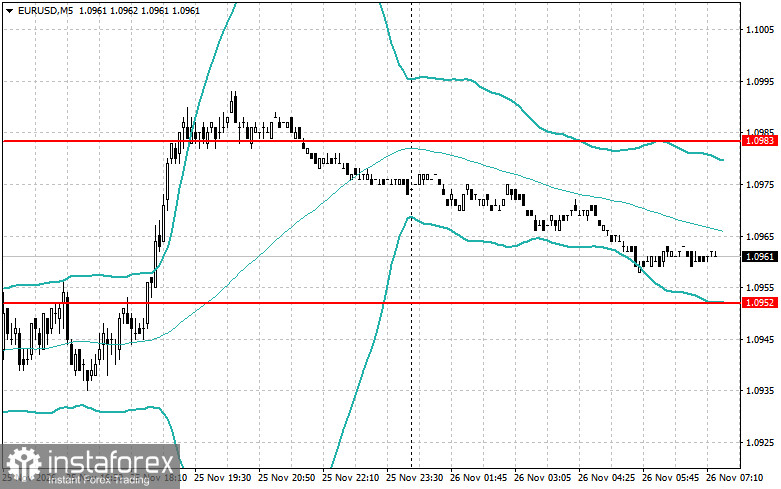
There are two levels here, 1.0983 and 1.0952. The upper reference sits 8 pips below the buy breakout point at 1.0991, so the price will reach it sooner. A novice should be cautious here because the two neighboring marks correspond to opposite scenarios. If the price moves above 1.0983, fails to continue, and quickly returns below, I consider selling toward 1.0952, placing the stop above the breakout point with a small margin at 1.0997. If the price reaches 1.0991 and confidently settles above, the return is canceled, selling is not allowed, and the breakout is in play. Such a picture is likely when the minutes are close to expectations, and the market retraces after the initial reaction. The difference between the two scenarios can take only a few minutes, so it is better to skip the first reaction in the zone.
The lower reference 1.0952 is only 9 pips from the current price, so the price may test it first. It stands 19 pips above the sell breakout point at 1.0933, so there is some margin between them. The scheme is simple. The price falls to 1.0952, dips slightly below, fails to settle, and returns above — then I look to buy toward 1.0983. I place the stop below the sell breakout point at 1.0927, so it is wide, and the trade size should be reduced accordingly. A bounce is likely if there are no new hawkish words and trading is thin because of the US holiday. If the price settles below 1.0933, the return is canceled, and a downside breakout works.

