
यह भी देखें


 26.11.2026 07:01 PM

On Thursday, gold (XAU/USD) continued to consolidate below the $3,600 level, pausing its sharp recovery recorded a day earlier after declining to a low not seen since August 2025. The latest US macroeconomic data showed a combination of persistent inflationary pressures and resilient economic growth, reinforcing expectations of further monetary policy tightening by the Federal Reserve (Fed). Together with renewed demand for the US dollar, these factors are limiting gold's upward potential.
On Wednesday, the US Bureau of Economic Analysis released data showing that the headline Personal Consumption Expenditures (PCE) Price Index increased by 0.3% in October, while its annual growth rate reached 3.8%, compared with the revised September reading of 3.7%. The core index, which excludes food and energy prices, also exceeded market expectations, accelerating to 3.3% year over year from 3.1% a month earlier. Meanwhile, the second estimate of US GDP showed that the American economy grew by 4.3% on an annualized basis in the third quarter. This was significantly higher than both the initial estimate of 3.4% and the second-quarter growth rate of 2.2%. The release of these figures strengthened market expectations of a Fed rate hike in December.
However, the market's initial reaction proved short-lived, as investors are likely still uncertain about the extent of further monetary policy tightening required to bring inflation back to the Fed's 2% target. Meanwhile, CME Group's FedWatch tool continues to reflect traders' expectations of two additional interest rate hikes in early 2027.
Persistent geopolitical tensions in the Middle East are providing additional support for the US dollar as a safe-haven asset. On Wednesday, Iran-backed Houthi forces claimed responsibility for strikes on the King Abdullah Financial District in Riyadh, the capital of Saudi Arabia, as well as an oil refinery in the eastern part of the country. In response, the Saudi-led coalition reported attacks on Houthi positions at the port of Hodeidah. In addition, reports emerged of further strikes on Sanaa, the capital of Yemen.
These developments point to an escalation of tensions between Saudi Arabia and Houthi forces, supporting additional demand for the US dollar following its recent corrective decline from a 20-month high.
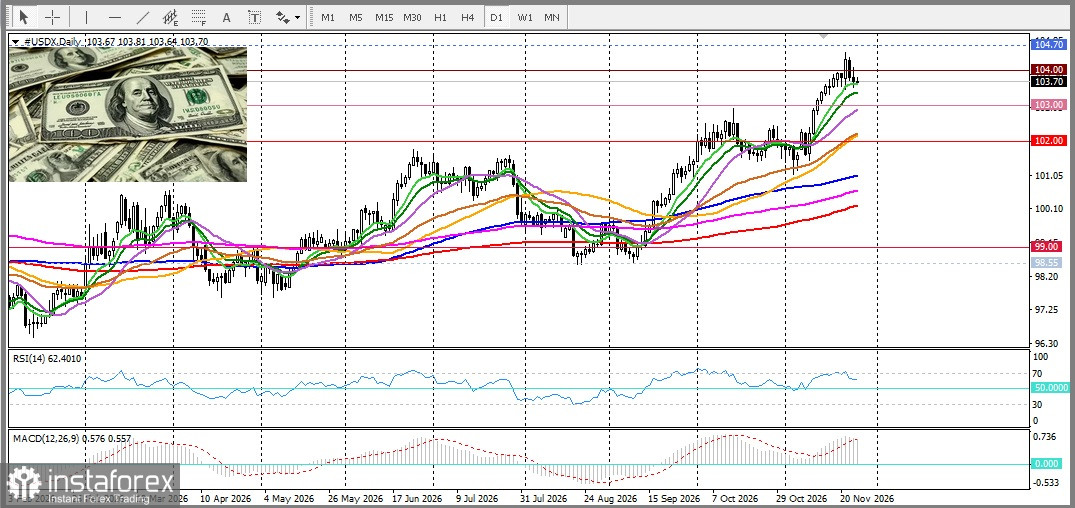
At the same time, trading activity is likely to remain subdued due to reduced liquidity in global financial markets amid the Thanksgiving holiday in the United States. Against this backdrop and given the current fundamental conditions, market participants should wait for a convincing return of buying interest before assuming that gold has formed a local bottom and opening positions in anticipation of a substantial recovery.
From a technical perspective, XAU/USD maintains a short-term bearish bias, trading below all major moving averages. The oscillators remain in negative territory, confirming the bears' advantage. The Relative Strength Index (RSI) has moved out of oversold territory, while selling pressure is resuming. Resistance is provided by the $3,600 level, followed by the 9-day Exponential Moving Average (EMA) and the key $3,700 level. However, bearish pressure will only ease once the bulls break above the 20-day Simple Moving Average (SMA). Support is provided by the key $3,500 level, followed by the annual low.

