
यह भी देखें


 27.11.2026 08:04 AM
The euro greets Friday around 1.0975 and so far holds within a narrow range. Yesterday midday, the pair nearly reached 1.0990, then pulled back, and in the early morning tried to rise again but stalled near 1.0984. Thin trading is hampering the move, since the US observed Thanksgiving yesterday and markets will close earlier than usual today.
The main event on Thursday was the European Central Bank minutes from the October 28–29 meeting, and its tone proved firmer than the pause the bank took then. Rates were left unchanged with unanimous consent, but many members acknowledged they could have voted for a hike already in October. Their argument is simple: the benefit of waiting is small, the 2.50% rate still sits in a neutral assessment range, and the question is only when to act. Pause supporters pointed to calm core inflation (excluding energy and food), lack of second-round effects (wage-price spirals), and tightening financial conditions. They wanted to wait for the December forecasts. Yet they agreed that another hike is likely needed if the inflation outlook does not improve materially.
Compared with earlier in the month, the tone is noticeably different. On October 29, Christine Lagarde said the council had only discussed a hike. Now it is clear many leaned toward tightening. On October 16, Nagel said new steps could not be ruled out, and on November 19 called a December hike a firm signal of resolve. ECB Vice-President Vujcic and Chief Economist Philip Lane also see it as likely. The situation has remained tense since October. Euro-area inflation reached 4.0% versus 3.8% in September, core inflation was 2.6%, and five-year consumer inflation expectations rose to 2.5% from 2.0%. The bank called this worrying because entrenched high expectations can keep inflation elevated. The only relief came from Brent crude, which fell from about $115 at the time of the meeting to roughly $95.5.
Today several releases are due. It starts with France, where Q3 GDP is expected to fall 0.1% quarter-on-quarter after zero growth in Q2. Year-on-year the forecast is -0.1% versus +0.5% previously. For a country where business activity remains in contraction in November, such a result would be logical. Recall that France's preliminary PMI showed services at 46.6 and manufacturing at 47.9. Then German labor market data will be published. Unemployment in November is forecast to remain at 6.4%, with the number of unemployed rising by 5,000 after a 4,000 increase the month before. The labor market remains stable, with no sharp movements.
The main focus will be political events. The EU leaders' summit continues in Brussels. At an informal meeting in Dublin on November 13, leaders discussed AI separately for the first time and agreed on the EU team for Ukraine talks. Then European Council President Charles Michel reported two candidates were nominated for ECB president and consultations with the Parliament and Council of Governors would begin at this summit. Nagel will speak at the end, and if he repeats his previous hawkish tone, that will support the euro.
EURUSD is now around 1.0975, inside the range between 1.0933 and 1.0991. It's about 16 pips to the upper boundary and about 42 pips to the lower. A breakout is a move beyond the range, but the signal comes only after a settlement—several consecutive five-minute candles must close beyond the level. A single poke at the boundary proves nothing.
The upper level 1.0991 has been tested several times over three days. On Wednesday evening the high was around 1.0993, yesterday midday around 1.0990, and early today around 1.0984, and each time the price returned lower. If settlement occurs above 1.0991, targets are 1.1030 and 1.1069. The first target is about 39 pips away, so the road is long. A hawkish tone from Nagel could push the price, and I consider that direction primary, but without a settlement I would not rush. The thin Friday market easily produces false probes.
The lower level at 1.0933 is far—about 42 pips from price. A settlement below it leads to 1.0884 and 1.0848. The path is blocked by the overnight low near 1.0962 and Wednesday's low around 1.0935, which lies just above the level and where buyers have already appeared. For all that to give way, you would need weak French data together with dovish words from Nagel, a combination I find unlikely. I would not enter on the first touch.
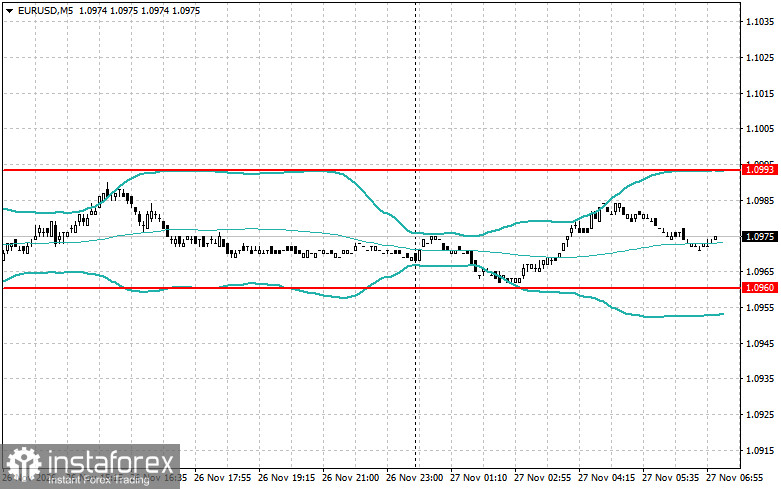
There are two levels here, 1.0993 and 1.0960. The upper reference sits 2 pips above the buy breakout point at 1.0991, so the two marks almost merge, and a novice needs to be particularly cautious. If price moves above 1.0991 and holds, that is still a breakout, and selling is not allowed. If the price rises above 1.0993, fails to hold, and returns below 1.0991, I consider selling toward 1.0960, placing the stop above the level with a small margin at 1.0999. Such a picture is likely when Nagel's remarks add nothing new and the market retraces after the initial reaction. The difference between a breakout and a return can take only a few minutes, so it's better to skip the first reaction.
The lower reference 1.0960 lies 15 pips below the price and 27 pips above the sell breakout point at 1.0933. Overnight, the price stopped near 1.0962, missing it by two pips, so a full test has not yet occurred. The scheme is: the price falls to 1.0960, pokes below, fails to settle, and returns — then I look to buy toward 1.0993. I place the stop below the sell breakout point at 1.0927, so it's wide — about 33 pips — and the trade size should be reduced accordingly. A bounce is likely because today is Friday and many market participants take profits rather than open new positions. If the price settles below 1.0933, the return is canceled, and the downside breakout is in play.

