
Lihat juga


 08.10.2026 06:38 PM
The wave structure on the 4-hour chart for EUR/USD is becoming more complex. There is still no reason to consider the bullish trend segment that began in January of last year (lower chart) invalidated. On the contrary, a complete corrective A-B-C structure has emerged and may already be complete. However, recent developments related to the Federal Reserve and its monetary policy have once again affected the current wave structure, making it more complex. It should be noted that the fundamental background and wave structure often conflict with each other, making adjustments necessary.
The wave structure has now transformed into a more complex formation. Wave C has taken a three-wave form, while the following wave is identified as wave D. The entire trend segment that began on January 27 may take the form of a five-wave corrective structure A-B-C-D-E. If this assumption is correct, wave D has been completed, and on August 21, EUR/USD entered the phase of forming wave E, whose low should be below the low of wave C at 1.1325. The pair is already very close to this level, and below it, the assumed wave E could complete its formation at any time.
The Market Did Not React to the FOMC Minutes
The EUR/USD pair changed very little during Thursday, which is one of the few recent instances when the dollar did not appreciate during the day. The latest significant, although only marginally so, market event was the FOMC minutes released yesterday evening. The minutes were not expected to contain important information, as all decisions made by the Federal Reserve during the meeting are announced immediately. Information on how many policymakers supported the decisions is also released immediately. The regulator's overall stance and objectives are communicated by the Chair immediately after the meeting. Therefore, the minutes generally contain no new information for traders.
Nevertheless, another increase in demand for the U.S. currency could reasonably have been expected yesterday evening. Demand for the dollar increased throughout the day before the minutes were released, but after their release, sellers stopped putting pressure on EUR/USD. The reason is that market expectations were not met. The market may once again have expected statements such as, "We are prepared to raise the interest rate twice more before the end of the year," or "Inflation is more important than the labor market, so the Federal Reserve will take all necessary measures to fulfill its price-stability mandate." However, the minutes contained no such statements. Instead, the document indicated that most policymakers support only one further tightening by the end of the year, while no specific plans have been indicated for next year. Therefore, traders can currently rely only on two rounds of tightening, both of which have already been priced in several times, in both summer and autumn. At the same time, none of the ECB's policy-tightening cycles has been reflected in market pricing.
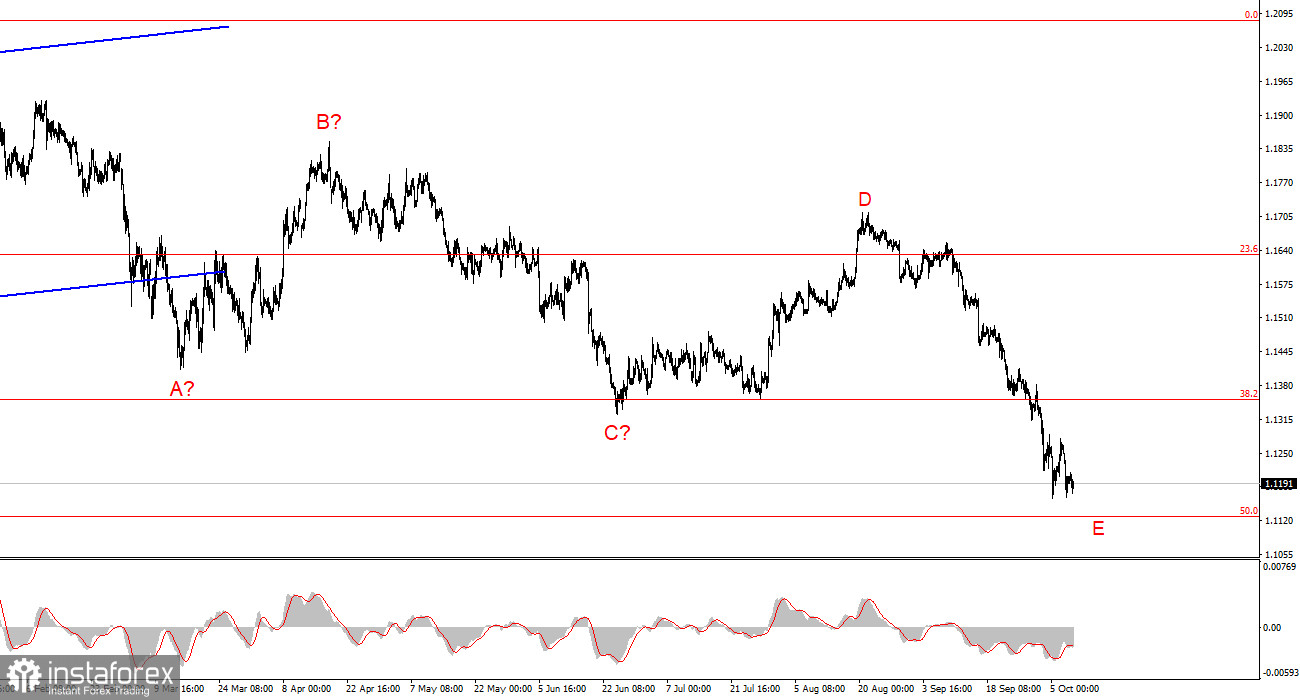
Based on the EUR/USD analysis, the pair remains within the global corrective trend structure A-B-C-D-E. If this assumption is correct, the decline will continue toward targets below the low of wave C at 1.1325. This scenario was previously considered an alternative, and without the Federal Reserve meeting, it would have remained a secondary scenario. However, the Federal Reserve meeting produced an unexpected outcome, leaving the market with no apparent alternative to another wave of U.S. dollar purchases. Nevertheless, dollar buying has continued for several weeks, despite the absence of new supporting factors. Opening short positions under such fundamental conditions would not be advisable; instead, preparations for a reversal would be more appropriate.
On the higher time frame, a downward trend segment can be seen taking the form of A-B-C-D-E. Therefore, EUR/USD may continue declining below the low of wave C, while the internal wave structure of wave E may take the form of a five-wave impulse.
Key Principles of the Analysis:


