
আরও দেখুন


 27.10.2026 06:51 PM
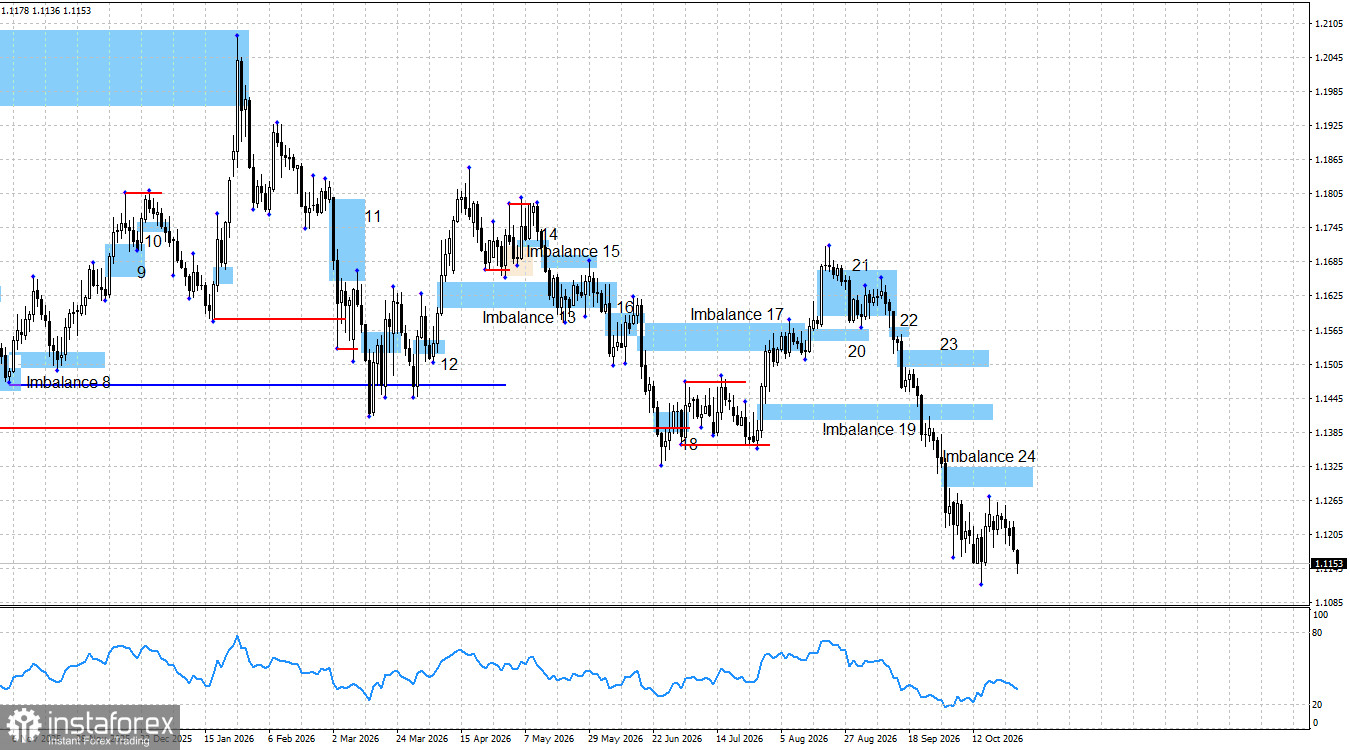
The EUR/USD pair has been declining for the fifth consecutive day, even though neither the ECB nor the Fed has held its meeting yet. It is worth recalling that the previous bearish move lasted a full 25 trading days, during which the euro lost almost 600 points. The same pattern now appears to be repeating. Nothing particularly serious has happened to the European currency this week so far, yet traders are once again rushing to sell it to avoid potential risks. There are, of course, several possible reasons. Over the weekend, new large-scale protests against the rising cost of living took place in European countries, accompanied by rioting and vandalism. The Fed will hold its meeting on Wednesday evening. Immediately after the US congressional elections, on November 4, Donald Trump may order the resumption of military operations against Iran. Traders are once again interpreting these three factors in much the same way: moving away from risk and into the safe-haven US dollar. This is the only way I can explain the dollar's renewed appreciation. Is the market justified in its reaction? Probably. Is it selectively interpreting the available information? Also yes. However, tensions are now extremely high not only in France and Italy, the Middle East, and Ukraine, but even in the currency market. Markets dislike uncertainty. Capital dislikes certainty.
It is worth noting that the Fed's current monetary policy stance is not particularly hawkish. Over the past two weeks, no FOMC member has spoken in favor of tightening monetary policy in October. Therefore, the Fed is almost certain to leave interest rates unchanged this week. I see no economic grounds for further gains in the US dollar. The ECB will also hold a meeting and may leave interest rates unchanged. Yet the euro has been declining for more than a month and continues to fall.
At present, I do not see a single sign that the euro's decline is coming to an end. Imbalance 24 remains valid, and the price may react to it, generating a new sell signal. The bears have moved too far for them to be stopped easily now. The bulls, meanwhile, need to invalidate Imbalance 24 and form bullish patterns before they can expect even a modest recovery. This would require a sharp upward move in the euro, but the bulls continue to show weakness.
In September, the FOMC raised interest rates and signaled its willingness to continue tightening monetary policy. This was enough to trigger a large-scale bearish move. However, even after the Fed's September tightening and the possibility of another rate hike in December, I do not believe that the euro has lacked positive developments throughout this period. The market is simply ignoring most of them.
Overall, in my view, the fundamental backdrop continues to favor the bulls. Although the Fed has adopted a more hawkish monetary policy stance, it is not the only factor influencing exchange rates. The European Union also faces problems, but the point is that problems exist everywhere, while only the euro is declining. Both central banks are pursuing tighter monetary policy, yet only the US dollar is appreciating. However, I would not recommend expecting the euro to rise before bullish signals emerge. Nor would I recommend buying the European currency in advance.
The current chart structure points unequivocally to the continuation of bearish momentum. Among the relevant patterns, Imbalance 24 remains in play and could be revisited in the near future. The bulls' only current opportunity may lie in a liquidity sweep below the 1.1066 low. However, opening long positions requires more than a liquidity sweep alone.
Economic data on Tuesday supported bearish traders, as the day's most important report came in above expectations. Durable goods orders increased by 1.8% in September, compared with the forecast of 1.5%. However, it is worth noting that the dollar had already been rising before the report was released, further demonstrating an obvious point: economic data is not the reason for the dollar's appreciation.
The bulls still have numerous reasons to launch an attack in 2026. Structurally and fundamentally, Trump's policies—which led to a significant decline in the dollar last year—have not changed. At present, I see no significant factors supporting the US currency, despite the FOMC's hawkish stance. Geopolitical developments and heightened tensions in Europe are weighing on the euro.
Economic calendar for the United States and the European Union:
The economic calendar for October 28 contains three events, with the Fed meeting being the most significant. The impact of economic developments on market sentiment could be substantial on Wednesday evening.
EUR/USD Forecast and Trading Tips:
In my view, the pair remains in the process of forming a bullish trend that has been in a corrective phase for an entire year. The fundamental backdrop shifted sharply in favor of the bears eight months ago, but the four-year trend cannot yet be considered invalidated or complete. The bulls may resume their advance before the end of the year, but their only realistic opportunity at present is the 1.1066 low established in June last year. The bears received a new sell signal at Imbalance 19. At this point, the only course of action is to keep existing short positions open. A new sell signal may form at Imbalance 24.


