
আরও দেখুন


 03.11.2026 06:37 AM
Bitcoin continues to decline, which may develop into a full-fledged wave of the downtrend that began last year. In total, over the past several weeks, Bitcoin has lost about $10,000 in value, which is not negligible. For now, the move is considered corrective, but Bitcoin is sliding downward with increasing persistence. Recall that the downtrend may have ended. However, reasons for a new "bull" trend still look ambiguous and debatable. The recent three-month rise in Bitcoin was essentially a move from the lower boundary of the sideways channel to the upper boundary on the daily timeframe after forming a deviation at the lower channel boundary and forming a deviation at the upper boundary. The upper-bound deviation was deep, but if it is indeed a deviation, Bitcoin set course for the $70,800 level. "Digital gold" confidently returned to the sideways channel, so a move to its 50% level would be natural and logical.
The new decline of the leading cryptocurrency and the entire crypto market was triggered by the hack of the Binance exchange, as a result of which about $6.4 billion was stolen, making this theft with a hack the largest in the history of the crypto segment. However, this week the "digital gold" faces a new challenge. Today, November 3, congressional elections take place in the US, and results will likely be known tomorrow. Bitcoin has fallen after US midterm elections each time over the past 12 years, with losses measured in tens of percent. In addition, the Democrats are highly likely to win, which could significantly reduce Bitcoin's popularity among investors. Recall that Donald Trump intended to turn the US into a crypto capital. If Democrats win, passing the Clarity Act can be forgotten. Investors have recently been in a fragile mood even without this, as threats from hacks of individual wallets and of the Bitcoin network in general are increasing month by month. Thus, we still see no basis for long-term growth of the leading cryptocurrency.
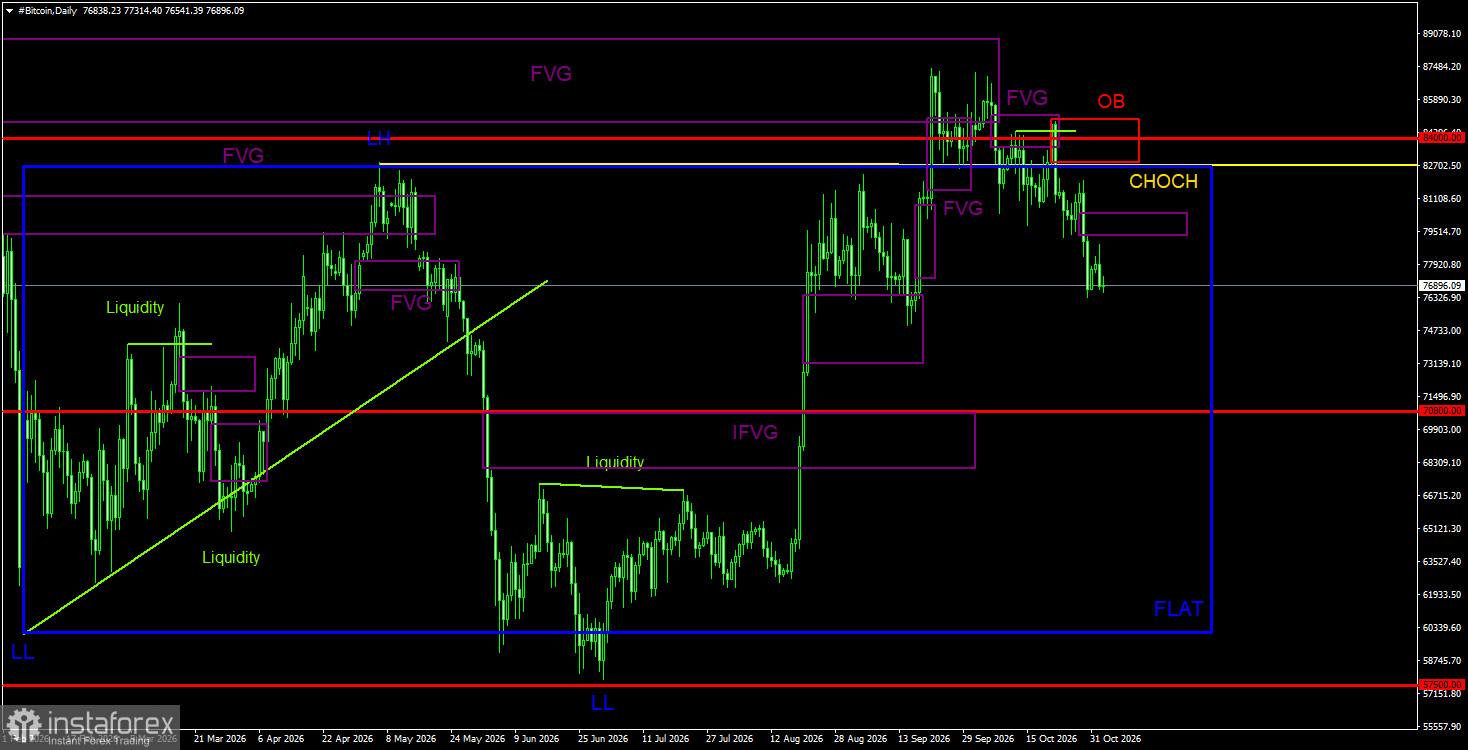
On the daily timeframe, the downtrend structure is broken, so "digital gold" has most likely begun forming a new bullish trend. The price reacted to the bearish FVG from the previous trend, received a response to that pattern, and a correction began as expected. However, the breakout beyond the sideways channel $60,000–$82,500 in September may still be a deviation, which, together with the reaction to the bearish FVG, could trigger a drop to the lower boundary of the sideways channel. In the last bearish FVG, another sell signal was formed. In addition, bearish order blocks and FVGs have formed, which also point south and may lead to the formation of new sell signals.
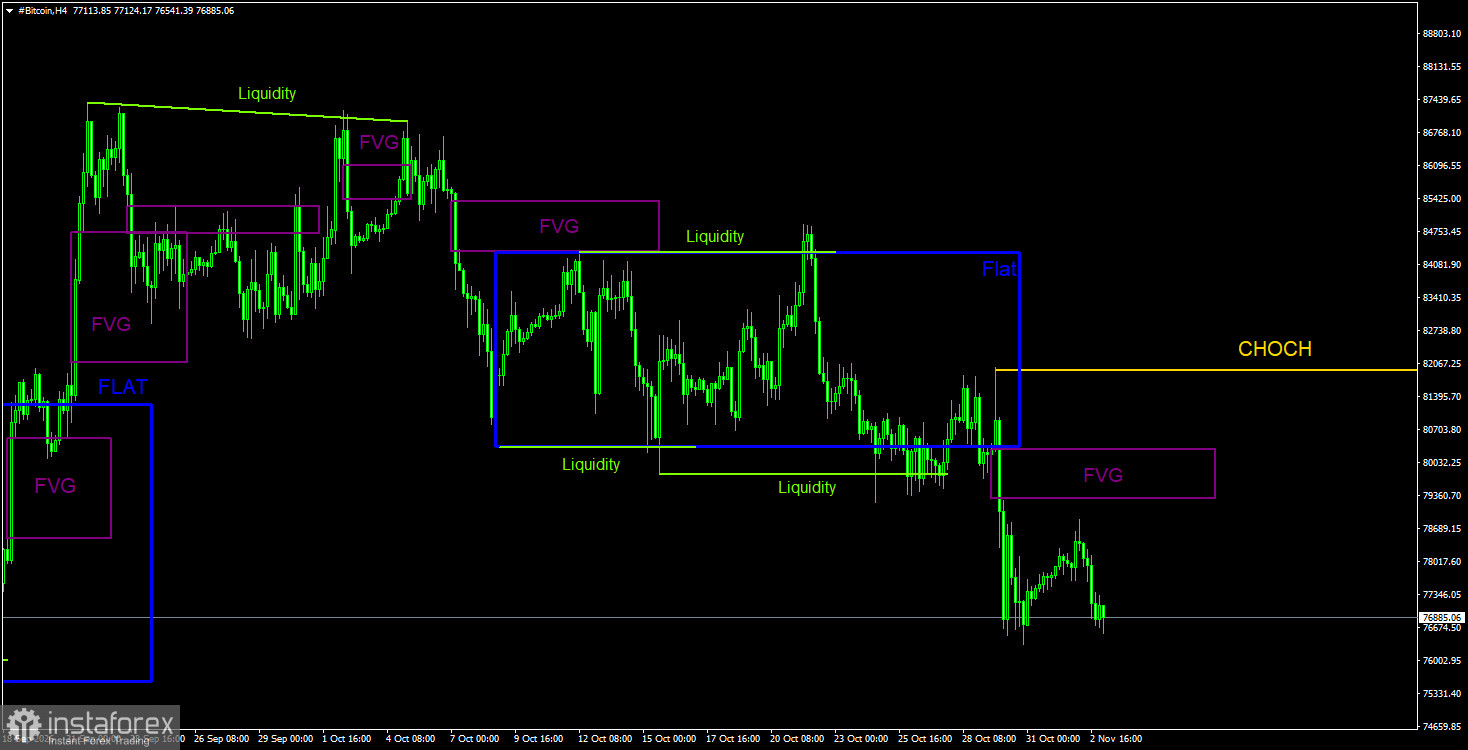
On the 4-hour timeframe, a descending structure continues to form. The CHOCH line is currently at the $82,000 level. On the daily timeframe, all necessary reversal-to-the-downside signals were received, allowing traders to open short positions. Bitcoin's targets are best determined by the sideways channel on the daily chart, which in our view remains relevant. On the 4-hour timeframe, Bitcoin left the sideways channel as we expected. Thus, in the near term, traders can use local bearish patterns to open short positions. One such pattern is the latest bearish FVG.
Bitcoin attempted to start a new uptrend, but the fundamental backdrop, spot demand, and recent news are too weak to count on its continuation. In the near term on the daily timeframe, Bitcoin may be declining, since the price reacted to the two latest bearish FVGs and formed a bearish order block. The breakout beyond the daily sideways channel is currently interpreted as a deviation. Thus, Bitcoin has generated a reversal signal and set course for the $70,800 level. Because a flat does not guarantee the end of the main trend, we do not believe the bearish trend is over. Short positions are the most relevant in the near term.


