
यह भी देखें


 07.09.2026 09:50 AM
Gold fell another 0.8 percent to $4,392 per ounce. Silver declined 0.7 percent to $65.75, platinum fell, and palladium rose.
The reason was a combination of two factors, each of which alone works against the metal. Friday's data showed US employment rose by 162,000 in August, with unemployment unchanged, strengthening arguments for a rate hike at the September 15–16 meeting. Traders raised the odds of such a step to roughly 60 percent, and higher borrowing costs traditionally undermine support for non-yielding gold.
The second factor came from the Middle East and works through the same rate logic. Iran said it attacked three oil tankers in the Strait of Hormuz, as well as several US-linked vessels, in response to American strikes on ships over the weekend. Brent rose above $97 per barrel. Here lies the main paradox of the moment: geopolitical escalation, which, by textbook logic, should lift a safe-haven asset, pushes it down because rising energy prices increase inflation expectations and raise the chances of policy tightening.
Technically, the metal returned below the 200-day moving average it only reclaimed a few weeks ago. Since the bounce from around $4,000 in July, gold has traded in a relatively narrow range, and last week it oscillated on both sides of $4,400 while traders repeatedly revised Federal Reserve policy expectations.
Another strong producer or consumer price report expected this week could reinforce the tightening story and push gold further below $4,400. In contrast, softer inflation would relieve some pressure only temporarily and act more like a breather than a reversal.
How serious is this threat for the medium-term picture? In my view, it is far less severe than the quotes suggest, and the behavior of large capital confirms this. Central bank buying and the narrative of debasement recall the same rally that took the metal to a record near $5,600 in January, and the world's largest managers have been rebuilding gold positions in recent weeks. Investors buying now are focused not on the September meeting but on the resilience of US finances overall.
As noted above, the resolution will come this week when CPI is released. I expect that if disinflation is confirmed, the metal will return to the $4,450–4,500 area, while a hot report will send it toward $4,250. I lean toward the view that, even in the second scenario, the decline will be limited, since buyers on dips have been active below $4,300 for three consecutive months. The risk to this forecast remains in the Strait of Hormuz: a full blockage of the strait with halted tanker traffic would create a situation in which the inflation channel overwhelms the safe-haven channel so much that the metal loses support even amid weak inflation.
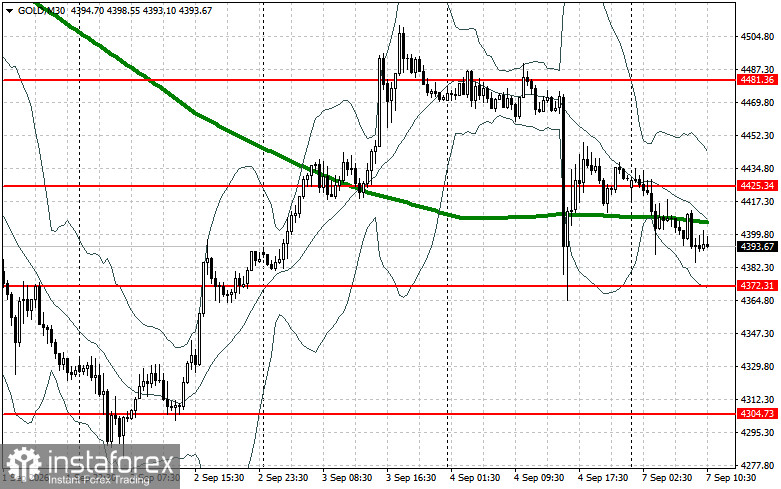
Regarding the current technical picture for gold, buyers need to reclaim the nearest resistance at $4,425. That would allow targeting $4,480, above which a breakout would become rather difficult. The most distant target is in the $4,540 area. If gold falls, bears will try to take control of $4,372. If they succeed, a break of that range would deal a serious blow to bulls and push gold toward the $4,304 low, with a further prospect of reaching $4,249.

