
यह भी देखें


 24.09.2026 06:03 PM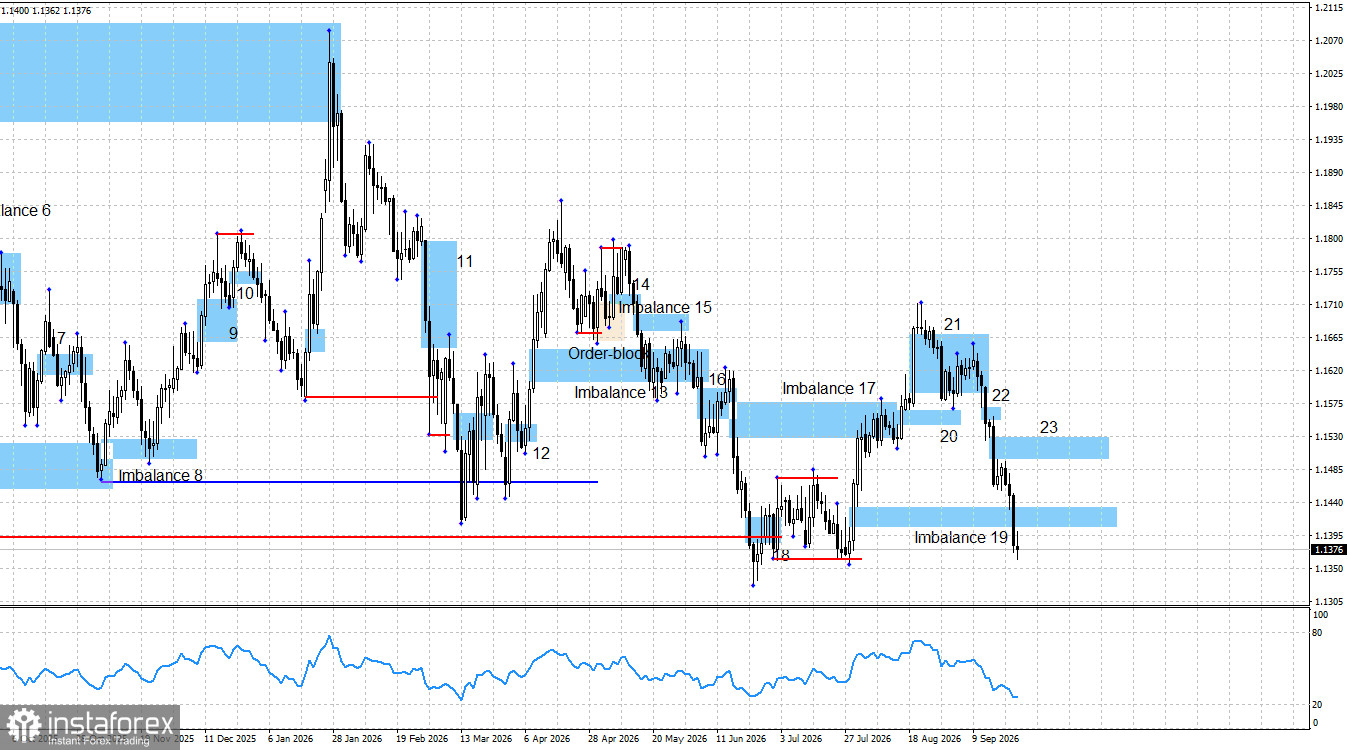
The EUR/USD pair has continued to decline for the eleventh consecutive day. During this period, the euro has lost 280 points. The euro's losing streak began the week before last as the market was preparing for an FOMC rate hike. Since then, the market has continued buying the dollar on the basis of the Fed's hawkish monetary policy stance, which is being confirmed daily by FOMC members, who, in turn, are not changing the expected overall magnitude of the rate increase. Nothing is currently capable of stopping the euro's decline. Neither tighter ECB policy, nor positive economic data from the European Union, nor the chart pattern or bullish patterns can stop it. Imbalance 19 has been invalidated, so the euro now has every chance of falling below the psychological level of $1.10. Moreover, bullish imbalance 19 has not simply been invalidated; it has turned into a bearish inverted imbalance. It is now a bearish pattern alongside imbalance 23. Thus, traders currently have two zones of interest for short positions. The only factor supporting the bulls is the proximity of the last two swings, from which liquidity could be taken.
Last week, the FOMC committee indicated its readiness to continue tightening policy, which was enough to trigger a new bearish advance. Even after the Fed's monetary policy tightening in September and possible further tightening in November or December, I do not see what other reasons could make traders continue buying the U.S. currency. The dollar has indeed performed strongly in recent weeks, but what factors have supported it during this period? FOMC monetary policy tightening—and that's it?
Overall, in my view, the fundamental backdrop remains supportive of the bulls. Despite the Fed's more hawkish monetary policy stance, this is not the only factor that determines exchange rates. However, at present, the only thing that matters is the strength of the bears and their willingness to continue attacking. All other factors have no influence on the market. Interestingly, the bears' advance could now end at any moment, as they have already been attacking for three weeks more on enthusiasm than on the basis of specific reasons. Thus, once the bears have had enough, the euro's decline will end. And the bears could have had enough at any moment.
The current chart picture indicates that the bearish momentum is still intact. Despite the highly contradictory nature of the price movement over the past three weeks, traders now have at least two zones of interest for short positions. The bulls can only hope for the lows of July 28 and June 24, from which liquidity could be taken, potentially triggering a bullish advance.
The economic backdrop on Thursday was virtually absent, but the bears continued to exert pressure today. The U.S. dollar's rise during the day was not particularly strong, but it was another day in which the dollar rose while the euro fell. And it was another day in which the economic backdrop provided no support whatsoever for the bears.
The bulls still have a huge number of reasons to attack in 2026. Structurally and globally, Trump's policies, which led to a significant decline in the dollar last year, have not changed. At present, I do not see any significant factors supporting the U.S. currency despite the FOMC's hawkish stance. Geopolitical factors, which supported demand for the U.S. currency for much of the first half of 2026, are no longer doing so.
On September 25, the economic calendar contains three entries, of which I would highlight only the report on Durable Goods Orders. The economic backdrop may influence market sentiment in the second half of the day on Friday.
In my view, the pair remains in the process of forming a bullish trend that paused for an entire year. The fundamental backdrop changed sharply in favor of the bears six months ago, but the trend itself cannot be considered canceled or complete. In the long term, I would say that the pair is trading in a range. A range does not invalidate the broader bullish trend. Thus, the bulls may resume their advance in 2026, but their only remaining opportunities are the 1.1354 and 1.1325 lows, from which liquidity could be taken. The bears currently have imbalances 19 and 23, from which short positions can be opened. However, in my view, the current movement is risky for traders because it lacks clear fundamental justification. The dollar could certainly continue falling even below the $1.10 level, but ask yourself: what could justify such a move?

