
यह भी देखें


 06.11.2026 07:50 AM
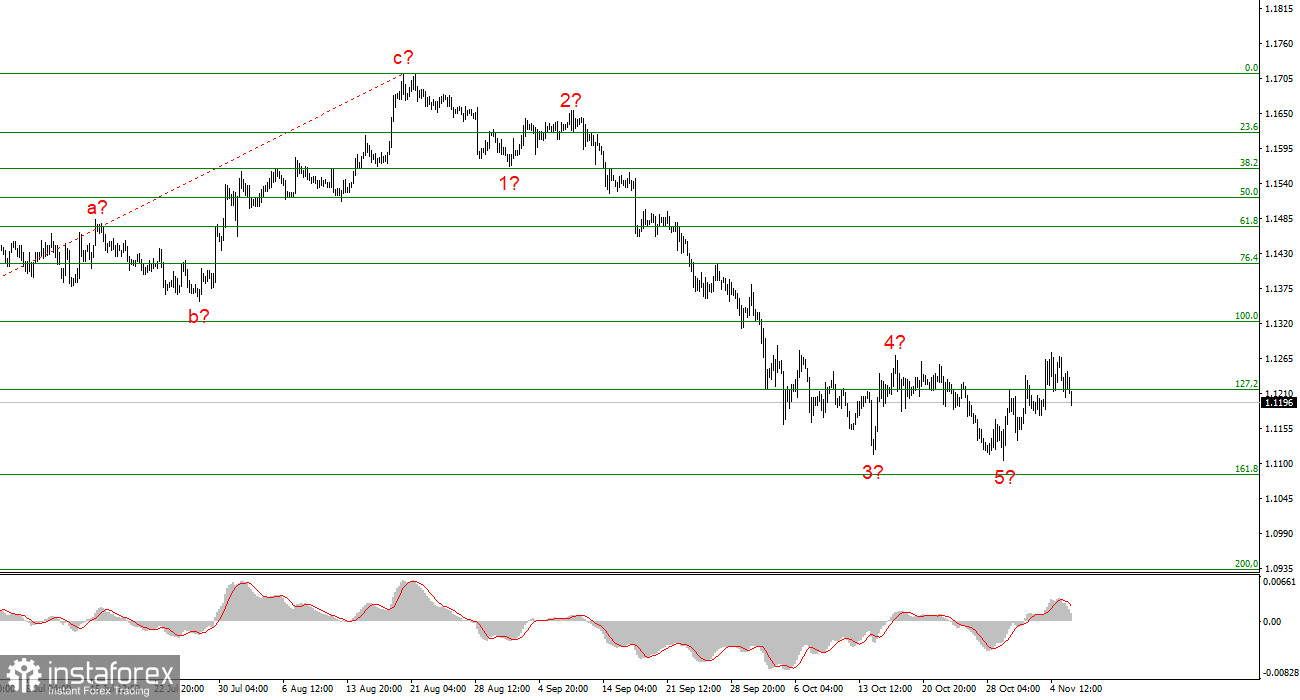
The Elliott Wave structure of the 4-hour EUR/USD chart has become more complex. On the higher timeframe (bottom chart), the downward trend segment has taken the form of a five-wave A-B-C-D-E structure, which could be completed at any time, as it appears sufficiently developed. All the waves within this segment are approximately equal in size, which suggests that the structure is corrective. If this assumption is correct, the completion of this structure will be followed by the development of a new upward impulse segment, with targets well above the 20th level.
On the lower timeframe (top chart), an impulsive wave structure continues to develop, which may belong to wave E of the higher timeframe. If this is indeed the case, the dollar's strengthening is approaching its end, regardless of how strong its upward movement becomes. The presumed wave 5 of E is either complete or nearing completion. In either case, the current wave structure suggests that the downward wave sequence is nearing completion on both charts.
The news background and the sharp shift in market sentiment have triggered a significant appreciation of the US currency. However, relatively few new reasons remain for further dollar strength.
The Euro Is Once Again Depending on Dollar Weakness
The EUR/USD exchange rate declined by 10 points on Thursday, and Friday began with a further decline of 20 points. Overall, the European currency remains in low demand and continues to struggle against the dollar. This week, conditions appeared particularly favorable for the euro, yet it failed to rise even above the peak of wave 4. Toward the end of the week, the euro is declining again, despite the news background and the Elliott Wave structure.
Overnight, Donald Trump stated that he might have to destroy the remaining part of Iran. As can be seen, the US president is paying no attention to the Democrats' demands to end the war and is showing no intention of reaching an agreement with Congress. As previously noted, Trump could well order new strikes against Iran, even without the approval of a fully Democratic Congress.
The only unclear point is what Trump is waiting for. Threats against Iran have been made for several consecutive months. Previously, Trump was concerned about further escalation because oil and fuel prices could rise even more sharply. There is now little reason for such concern: the elections are over, so what comes next? In any case, the market appears to place more confidence in Trump than in the Democrats. At least, this is the conclusion that can be drawn from the latest appreciation of the US dollar.
Important US labor market and unemployment reports will be released today. However, it is worth considering in advance what results could realistically mean for the market. If the labor market once again produces disappointing figures, should a dollar decline of more than 20–30 points be expected? Probably not. The market has already had sufficient reasons to sell the dollar this week. Therefore, regardless of how weak the US reports turn out to be, a substantial dollar decline is not expected.
At the same time, if the reports exceed expectations, the dollar is likely to continue appreciating. A decline in EUR/USD below the 1.11 level would make adjustments to the Elliott Wave structure necessary.
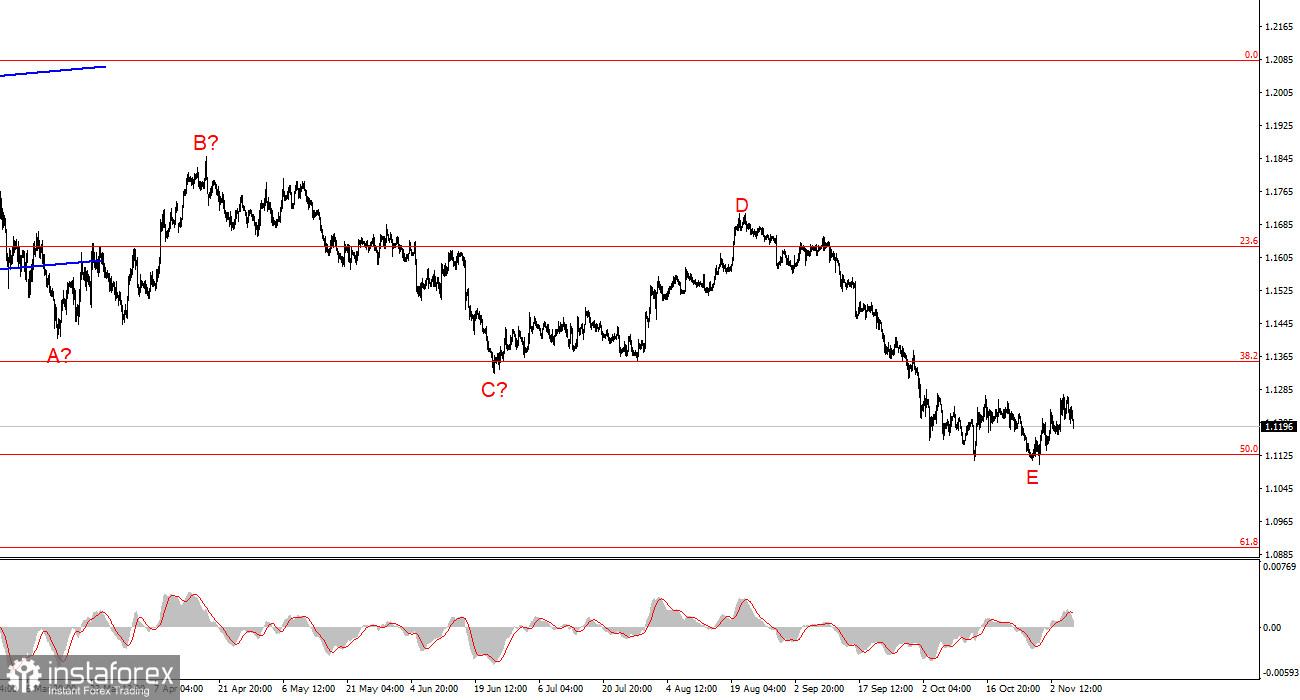
Based on the EUR/USD analysis, the instrument is still within the global corrective A-B-C-D-E trend structure. However, this structure appears fully developed and may therefore be complete. At present, conditions appear favorable not only for buying the European currency but also for anticipating the development of a full-fledged upward trend segment.
According to the higher timeframe, an advance of at least to the 1.17–1.18 levels is expected. The unsuccessful attempt to break above the 1.1126 level, corresponding to the 50.0% Fibonacci retracement level (bottom chart, higher timeframe), also indicates that the market may be preparing for an upward move.
The higher timeframe shows a downward trend segment that has taken the form of an A-B-C-D-E structure. The internal wave structure of wave E has developed into a five-wave impulse pattern, but it may already be complete. If this assumption is correct, a new upward trend segment should begin to develop.
The Main Principles of the Analysis:
1. Wave structures should be simple and easy to understand. Complex structures are difficult to trade and are often subject to changes.
2. If there is uncertainty about current market conditions, it is better to stay out of the market.
3. There can never be 100% certainty about the direction of price movement. Do not forget to use protective Stop Loss orders.
4. Elliott Wave analysis can be combined with other types of analysis and trading strategies.

