
यह भी देखें


 13.11.2026 08:38 AM
Yesterday, Binance said it has fully reimbursed the $6.3 billion stolen from customers in the October 29 hack, closing the chapter on the largest crypto theft in history. The trickiest assets were lesser-known tokens that took the longest to locate and repurchase, but by Thursday, all had been restored. The same day, the US Department of Justice announced that, together with Tether and Circle, it has secured court permission to seize or freeze $1.2 billion of the $2.7 billion that issuers blocked immediately after the attack. That equals roughly 44% of frozen funds and about one-fifth of the total theft; investigators continue to trace the remaining proceeds.
The timeline is instructive. On October 30, the exchange suspended deposits and withdrawals, Bitcoin fell to $78,400, and Binance said that about $3 billion had been frozen, and losses would be covered. By the end of October, roughly 90% of stolen assets had been recovered. On November 3, Binance reported $2.85 billion frozen or intercepted, and now coverage has reached 100%. Binance absorbed the cost out of profits and emergency reserves — customers were made whole by the exchange, not by clawing back the stolen assets. The FBI named the group TraderTraitor, linked to North Korea, as the perpetrator on October 31. Pyongyang denies the accusations, and on November 2, Kim Yo Jong dismissed the claims as absurd propaganda. The US Justice Department says it will use every available tool to recover assets allegedly taken by North Korea.
The hackers were highly active. Elliptic reports that in the first week, more than 20,000 wallets and at least 65,000 transactions took part in laundering — a new wallet appeared roughly every 30 seconds and a transaction every 10 seconds. Funds flowed through bridges, mixers, and exchanges, and some $430,000 was laundered via bespoke memecoins. Chainalysis highlighted the role of Chinese laundering networks that cash out proceeds. The fact that $1.2 billion was stopped at the stablecoin issuers' side shows the key lever against such schemes is speed: freeze funds before they move beyond reach.
Market implications are twofold. On the one hand, Binance's reimbursement removes the most immediate risk that hung over the exchange on October 30, when liquidations exceeded $1.3 billion, and spot Bitcoin ETFs saw $643.2 million of outflows. On the other hand, selling has not ended. From October 30 through November 11, spot Bitcoin ETFs lost more than $2.5 billion, and on Friday, Bitcoin fell below $68,000, roughly 12% below the level on the day of the hack. That indicates the decisive factor for the price has been Fed rate expectations and Treasury yields, not the hack itself. I believe the reimbursement and Justice Department actions will not trigger a new buying wave until ETF flows return to positive territory; until then, Bitcoin remains under pressure, and the risk of breaching the 200-week moving average near $67,700 persists.
Technical analysis and recommendations:
Bitcoin
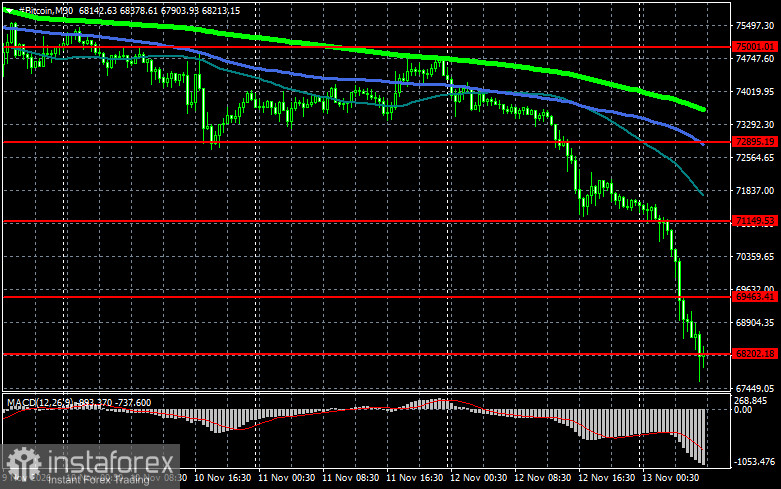
Buyers are targeting a return to $69,400, which opens a direct path to $71,100 and then $72,900. Clearing that level would signal attempts to restore the bull market. On the downside, I expect buyers to defend $68,200. A drop below that area could quickly push BTC toward $66,500, with a further target near $65,000.
Ethereum
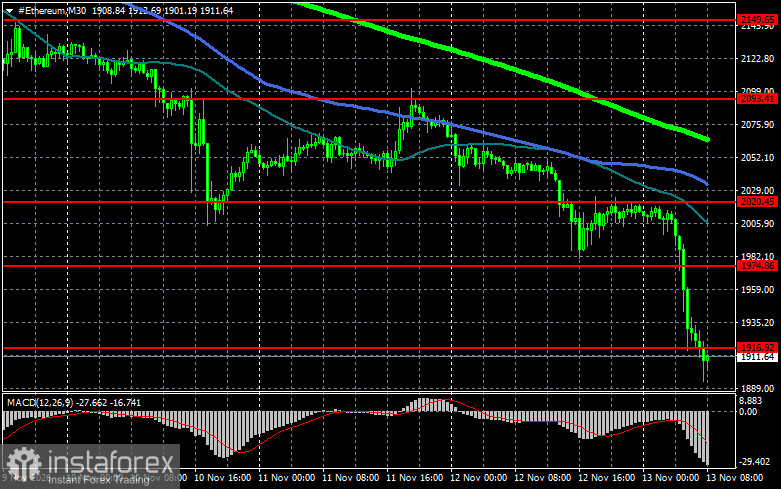
Consolidation above $1,974 opens a path to $2,020. The next upside target is around $2,093. A break above that level would indicate strengthening bullish sentiment and renewed buyer interest. On the downside, buyers should appear near $1,916. A break below that level could send ETH toward $1,872, potentially extending weakness to $1,834.
What's on the chart:
Crosses or price tests of these averages typically either stop a move or set a new market impulse.

