
Lihat juga


 02.09.2026 09:45 AM
Today, WTI has risen by more than 6% to $92.22 per barrel, while Brent has increased by 4.6% to $94.65. The cause of this spike was the new U.S. strikes against Iran, which heightened concerns about prolonged disruptions in energy flows through the Strait of Hormuz.
President Trump stated that the attacks were a response to Iran's attempts to lay mines in the strait and to Tehran's earlier attack on a military base in Jordan. This occurred after a highly alarming episode late Monday night, when two oil supertankers were struck by shells while attempting to navigate out of Hormuz. The Islamic Revolutionary Guard Corps warned of "severe punishment" for the U.S. retaliatory strike. At the same time, Trump noted that Iran's response could provoke much more powerful military actions, and the country could be "completely wiped off the face of the Earth."
The European gas market has become the most vulnerable in this situation, with the situation nearing critical levels. The region has only one month left to replenish gas reserves before winter, and the storage facilities are filled to about 65%, the lowest seasonal level recorded since monitoring began in 2009. The European gas benchmark is currently more than 70% above the levels at the beginning of July. It's worth noting that Isabel Schnabel of the European Central Bank highlighted gas as a source of particular concern, emphasizing that low reserves could worsen the situation during a cold winter.
Notably, despite the severity of the situation, price growth remains limited, and there is a concrete explanation for this. Exports continue through Hormuz, often on tankers with transponders turned off to avoid detection, and producers in the Persian Gulf, including the UAE, Saudi Arabia, Kuwait, and Iraq, continue to export barrel after barrel.
Washington's position regarding the strait is becoming increasingly provocative. Treasury Secretary Scott Bessent has downplayed the significance of Hormuz, stating that it will soon be circumvented by pipelines and become a "useless chunk of water." This rhetoric comes amid growing concerns that the war is depleting U.S. firepower and is becoming increasingly unpopular domestically, raising questions about the sustainability of the entire campaign.
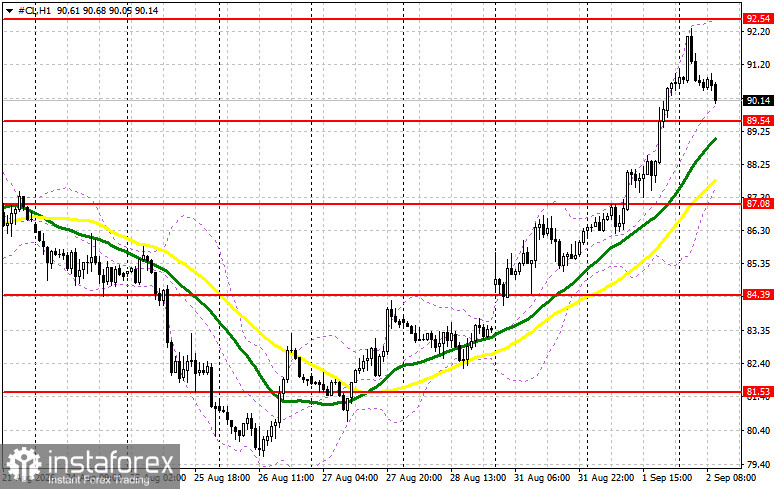
Regarding the current technical picture of oil, buyers need to conquer the nearest resistance at $92.50. This will allow them to target $96.54, above which it will be quite challenging to break through. The farthest target will be around $100.40. In the event of a decline in oil prices, bears will attempt to take control of $89.54. If they succeed, breaking this range will deal a serious blow to the bulls' positions and could push oil down to a low of $87.08, with the potential to reach $84.40.


