
یہ بھی دیکھیں


 09.07.2026 08:52 AM
Yesterday, US equity indices finished mixed. The S&P 500 fell by 0.28%, while the Nasdaq 100 rose by 0.20%. The Dow Jones Industrial Average lost 1.29%.
European stocks are set to rebound after oil gave up an early move higher, sparked by fresh US strikes on Iran, and US Treasuries ticked up slightly. Futures point to a roughly 1% gain for European bourses at the open, contracts on US indices have flipped from negative to about +0.3%, Asian benchmarks are up ~0.3%, while Brent eased about 0.4% to below $78/bbl.
Bonds bounced back after Wednesday's sharp sell-off driven by bets the Fed may tighten further to fight inflation. The 10-year US Treasury yield slipped two basis points to 4.56%. Gold and silver also advanced. Nonetheless, the overall picture remains worrying: this week's spike in oil on renewed Middle East tensions has revived inflation concerns and pushed money markets to move the odds of the next Fed hike from December into October. That pressure comes on top of already-stretched equity valuations following the AI rally and did not provide support to the US dollar.
Vantage Global Prime described the shift in sentiment as a "deal of chaos," with oil, gold, and defensive assets suddenly back in the spotlight. It is an apt characterization of a market that must simultaneously price in geopolitical risk and a rapid re-rating of monetary policy expectations. The risk that a breakdown of the ceasefire between the US and Iran will re-accelerate oil prices keeps inflation expectations elevated, which, in turn, could force the Fed to tighten.
Rate-hike probability by year-end is now considered likely not only for the Fed but also for the ECB, the Bank of England, and the Bank of Japan, with two further hikes expected in New Zealand. This is an unusually synchronous hawkish shift across several of the world's major central banks.
Meanwhile, the situation regarding the Strait of Hormuz continued to deteriorate. Ship movements essentially halted on Thursday after two consecutive days of US strikes on Iran. Vessel-tracking data show that most transits occurred on Iran-approved northern routes, while the US-supported Omani corridor remained largely empty.
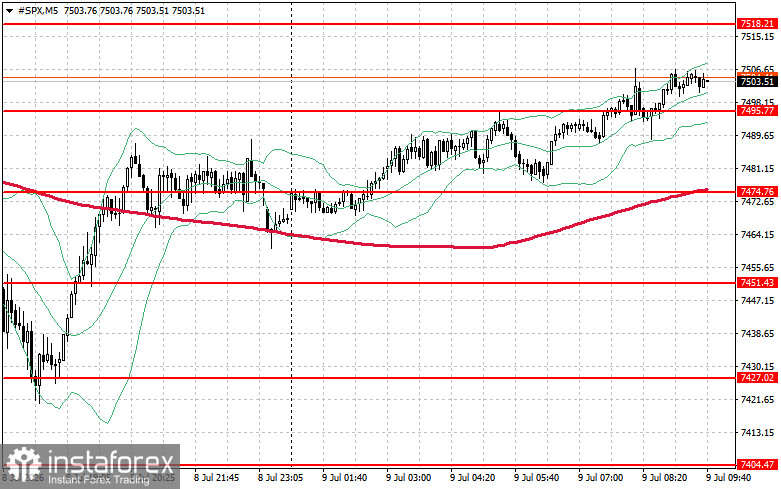
Technically, the daily chart shows that the immediate task for buyers is to overcome the resistance level of $7,518. Doing so would confirm upside and open the path to $7,544. Maintaining control above $7,574 would further strengthen buyers' positions. On the downside, buyers need to defend $7,494. A break below that level would likely push the index back to $7,474 and open the way to $7,451.


