
আরও দেখুন


 02.06.2026 07:17 AM
The three-week dynamics paint a stable picture: speculators are methodically reducing their longs, while hedgers are sending mixed signals.
Open Interest: 282,065 contracts (each contract = £62,500). Decreased by 3,582 over the week (compared to +2,004 a week earlier—indicating the market began to compress).
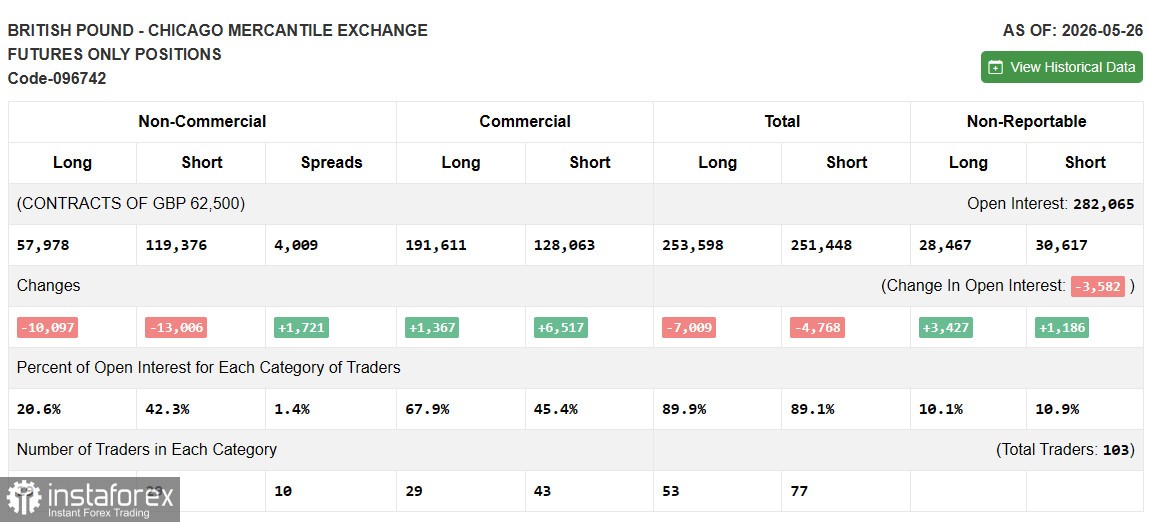
Speculators simultaneously closed both long and short positions—a sign of reduced interest in the instrument and a wait-and-see stance. The net short position for non-commercial participants is -61,398 contracts (compared to -64,307 a week earlier)—bearish pressure has slightly weakened, but structurally the position remains deeply bearish. The number of traders has decreased: 19 long / 29 short.
Hedgers have increased shorts for the second time in three weeks. Despite retaining a net long position (+63,548 contracts), the direction of movement is concerning: the growth of shorts among commercial participants signals increasing hedging against potential depreciation of the pound. The number of traders: 29 long / 43 short.
The overall balance is nearly neutral, with a minimal excess of longs.
Small participants increased longs more aggressively than shorts—the only group to show moderately bullish movement during the period.
The three-week dynamics paint a consistent picture: speculators have methodically reduced their long positions for three consecutive weeks—from 79,605 to 57,978 contracts, a decrease of nearly 27%. Even with the parallel closure of shorts this week (-13,006), the net position of non-commercial participants remains deep in the negative at -61,398 contracts. At the same time, hedgers send mixed signals—their net long remains and has even slightly increased in absolute terms, but the simultaneous growth of shorts (+6,517) suggests they are beginning to hedge against potential declines in the pound without fully exiting their long positions. The overall compression of open interest (-3,582) amidst declining activity from both groups suggests the market has entered a phase of uncertainty—participants are not ready to make large bets.
The geopolitical backdrop enhances this caution. Sustained demand for the dollar as a safe-haven asset amid ongoing regional tensions structurally limits the growth potential of GBP/USD. In such an environment, the position of speculators—to maintain a substantial net short while gradually reducing it without reversing—appears quite rational: the market awaits either a de-escalation of the conflict or a clear signal from the Bank of England before making the next move.


