
See also


 11.12.2025 09:00 AM
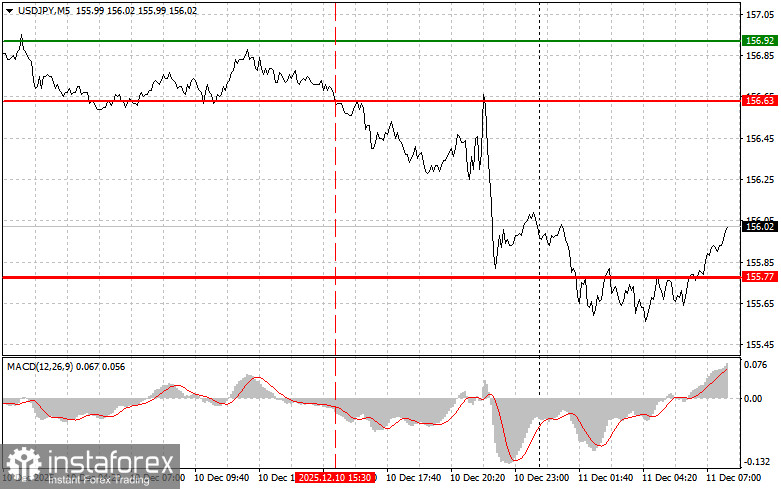
The test of the 156.63 price coincided with the MACD indicator moving significantly below the zero mark, which limited the pair's downside potential. For this reason, I did not sell the dollar.
Yesterday, the Federal Reserve voted 9 to 3 to lower the key interest rate by a quarter percentage point to 3.75%. This led to a weakening of the dollar and a strengthening of the Japanese yen. The Fed's decision aligned with the expectations of many analysts. The dollar's weakening after this news was immediate. Investors redirected their assets toward currencies with higher yields, leading to an increase in demand for the yen and, consequently, strengthening its position. Given that the Bank of Japan plans to raise rates next week, the decline of the USD/JPY pair seemed entirely understandable.
Today, the BSI Business Conditions Index for large manufacturers in Japan was released, showing growth and exceeding economists' forecasts. However, this did not provide strong support for the yen. Considering that a significant portion of yesterday's sell-off has already been priced in, be very cautious with sales. Despite the Fed's dovish stance, the dollar is relatively comfortable against the Japanese yen, which could spark a new wave of growth in USD/JPY.
Regarding the intraday strategy, I will primarily rely on executing Scenarios 1 and 2.
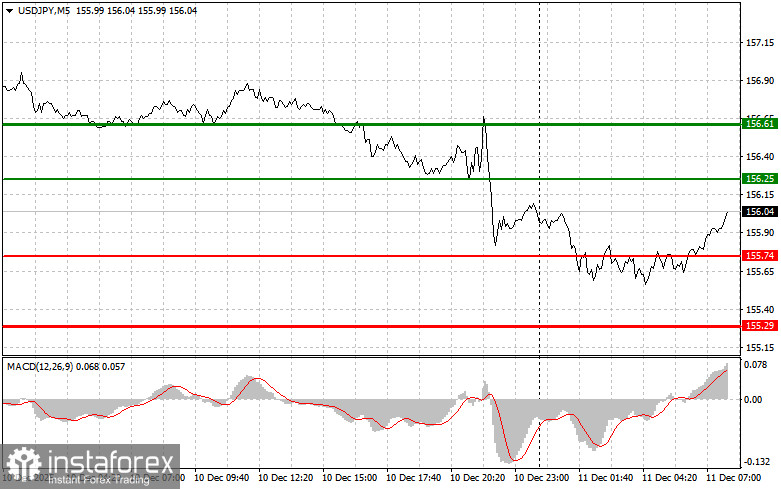
Scenario 1: I plan to buy USD/JPY today upon reaching an entry point around 156.25 (green line on the chart), targeting growth to the level of 156.61 (thicker green line on the chart). At around 156.61, I intend to exit the long positions and open shorts in the opposite direction, aiming for a movement of 30-35 pips from the entry level. It is best to return to buying the pair on corrections and significant dips in USD/JPY. Important! Before buying, ensure the MACD indicator is above the zero mark and just starting an upward move from it.
Scenario 2: I also plan to buy USD/JPY today if the price tests 155.74 twice while the MACD indicator is in the oversold area. This will limit the pair's downside potential and lead to an upward market reversal. A rise can be expected to the opposite levels of 156.25 and 156.61.
Scenario 1: I plan to sell USD/JPY today only after the 155.74 level (red line on the chart) is reached, which will trigger a quick decline in the pair. The key target for sellers will be the 155.29 level, where I intend to exit the shorts and buy immediately in the opposite direction, aiming for a move of 20-25 pips from this level. It is better to sell as high as possible. Important! Before selling, ensure that the MACD indicator is below the zero mark and is just starting its downward movement from it.
Scenario 2: I also plan to sell USD/JPY today if the price tests 156.25 twice while the MACD indicator is in the overbought area. This will limit the pair's upward potential and lead to a market reversal downward. A decline can be expected to the opposite levels of 155.74 and 155.29.
Important: Beginner traders in the Forex market need to make entry decisions with great caution. It is best to stay out of the market before significant fundamental reports to avoid sudden price fluctuations. If you choose to trade during news releases, always set stop orders to minimize losses. Without setting stop orders, you can quickly lose your entire deposit, especially if you do not use money management and trade large volumes.
And remember, successful trading requires a clear trading plan, like the one presented above. Spontaneous trading decisions based on the current market situation are inherently a losing strategy for the intraday trader.


