
See also


 12.12.2025 12:49 AM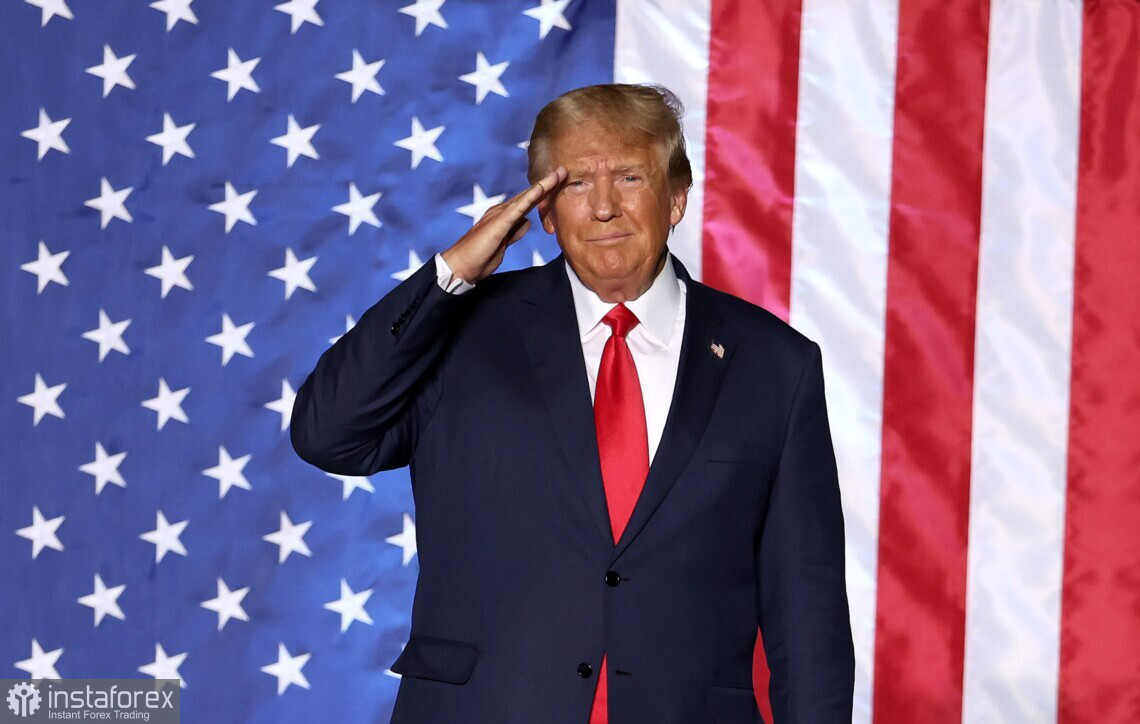
But in all the assumptions and conclusions made in the previous two reviews, there is one big "BUT." And that "BUT" is Donald Trump. Despite three consecutive rounds of interest rate cuts, the rate is still far from Trump's dream. Currently, the Federal Reserve's interest rate stands at 3.75%, while the occupant of the White House dreams of 2% or slightly higher. Or slightly lower... Therefore, we can also draw another highly probable conclusion: Trump will not back off from the Fed in 2026.
However, starting in May, the pressure on the "stubborn hawks" will come from two directions. On one side will be Trump attacking, and on the other, the new Fed president, likely to be Trump's current advisor, Kevin Hassett. I do not want to speculate on what methods will be used to apply pressure, as we have all seen Trump's tactics during late summer and early autumn. He would have long since fired any governors who do not want to vote for a rate cut, given his will. So there are exactly two options left: either continue to fire Fed officials through social media and then argue in court whether such firings were lawful, or try to negotiate with a few governors to change their views and "start thinking in a state-scale dimension."
I don't even want to think about how Trump might "interest" members of the FOMC. But we all understand that there are a multitude of methods: from corruption to searching for "skeletons in the closets" of each negligent official. However, the fact that the Fed is currently "planning" one round of easing in 2026 is only a "plan" for the period while Jerome Powell remains president.
The conclusion from all three reviews is that the U.S. dollar will gain no advantage from the Fed taking a pause at the start of 2026. If, after May 2026, the rate resumes its decline, it is evident that this will be another reason for the market to sell the American currency. Therefore, at best, the dollar will fall slowly; at worst, it will decline rapidly. Inflation in the coming months will be the best friend of the U.S. currency. The higher the inflation, the better the dollar will perform, as the Fed will not dare to continue easing its monetary policy.
Based on the analysis of EUR/USD, the instrument continues to build an upward section of the trend. In recent months, the market has paused, but Donald Trump's policies and the Fed's remain significant factors in the U.S. dollar's future decline. The targets for the current trend segment could extend to the 25th figure. The last upward segment of the trend is beginning to develop, and I hope we are witnessing the formation of an impulsive wave structure within a larger wave 5. Therefore, growth can be expected up to the 25th figure mentioned above.
The wave structure of the GBP/USD instrument has changed. We continue to deal with an upward, impulsive segment of the trend, but its internal wave structure has become complex. The downward corrective structure a-b-c-d-e in C in 4 appears quite complete. If this is indeed the case, I expect the main trend segment to resume its formation with initial targets around the 38 and 40 figures.
In the short term, I anticipated the development of wave 3 or c, with targets around 1.3280 and 1.3360, corresponding to the 76.4% and 61.8% Fibonacci retracement levels. These targets have been reached. Wave 3 or c may continue its formation, and the current collection of waves is beginning to take on an impulsive appearance. Therefore, a continuation of price increases can be expected.


