
See also


 20.01.2026 06:23 PM
The EUR/USD pair reversed in favor of the European currency and began a growth process that, over two days, has retraced most of the decline seen over the past three weeks. Under the current conditions, it can be said that the market is fleeing from a troubled dollar, but this situation is not new. Ever since Donald Trump became U.S. president, the market has largely been shedding the American currency. Trump's new trade tariffs are not just new tariffs—they effectively constitute a violation of the trade deal concluded in 2025. This was openly stated by Ursula von der Leyen, who oversaw that agreement. She noted that a deal means shaking hands and adhering to the agreed terms. Perhaps the agreement between the U.S. and the EU does not explicitly prohibit the introduction of new tariffs, but it is obvious to any reasonable person that, in this case, Trump could impose new tariffs every quarter, each time demanding concessions from the EU—territorial, financial, or trade-related. What would be the point, then, of holding further negotiations and signing new agreements?
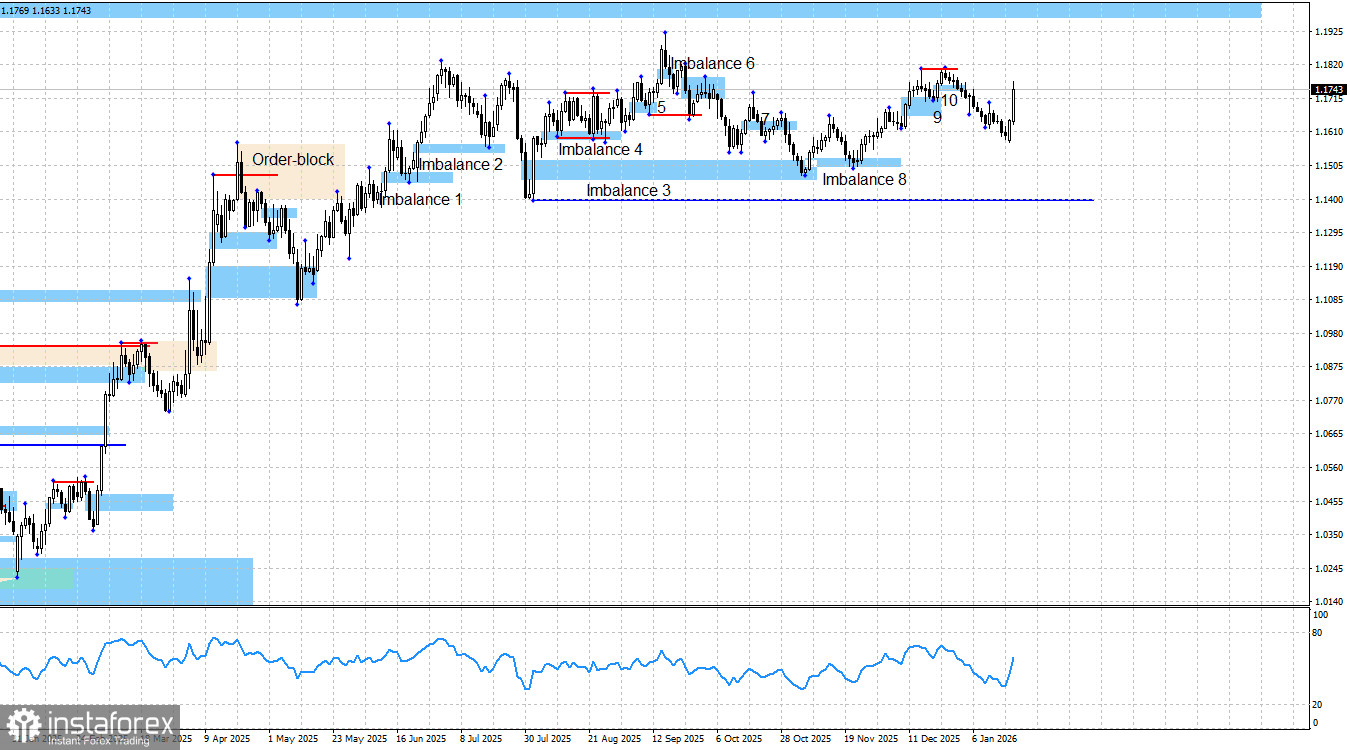
At present, traders have two possible trading approaches. Since the bullish trend remains intact despite a local loss of initiative by the bulls, one can wait for the formation of new bullish patterns or at least liquidity grabs from clearly defined bearish swings. The second option is to trade short from bearish patterns, which are currently absent but may appear in the future. However, any decline in the pair under current circumstances would likely be only a corrective pullback, which should be kept in mind when opening short positions.
The chart picture continues to signal bullish dominance, but in the long term. The bullish trend remains in place. A new bullish signal may form in the near future, as the European currency has been rising rapidly over the past two days. As a result, bullish imbalances will be formed, from which buy trades can later be opened.
The news background this week can be divided into two parts: economic and political. The economic side was of no value to traders, as the final inflation reading turned out to be even lower than the preliminary one—1.9% year-on-year—and the remaining reports were insignificant. The lower the inflation, the higher the chances of further ECB monetary easing, which is negative for the euro. However, the euro is rising because the political backdrop (in particular, Donald Trump's new trade tariffs) is more important. Trump introduced new 10% tariffs against a whole list of EU countries and the United Kingdom in response to their refusal to recognize U.S. claims to Greenland. The EU is preparing a package of retaliatory tariffs and countermeasures. Thus, the trade war is not only continuing, but gaining momentum.
Bulls have had plenty of reasons for a new offensive for the past four to five months, and their number keeps growing with each passing day. These include the inevitably dovish outlook for FOMC monetary policy, Donald Trump's overall policies (which have not changed recently), the confrontation between the U.S. and China (where only a temporary truce has been reached), protests by the American public against Trump under the "No kings" banner, weakness in the labor market, bleak prospects for the U.S. economy (recession), and the government shutdown (which lasted a month and a half but was clearly not priced in by traders). Now add to that U.S. military aggression toward certain countries, the criminal prosecution of Powell, and Trump's new trade tariffs. As a result, further growth of the pair, in my view, is entirely justified.
I still do not believe in a bearish trend. The news background remains extremely difficult to interpret in favor of the dollar, which is why I am not attempting to do so. The blue line shows the price level below which the bullish trend could be considered finished. Bears would need to push the price down about 340 pips to reach it, and I consider this task impossible under the current news backdrop and circumstances. The nearest upward target for the European currency remains the bearish imbalance at 1.1976–1.2092 on the weekly chart, which was formed back in June 2021.
News Calendar for the U.S. and the Eurozone:
On January 21, the economic calendar contains only one event. The impact of the news background on market sentiment on Wednesday may be weak.
EUR/USD Forecast and Trading Advice:
In my view, the pair remains in the stage of forming a bullish trend. Despite the fact that the news background remains on the bulls' side, bears have been mounting regular attacks in recent months. Nevertheless, I see no realistic reasons for the start of a bearish trend.
From imbalances 1, 2, 4, 5, 3, 8, and 9, traders had opportunities to buy the euro. In all cases, some growth was observed, but the bullish trend was not extended. New buy trades are acceptable if a new bullish signal is formed. However, at the moment, there are no workable bearish or bullish patterns.


