
See also


 27.01.2026 08:56 AM
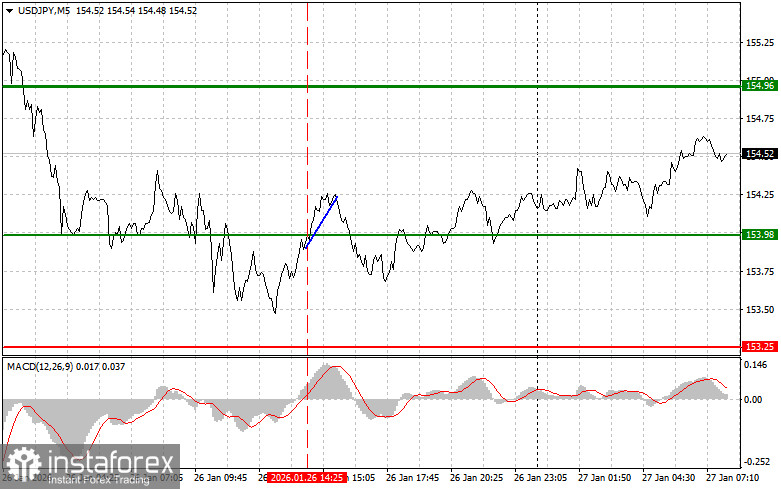
The price test at 153.98 coincided with the MACD indicator just starting to move upward from the zero mark, confirming a good entry point to buy dollars. As a result, the pair rose by 25 pips.
Discussion about the possibility that the US may help Japan support the yen has weighed on the USD/JPY pair, which remained under pressure for most of the day yesterday. The prospect of US intervention or coordinated actions with the Bank of Japan is seen as a potential tool for stabilizing the yen. However, given the current economic situation in the US, with its own inflation and the need to contain economic growth, participation in supporting the yen may prove a complicated decision. It is important to understand that for now, these are just discussions, as any intervention must be carefully weighed against its potential impact on the American economy and monetary policy. The situation surrounding the yen and the possibility of US support appears to be a complex balance of economic and political factors. The market will react keenly to any signals from American and Japanese authorities. Uncertainty about future actions by both the Bank of Japan and the Federal Reserve will continue to influence the yen and US dollar exchange rates.
For the intraday strategy, I will primarily rely on implementing scenarios #1 and #2.
Scenario #1: I plan to buy USD/JPY today at the entry point around 154.68 (the green line on the chart), with a target at 154.96 (the thicker green line on the chart). At 155.56, I plan to exit my long positions and open shorts immediately in the opposite direction (anticipating a move of 30-35 pips from that level). It is best to resume buying the pair on corrections and significant pullbacks in USD/JPY. Important! Before buying, ensure that the MACD indicator is above the zero mark and just starting its ascent from there.
Scenario #2: I also plan to buy USD/JPY today if there are two consecutive tests of the price at 154.35 when the MACD indicator is in oversold territory. This will limit the pair's downside potential and lead to an upward market reversal. A rise can be expected toward opposing levels of 154.68 and 155.56.
Scenario #1: I plan to sell USD/JPY today only after updating the 154.35 level (the red line on the chart), which will trigger a rapid decline in the pair. The key target for sellers will be the 153.57 level, where I intend to exit my shorts and buy immediately in the opposite direction (anticipating a move of 20-25 pips from the level). It is better to sell as high as possible. Important! Before selling, ensure that the MACD indicator is below the zero mark and just starting its descent from there.
Scenario #2: I also plan to sell USD/JPY today if there are two consecutive tests of 154.68 when the MACD indicator is in overbought territory. This will limit the pair's upward potential and lead to a market reversal downward. A decline can be expected toward opposite levels of 154.35 and 153.57.
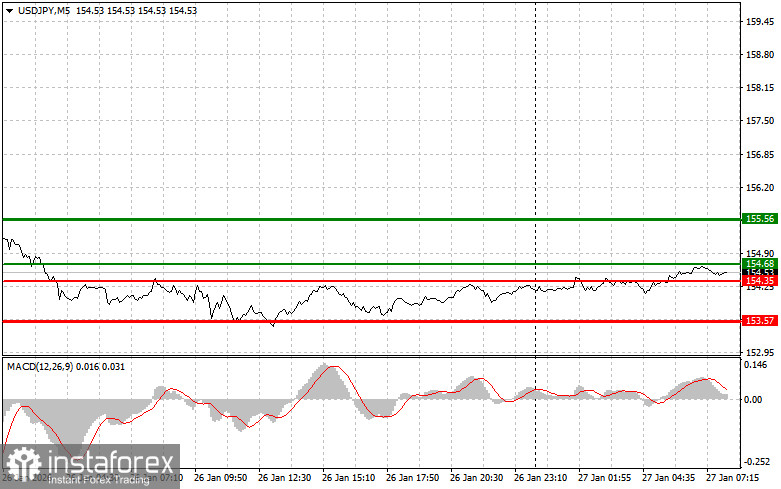
The thin green line represents the entry price at which one can buy the trading instrument;
The thick green line represents the approximate price where one can set Take Profit or secure profits, as further growth above this level is unlikely;
The thin red line represents the entry price at which one can sell the trading instrument;
The thick red line represents the approximate price where one can set Take Profit or secure profits, as further decline below this level is unlikely;
The MACD indicator: when entering the market, it is important to consider overbought and oversold zones.
Important: Beginner traders in the Forex market should be very careful when making entry decisions. It is best to stay out of the market before important fundamental reports are released to avoid getting caught in sharp price fluctuations. If you decide to trade during news releases, always set stop orders to minimize losses. Without setting stop orders, you can quickly lose your entire deposit, especially if you do not use money management and trade large volumes.
And remember, for successful trading, it is essential to have a clear trading plan, like the one presented above. Making spontaneous trading decisions based on the current market situation is inherently a losing strategy for an intraday trader.


