
See also


 31.03.2026 10:18 AM
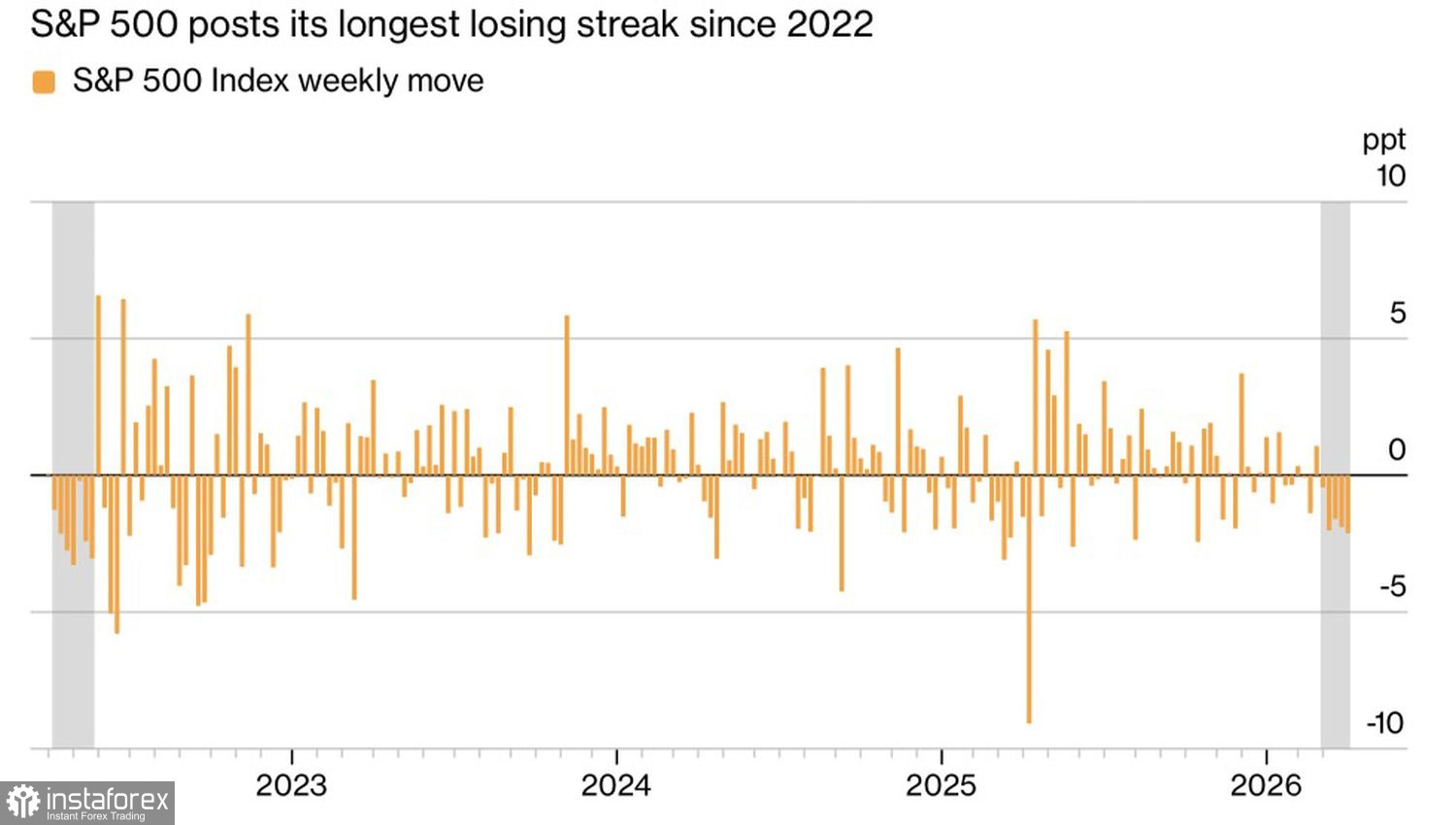
US stock indices have been falling for the fifth consecutive week, with most now in correction territory. 10 of the 11 S&P 500 sectors are set to close the whole month of March in the red, down an average of 8.3%. Only energy companies will finish in the black amid the Middle East conflict. As the risk of a prolonged confrontation grows, fear is increasingly enveloping the stock market.
Monthly dynamics of S&P 500
Investors have abandoned illusions and are expecting higher oil prices and the Federal Reserve to keep the federal funds rate at 3.75% for an extended period. That mix of factors raises recession risk for the US economy — clearly bad news for the benchmark stock indices.
Over the past 13 trading sessions, the S&P 500 has moved opposite Brent 12 times. The strong inverse correlation helps identify the market's main driver. JP Morgan argues that if a protracted conflict means the world can no longer rely on oil from the Persian Gulf, a recession is almost certain.
That said, the bank believes the current situation differs from 2022, when inflation surged to four-decade highs. Today, CPI rates are higher, wage acceleration is absent, and AI is acting as a moderating force on prices. The odds of an economic downturn are higher than those of full stagflation.
Tech stocks' dynamics
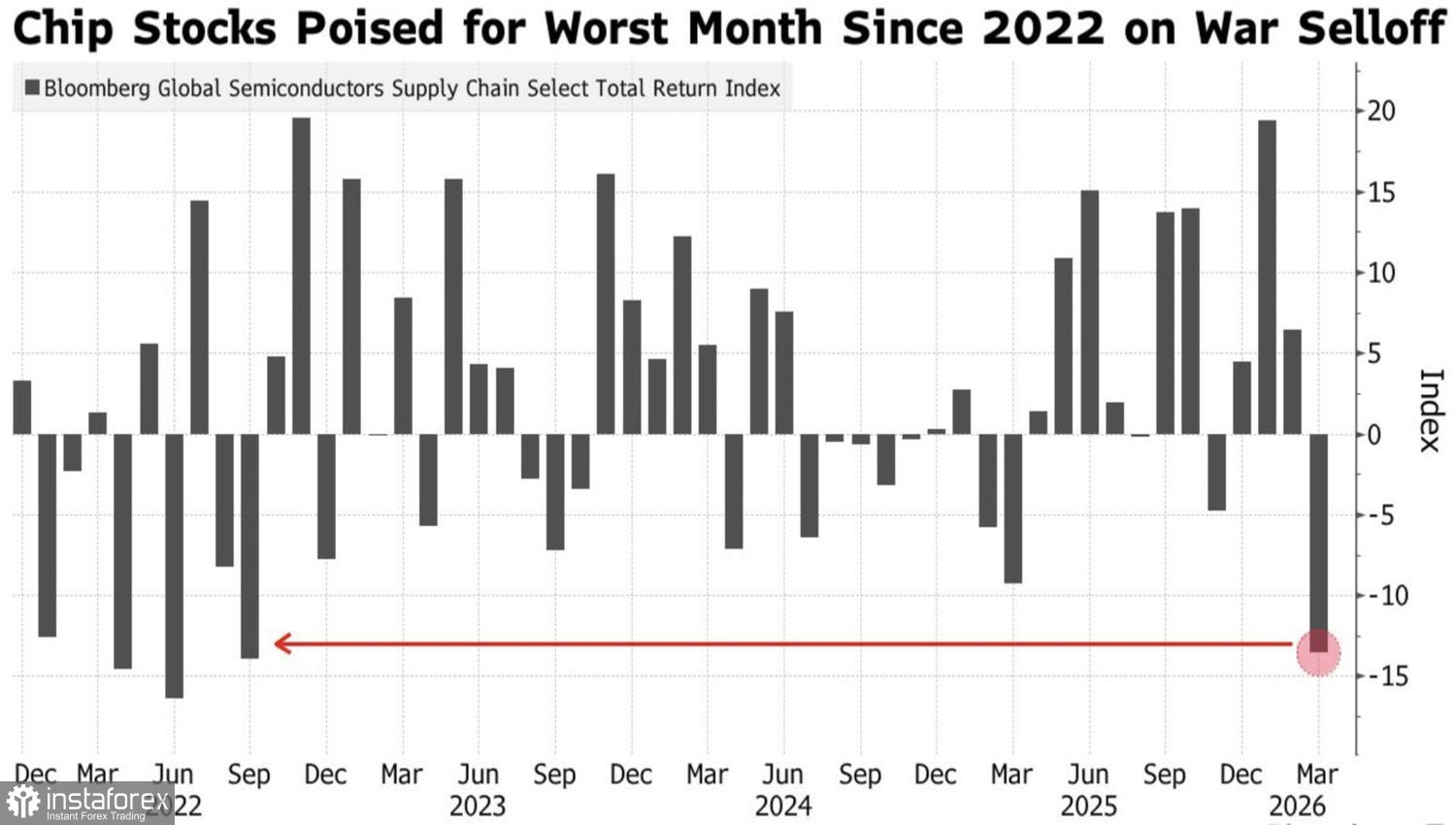
AI was previously seen as a cushion against a tech sell-off — a reason to view Big Tech as a kind of safe haven in the US stock market. In fact, this has not held up. The tech index posted its worst performance since September 2022 in March. High Treasury yields, rising electricity costs and supply disruptions of critical chip inputs like helium have knocked the sector out.
Hedge funds have effectively capitulated as well. Goldman Sachs' analysis shows they cut their stock positions for six straight weeks. On the one hand, that signals that bears are in control. On the other hand, it can set the stage for a rebound if the worst investor fears do not materialize. Morgan Stanley believes the S&P 500 correction is approaching its final stage, pointing to prior episodes where recession fears and Fed-rate hikes didn't come true.
But the real fate of the S&P 500 depends on the Middle East. The White House is oscillating between extremes — to launch a ground operation or to withdraw from Iran, even with the Strait of Hormuz remaining closed.
Technical view
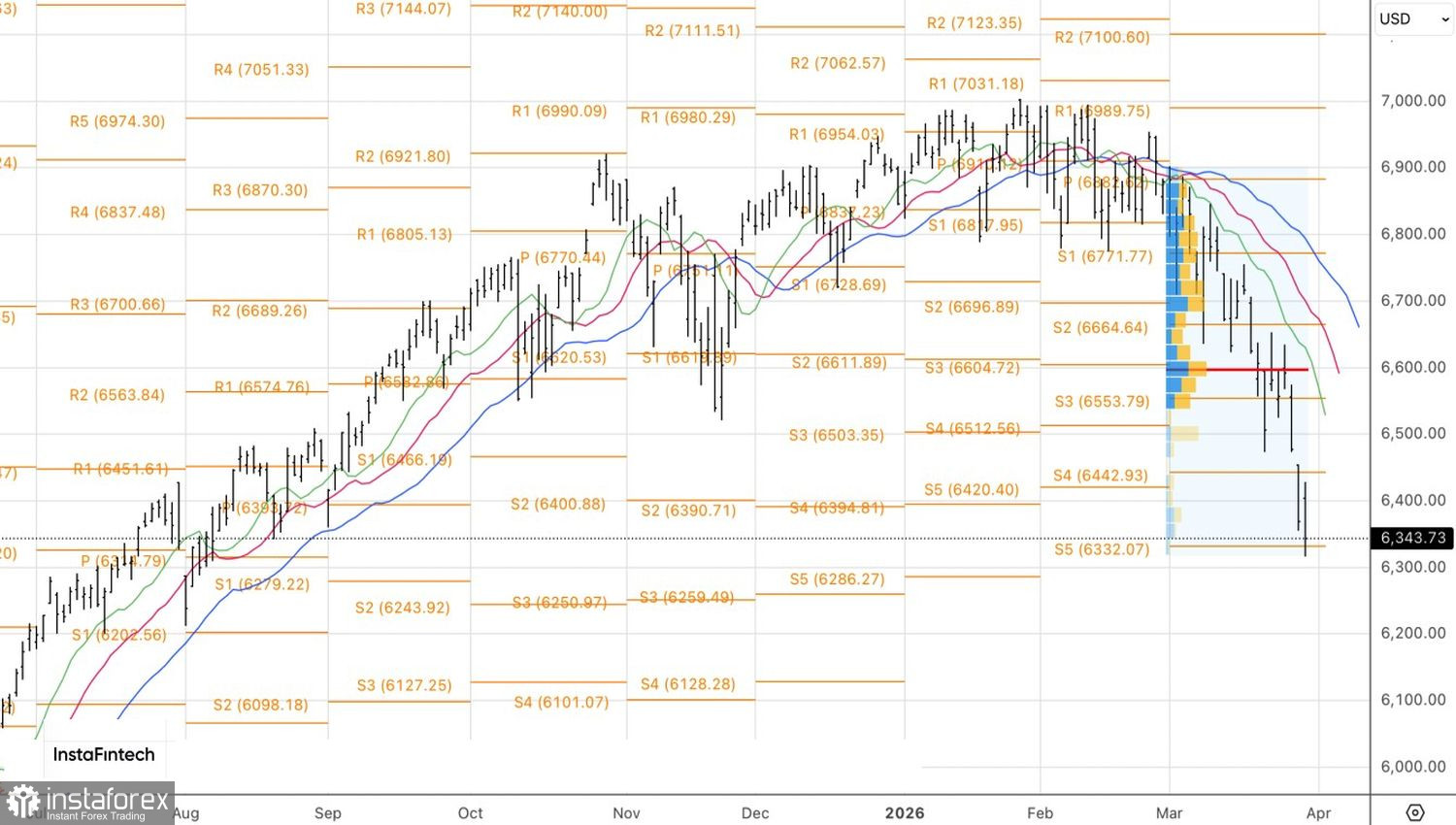
On the daily chart, the broad market index is going on with a corrective move within the longer uptrend. Short positions initiated earlier with targets at 6,100 and 6,000 make sense to hold. Key resistance levels are the pivot points at 6,440 and 6,510. A rejection from those levels could be used to add to short positions on the S&P 500.


