
See also


 29.05.2026 09:15 AM
Oil is falling again, reacting to the situation, with May threatening to become the worst month for Brent since 2020—a decline of 19% for the month. Brent is trading around $92 per barrel, while WTI has dropped to $87 per barrel. This is how traders are responding to a preliminary agreement between the US and Iran on extending the ceasefire for 60 days and the possible reopening of the Strait of Hormuz.

However, it is important to understand how fragile this arrangement remains. Trump has reportedly not yet agreed to the terms of the agreement. Vice President Vance stated to reporters that "it's too early to say when or if an agreement will actually be reached." Treasury Secretary Bessen replied to a direct question that "teams are negotiating"—and immediately reminded everyone of Trump's red lines: reopening the Strait and the transfer of highly enriched uranium. Key disagreements over the nuclear program, sanctions, and control over the Strait remain unresolved.
Even if an agreement on extending the ceasefire is reached, the physical restoration of supplies is a separate story that the market currently underestimates. For starters, mines in the Strait of Hormuz need to be cleared. Resuming operations at halted fields will take several months. Damage to energy infrastructure from drone and missile strikes requires restoration. Finally, tankers will take weeks to reach importing countries. TD Securities strategist Ryan McKay warns that during the recovery period, the market could lose another approximately 1 billion barrels of supply.
Meanwhile, the domestic deficit in the US is growing at an alarming rate. Distillate stocks have fallen to a level not seen in more than two decades. Inventories at the key hub in Cushing have decreased for the fifth consecutive week to 23 million barrels—dangerously close to the 20 million mark, below which the physical operation of pipeline infrastructure becomes difficult. These are not abstract figures; they represent a real operating limit that could manifest earlier than policymakers expect.
Aaron Stein, president of the Foreign Policy Research Institute, accurately describes the situation: the parties are slowly and painfully moving towards what is being presented as an agreement. The main difference from all previous attempts is the existence of at least a consensus regarding the need for mutual easing of both blockades. This is no small thing—but it is far from enough for a sustainable decrease in oil prices.
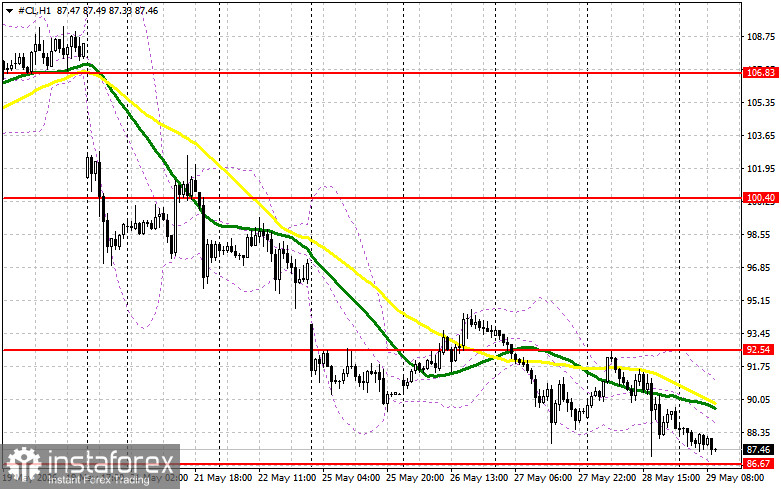
In any case, positive news from the Middle East will exert pressure on oil prices.
As for the current technical picture of oil, buyers need to overcome the nearest resistance at $92.50. This will allow targeting $100.40, above which it will be quite problematic to break through. The most distant target will be around $106.80. In the event of an oil decline, bears will attempt to take control of $86.50. If they succeed, breaking through the range will deal a serious blow to the bulls' positions and drive Oil down to a low of $81.40, with the prospect of reaching $74.85.


