
See also


 01.06.2026 11:39 AM
While Bitcoin continues to lose ground, the discussion around the CLARITY Act has shifted from a narrow regulatory conversation into a decision about whether the United States will lead the next financial system or merely watch it be built elsewhere, Senator Cynthia Lummis put it bluntly.
That framing moves the debate from whether to regulate to a question of geopolitical competition: as Congress hesitates, other jurisdictions—from the European Union with its MiCA framework to Georgia, which is launching a sovereign stablecoin in partnership with Tether—are writing their own rules and attracting capital that might otherwise flow to the United States.

Pressure on Congress is mounting from multiple directions. Last week, Treasury Secretary Scott Bessent repeatedly and publicly urged prompt passage of the bill, directly appealing to both chambers to finalize CLARITY. Securities and Exchange Commission chair Paul Atkins has been optimistic as well and believes the law will be adopted in the foreseeable future. President Trump has pledged to create a regulatory architecture resilient to future shocks and to opposition from crypto critics. There is a clear consensus within the executive branch: key officials are pulling in the same direction.
A gap, however, still yawns between political will and legislative reality. Congress's schedule is congested: budget negotiations, FISA reform, and a housing bill all compete with the CLARITY Act for scarce time during the eight working weeks remaining before the August recess.
It is evident that the market now awaits fresh signals, and every week of delay translates into continued outflows from Bitcoin ETFs, sustained institutional caution, and lost capital migrating to jurisdictions where the rules are already written.
Trading recommendations:
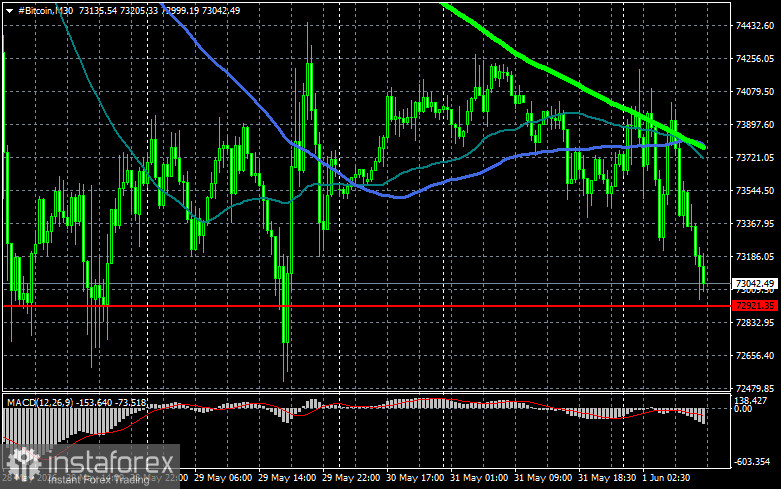
Buyers of BTC are currently targeting a return to $74,700, a level that would open a direct path to $76,500 and then toward $78,300; a breach above $78,300 would indicate attempts to restore a bull market. On the downside, buyers are expected at $72,900; a drop below that area could quickly push Bitcoin toward $71,400, with a more distant target near $69,800.
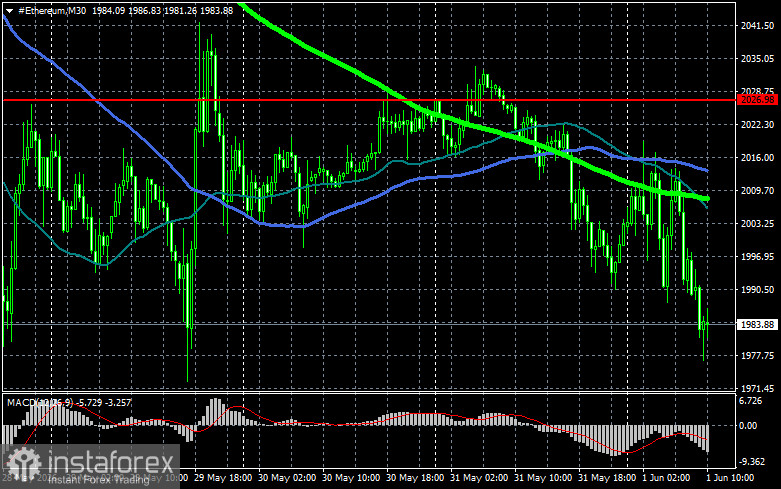
As for Ethereum, a clear hold above $2,026 would open a direct route to $2,084. The farther target is the high near $2,128. A break above that level would signal strengthening bullish sentiment and renewed buyer interest. On the downside, buyers are expected at $1,969; a fall below that point could rapidly send Ethereum toward $1,911, with a deeper target at $1,845.
What we see on the chart:
- Red lines indicate support and resistance levels where either a price slowdown or active growth is expected;
- Green lines indicate the 50-day moving average;
- Blue lines indicate the 100-day moving average;
- Light green lines indicate the 200-day moving average.
A crossover, or a price test of moving averages, typically either halts the move or sparks fresh market momentum.


