
See also


 07.09.2026 08:42 AM
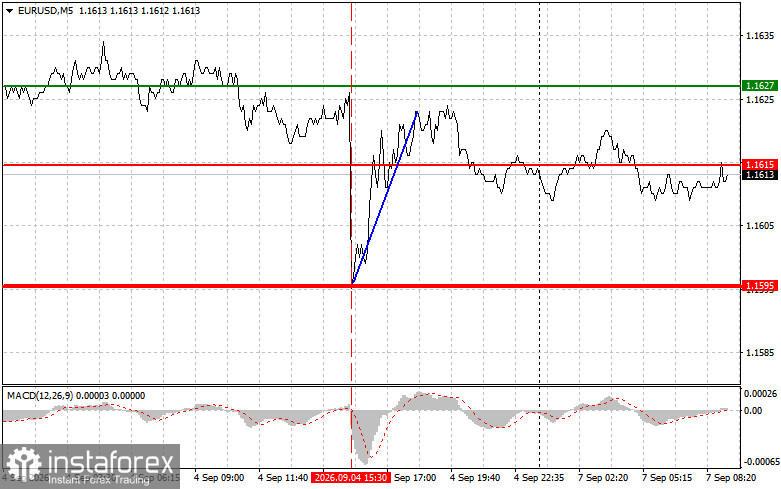
The price test at 1.1615 occurred as the MACD indicator began to move down from the zero line, confirming the correct entry point to sell the euro. As a result, the pair plunged to around 1.1595. Long positions from there on the rebound allowed taking another roughly 20 pips of profit from the market.
The August US employment report surprised the market and supported the dollar. Nonfarm payrolls rose by 162,000 versus the expected 55,000. Still, the revisions were even more important: July was revised from negative to positive, and the whole narrative about a weakening labor market collapsed before our eyes. The July miss had been the basis for the pause discussion, and now that argument is gone. The single currency lost ground as a result, because a strong labor market frees the Federal Reserve's hands. I believe the report was a cold shower for doves like Waller and Williams, who had adopted a soft stance on weak employment data. But in my view, EUR/USD will remain under pressure until the inflation report on September 11, and only a weak CPI can return initiative to the euro.
Today, the single currency enters the day focused on a block of European data: in addition to German industrial production and the Sentix investor confidence indicator, revised eurozone Q2 GDP and employment figures will be released. GDP and employment are key here because they confirm or refute economic resilience and, in turn, influence the European Central Bank's stance. I regard industrial production and Sentix as more secondary indicators that complement the overall picture.
The outlook for the euro, in my view, is cautious. If the revised figures match forecasts and deliver no surprise, pressure on EUR/USD can return, especially since the dollar strengthened after the unexpectedly strong NFP. Only a notable positive surprise can seriously support the single currency now, while a neutral result will leave the initiative with the US currency. Until the releases, I expect restrained euro dynamics.
As for the intraday strategy, I will rely mainly on executing Scenarios No. 1 and No. 2.
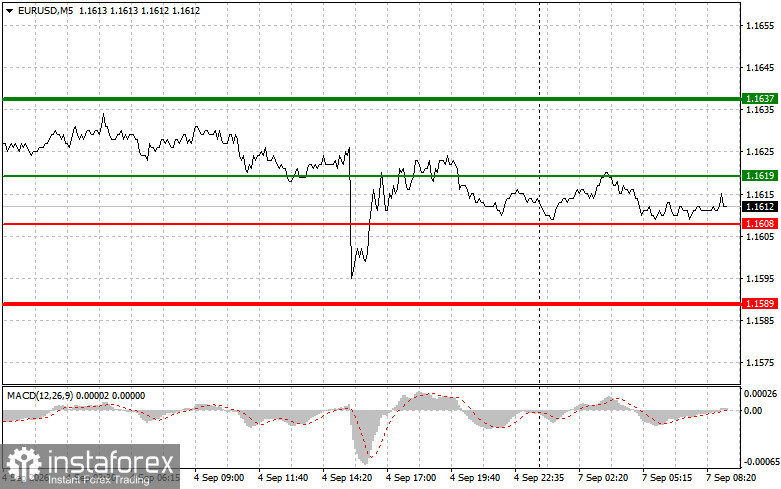
Scenario No. 1: Today the euro can be bought if the price reaches around 1.1619 (the green line on the chart), with a target to rise to 1.1637. At 1.1637, I plan to exit the market and sell the euro in the opposite direction, expecting a 30–35-pip move from the entry point. Expect euro strength only after very strong data. Important! Before buying, make sure the MACD indicator is above the zero line and is just beginning to rise from it.
Scenario No. 2: I also plan to buy the euro today in the event of two consecutive tests of 1.1608, with the MACD indicator in an oversold area. This will limit the pair's downside potential and lead to an upward reversal. One can expect a rise toward the opposite levels of 1.1619 and 1.1637.
Scenario No. 1: I plan to sell the euro after the level 1.1608 (the red line on the chart) is reached. The target will be 1.1589, where I plan to exit the market and buy immediately in the opposite direction (expecting a 20–25 pip move in the opposite direction from that level). Pressure on the pair will return today with weak data. Important! Before selling, make sure the MACD indicator is below the zero line and is just beginning to decline from it.
Scenario No. 2: I also plan to sell the euro today if there are two consecutive tests of 1.1619 while the MACD indicator is in an overbought area. This will limit the pair's upside potential and lead to a downward reversal. One can expect a decline toward the opposite levels of 1.1608 and 1.1589.
Important: Beginner traders in the Forex market need to be very cautious when making entry decisions. It is best to stay out of the market ahead of significant fundamental reports to avoid being caught in sharp price fluctuations. If you decide to trade during news releases, always set stop orders to minimize losses. Without stop orders, you can quickly lose your entire deposit, especially if you do not employ money management practices and trade large volumes.
Also, remember that successful trading requires a clear trading plan, similar to the one provided above. Making spontaneous trading decisions based on current market conditions is inherently a losing strategy for intraday traders.


