
See also


 22.10.2026 07:10 PM
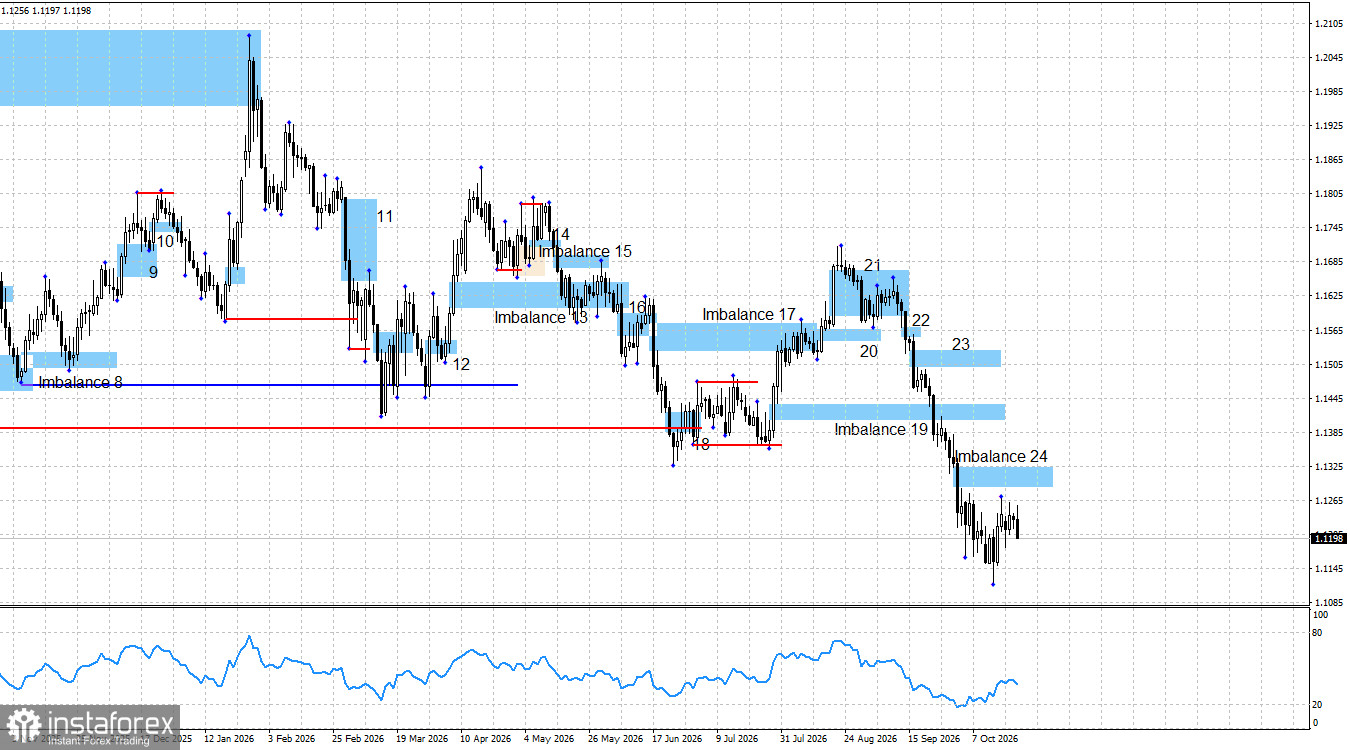
The EUR/USD pair showed some upward movement on only three days last week, then remained largely flat for several days before declining again today. At this point, it is too early to say that the bearish advance has resumed, as the pair's price may recover before the end of the day. However, after the latest bearish impulse ended, the bulls failed to produce even a corrective pullback. Imbalance 24 is clearly visible on the chart, and a move to this pattern would be logical even if the bears have no intention of launching another advance. Nevertheless, the bulls have been unable to push the euro up to this pattern.
Overall, the reasons for another decline in the euro are not difficult to find. They can simply be selected from a list: the crisis in France, unrest and strikes in many European countries, FOMC monetary policy tightening, rising geopolitical tensions, and so on. The last factor deserves a closer look. This week, reports emerged that the war in Iran could resume immediately after the US midterm elections, and Donald Trump has already begun developing plans for new strikes in coordination with Israel. It is therefore possible that the market is preparing for another war and seeking to distance itself from the European Union, which is currently engulfed in turmoil, as well as from its currency.
Over the past two weeks, no FOMC member has spoken in favor of monetary policy tightening in October. Therefore, the Federal Reserve will almost certainly decide to leave interest rates unchanged next week. In that case, the dollar's gains are not being driven by Fed monetary policy.
At this point, it is also too early to say that the euro's decline has been halted and reversed. Imbalance 24 remains valid, and the price may react to it, generating a new sell signal. The bears have advanced too far, and stopping them will now be difficult. Although the market spent more than a month largely ignoring the fundamental factors supporting the euro, this does not mean the euro will now rise continuously. First, Imbalance 24 must be invalidated, and the bulls must form their own bullish patterns. This would require a sharp upward move in the euro, but the bulls continue to demonstrate weakness and a lack of momentum.
In September, the FOMC not only raised interest rates but also signaled its willingness to continue tightening policy. This was enough to trigger a large-scale bearish advance. However, even after the Fed's September tightening and the possibility of further tightening in December, I do not believe that the euro has received any positive news during this period. The market is simply ignoring most of it.
Overall, in my view, the fundamental backdrop continues to favor the bulls. Despite the Fed's more hawkish monetary policy stance, this is not the only factor determining exchange rates. The European Union also faces problems, but that is precisely the point: problems exist everywhere, yet only the euro is falling. Both central banks are tightening monetary policy, but only the dollar is rising. Nevertheless, I do not recommend expecting the euro to rise before bullish signals emerge. Buying the euro in advance is not advisable either.
The current technical picture indicates that the bearish impulse remains intact, with no clear signs of a reversal. The only relevant pattern at present is Imbalance 24, which may be revisited soon, as a corrective pullback has finally begun. The bulls' only current opportunity lies in a liquidity sweep below the 1.1066 low. However, opening long positions requires more than just a liquidity sweep.
There was no significant economic news on Thursday, which explains the low level of trading activity. The US dollar has begun rising again, but for now, the hope is that this will not turn into another bearish advance without a clear fundamental catalyst.
The bulls still have numerous reasons to attack in 2026. Structurally and fundamentally, Trump's policies, which led to a significant decline in the dollar last year, have not changed. At present, I see no substantial factors supporting the US currency, despite the FOMC's hawkish stance. Geopolitical risks and the tense situation in Europe are currently weighing on the euro.
On October 23, the economic calendar contains six releases, but traders are currently managing perfectly well without economic data. The influence of economic releases on market sentiment may be limited on Friday.
In my view, the pair remains in the process of forming a bullish trend that has been undergoing a corrective pause for an entire year. The fundamental backdrop shifted sharply in favor of the bears eight months ago, but the trend itself, which has lasted four years, cannot be considered invalidated or complete.
The bulls may resume their advance before the end of the year, but their only realistic opportunity at present is the 1.1066 low established in June last year. The bears received a new sell signal at Imbalance 19. At this point, existing short positions should be kept open. A new sell signal may form at Imbalance 24. Since a further corrective pullback remains possible, it would be prudent to take partial profits on short positions.


