
See also


 16.11.2026 08:12 PM
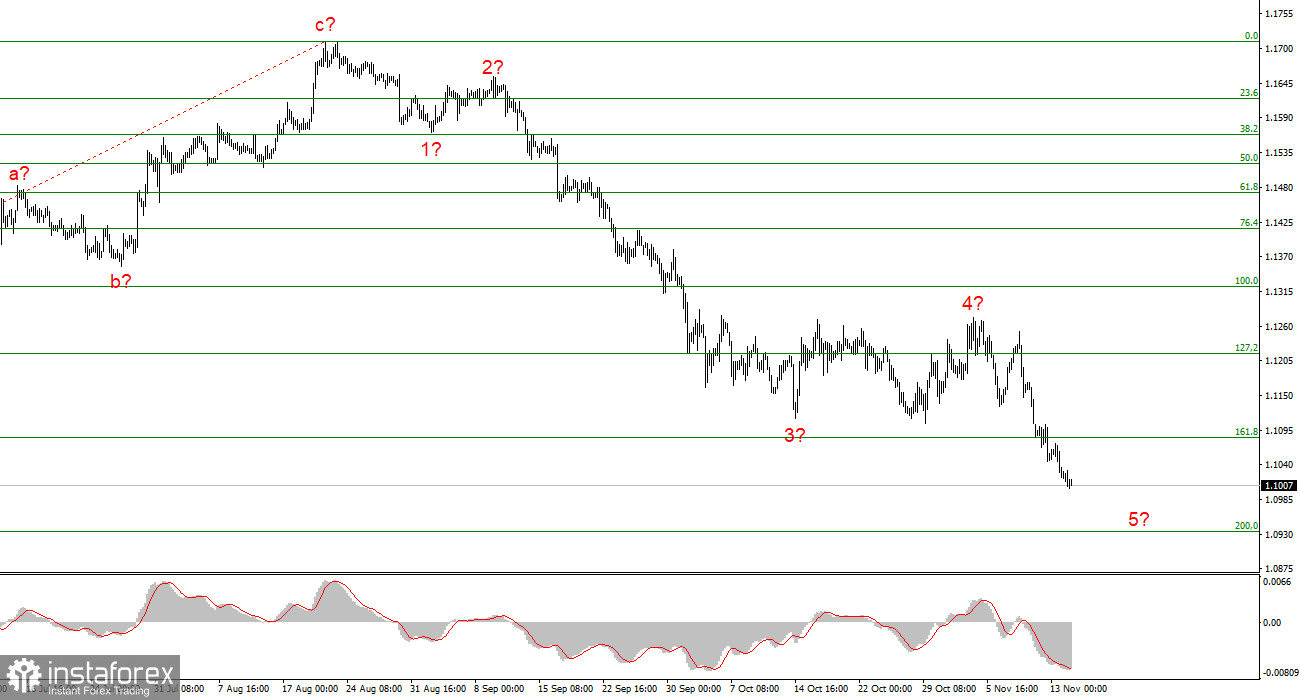
The wave count on the 4-hour chart for EUR/USD has become more complex. On the higher timeframe (lower chart), the downward trend segment has taken the form of a five-wave structure, A-B-C-D-E, which could be completed at any moment, as it appears to be fully developed. All the waves within this segment are approximately equal in size, so it is considered corrective. If this assumption is correct, an impulsive upward trend segment will begin forming once the correction is complete, with targets well above the 20th level.
On the lower timeframe (upper chart), an impulsive wave sequence continues to develop, which may belong to wave E of the higher timeframe. If this is indeed the case, then regardless of how strongly the dollar rises, its appreciation is nearing an end. The presumed wave 5 of E is approaching completion. In any case, the current wave structure suggests that the downward wave sequence is nearing completion on both charts. The news flow and the sharp shift in market sentiment have led to a substantial appreciation of the US dollar, but there are few remaining reasons for further dollar strength.
Monday promises to be interesting.
The EUR/USD exchange rate declined by another 20 basis points on Monday, which was fully consistent with the news flow throughout the day. More specifically, there was only one economic report today: industrial production in the European Union. It showed that production fell by 1.5% year-on-year and increased by 0.2% month-on-month. The market had expected a 0.2% year-on-year decline and a 0.3% month-on-month increase. Clearly, this report had little chance of supporting demand for the European currency, which was already extremely weak.
Over the past week and a half, the euro has faced a series of negative developments. It all began on Friday of the week before last, when strong payrolls and unemployment reports triggered a sharp increase in demand for the US dollar. This was followed by a strong US inflation report and a relatively strong PPI reading. At the same time, several FOMC members suggested that a more hawkish policy scenario could unfold in December and early next year. For example, they raised the possibility of a 50-basis-point rate hike in December, followed by additional tightening early next year.
It should be noted that only two of the twelve FOMC governors have so far expressed support for a more hawkish scenario, while the latest inflation report did not provide a year-on-year figure. Therefore, the expectation is that the Fed will decide to raise interest rates by 25 basis points on December 7–8, a move that has long been priced in by the market. However, the market appears to have shifted its focus to next year and is once again anticipating the most hawkish possible actions from the US central bank. The ECB's monetary policy continues to have little influence on the market, although the ECB is also taking action, and its policy stance is no different from that of the Fed.
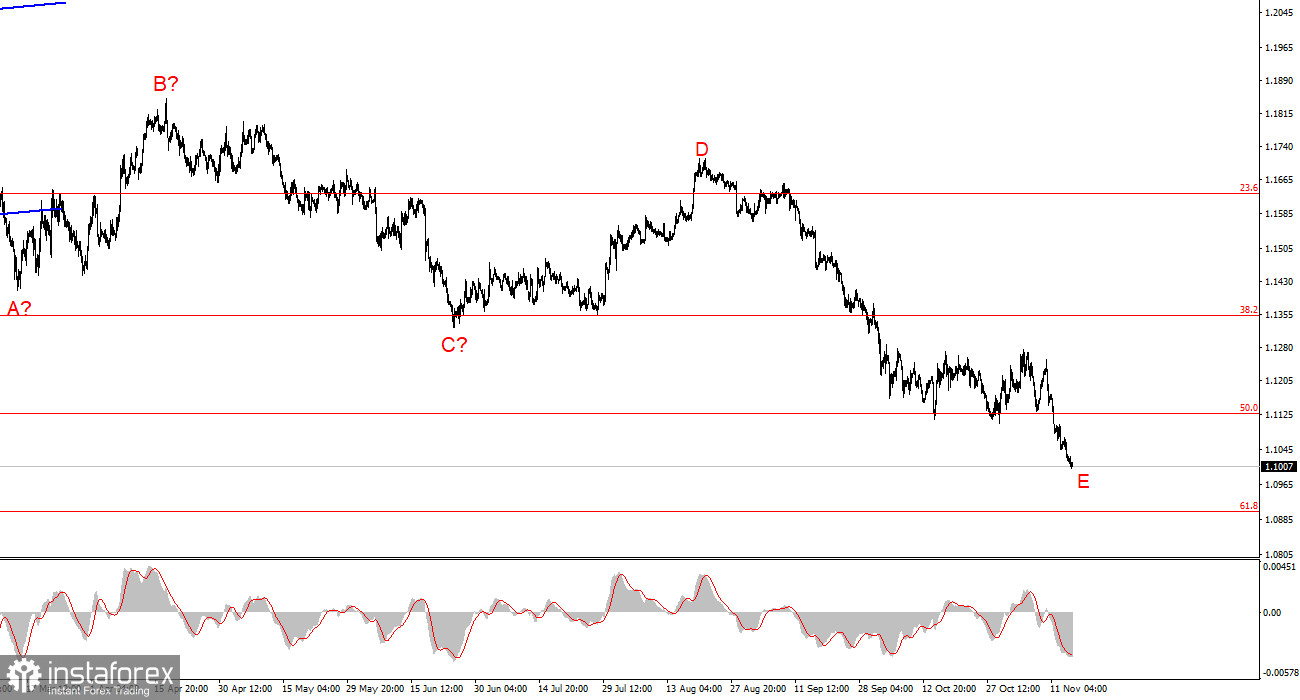
Based on the EUR/USD analysis, the pair remains within the global corrective trend segment A-B-C-D-E. However, this structure appears to be fully developed and could be completed at any moment. At this stage, conditions appear favorable not only for buying the European currency but also for anticipating the development of a full-fledged upward trend segment. According to the higher timeframe, the pair is expected to rise by at least to the 17th–18th levels. The stronger the pair declines now, the stronger its subsequent recovery may be. However, confirmation is needed that the downward wave sequence has been completed. One possible signal would be an unsuccessful attempt to break below the 1.0902 level, which corresponds to the 61.8% Fibonacci retracement level on the higher timeframe.
The higher timeframe shows a downward trend segment that has taken the form of an A-B-C-D-E structure. The internal wave structure of wave E has developed into a five-wave impulsive pattern, but this pattern may already be complete. If this assumption is correct, a new upward trend segment will begin forming in the near future.
1. Wave structures should be simple and easy to understand. Complex structures are difficult to trade and often involve changes in the market outlook.
2. If there is no clear understanding of current market conditions, it is better to stay out of the market.
3. There can never be absolute certainty about the direction of price movement. Do not forget to use protective Stop Loss orders.
4. Wave analysis can be combined with other types of analysis and trading strategies.


