
See also


 19.11.2026 08:56 AM
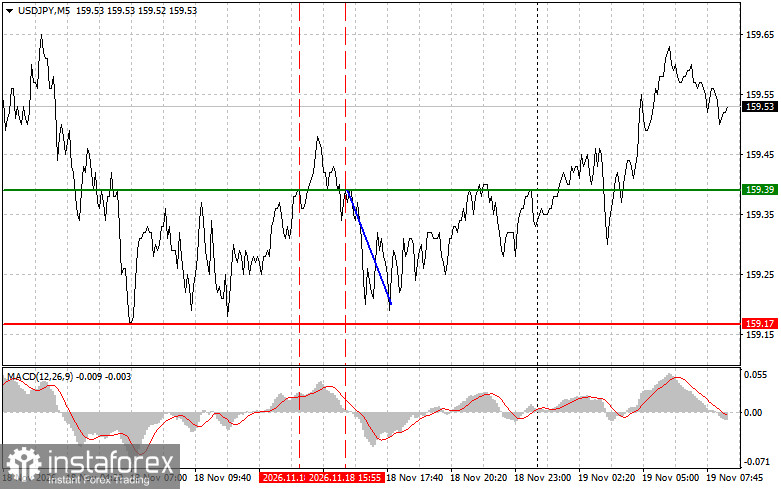
The 159.39 price test occurred after the MACD indicator had already moved significantly above the zero line, limiting the pair's upside potential. A second test of 159.39 triggered a sell entry under Sell Scenario No. 2 and resulted in a 15-pip decline.
The Federal Reserve minutes proved tougher than the vote outcome on October 28. Ten of the twelve voters favored keeping the rate unchanged, two voted for a 25-bp hike, yet almost all participants expect another hike will be needed to return inflation to 2%. Two members allowed for a step larger than 25 bps as early as December if inflation disappoints, and Fed staff expect a return to target only around 2028. U.S. data were mixed. Housing starts came in at 1.309 million versus a 1.250 million forecast, but building permits — which show developers' plans — were 1.295 million versus a 1.380 million forecast, and pending home sales fell 4.7% versus an expected -2.0%. A weak housing sector amid expensive mortgages did not prevent the dollar from holding its ground because the market focuses primarily on the rate trajectory.
Today's Japanese data sent mixed signals to the yen. Machinery orders for September, an indicator of business investment in the coming months, rose 13.4% y/y versus a 13.7% forecast after 18.6%, while they fell 0.3% month on month versus an expected +1.3% after +5.2%. Annual growth remains double-digit, but after a sharp August surge, companies have slowed equipment purchases, slightly weakening the case for an imminent Bank of Japan hike. Japanese investors' foreign bond purchases remained negative at -£440.7 billion versus -£534.1 billion previously — capital continues to return home, providing some support to the yen.
The BOJ keeps the policy rate at 1.25% and is considering a hike at its December 17–18 meeting. Risks the Fed sees in the AI sector could boost demand for the yen as a safe asset if equity markets keep falling. In my view, as long as the Fed looks more determined than the BOJ, USD/JPY retains upside potential and any declines are likely corrective.
For intraday strategy, I will rely mainly on Scenarios No. 1 and No. 2.
Scenario No. 1: Today I plan to buy USD/JPY when the entry point reaches around 159.58 (the green line on the chart), targeting 159.89 (the thicker green line on the chart). Around 159.89, I plan to exit long positions and open short positions in the opposite direction (expecting a 30–35 pip move back from that level). It is best to return to buying the pair on corrections and significant pullbacks. Important: before buying, make sure the MACD indicator is above zero and is just beginning to rise from it.
Scenario No. 2: I also plan to buy USD/JPY today in case of two consecutive tests of 159.44 when the MACD indicator is in the oversold area. This will limit the pair's downside potential and lead to an upward reversal. You can expect a rise to the opposite levels 159.58 and 159.89.
Scenario No. 1: Today I plan to sell USD/JPY only after the 159.44 level is broken (the red line on the chart), which will lead to a rapid decline in the pair. The sellers' key target will be 159.21, where I intend to exit shorts and immediately open longs in the opposite direction (expecting a 20–25 pip move back from that level). Sellers can return at any moment; only the slightest hint from the central bank is needed. Important: before selling, make sure the MACD indicator is below zero and is just beginning to decline from it.
Scenario No. 2: I also plan to sell USD/JPY today in case of two consecutive tests of 159.58 when the MACD indicator is in the overbought area. This will limit the pair's upside potential and lead to a downward reversal. You can expect a decline to the opposite levels of 159.44 and 159.21.
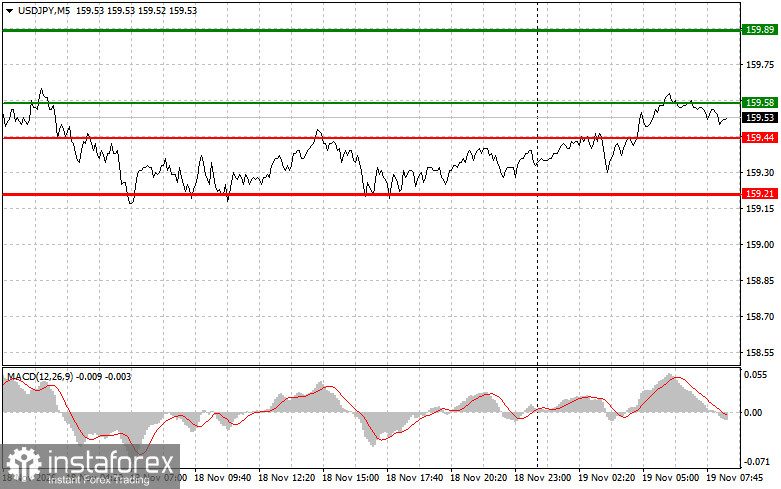
Thin green line – the entry price at which you can buy the trading instrument;
Thick green line – the suggested price where you can place a Take Profit or manually lock in gains, since further upside above this level is unlikely;
Thin red line – the entry price at which you can sell the trading instrument;
Thick red line – the suggested price where you can place a Take Profit or manually lock in gains, since further downside below this level is unlikely;
MACD indicator. When entering the market, it is important to follow the overbought and oversold zones.
Important. Beginner Forex traders must be very cautious when making entry decisions. Before the release of important fundamental reports, it is best to stay out of the market to avoid getting caught in sharp price swings. If you decide to trade during news releases, always place stop orders to minimize losses. Without stop orders, you can quickly lose your entire deposit, especially if you don't use money management and trade large volumes.
Remember, successful trading requires a clear trading plan, like the example I presented above. Spontaneous trading decisions based on the current market situation are a losing strategy for an intraday trader from the start.


