
See also


 20.11.2026 01:28 PM
Ethereum is trading around $1,750, roughly 15% below its November 11 level of about $2,050. Developers added another negative signal to the pressure by delaying the Glamsterdam upgrade from December 2026 to January or February 2027. There is no firm date yet — the decision was made at an executive-level meeting on November 19. It's worth noting this isn't the first delay: the upgrade, the largest since the transition to proof-of-stake, was supposed to increase the mainnet's scalability and make it cheaper for users.

Experts say the reason is a change to the fee mechanism. Glamsterdam is revising gas costs to raise the block gas limit from 60 million to roughly 200 million units, and the Ethereum Foundation estimates this could break up to 15,000 smart contracts out of about 90 million deployed on the network.
A reminder of the timeline: the upgrade was originally planned for June 2026; in mid-August, the target was pushed to Q4; on October 6, it went live on the Sepolia testnet; and the Hoodi testnet launch scheduled for October 26 was canceled four days before the date. Developers prefer postponement because a bug on the mainnet — where billions of dollars sit in DeFi — would be far more costly than a few months' delay.
For the market, the bigger issue is demand. Ethereum has already fallen about 38% year-to-date as of November 15; roughly $398.9 million flowed out of spot ETH ETFs in the week of November 9–13. Against this backdrop, the upgrade was one of the few native catalysts that could have revived network interest. Now it's pushed back by at least two months. Support comes only from BitMine, whose holdings have reached 6,077,745 ETH, about 4.97% of the supply, but those purchases don't offset pressure from rising real yields and a strong dollar.
Bitcoin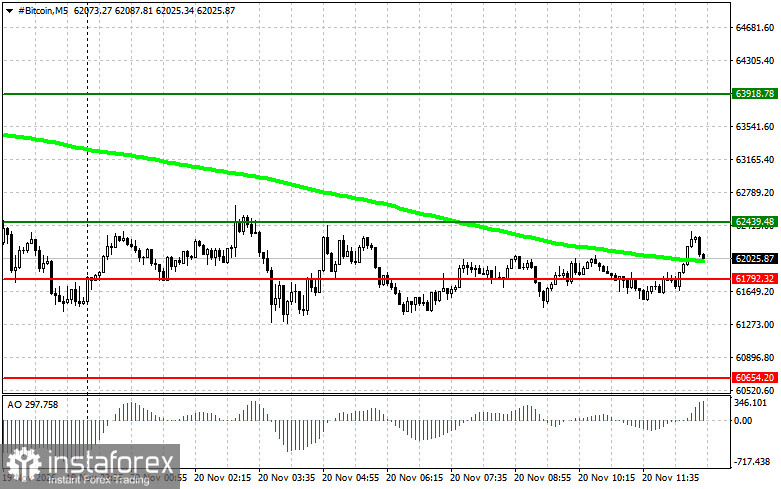
Bitcoin is currently held between immediate support at $61,700 and resistance at $62,400. The trading plan is built around two mirrored directions with full scenarios for breakouts and rejections. If price holds above $62,400 while remaining above the 50-day moving average and the Awesome Oscillator is above zero, I'd consider buying with a target at $63,900 to lock in profits; on a pullback from there, one can consider reversing into a short position. If a break below $61,700 fails and price returns to the range, buying at that support targets $62,400 first and then $63,900.
The logic for shorts is mirrored. A confirmed break below $61,700 while the moving average is above price and the Awesome Oscillator is below zero opens a short targeting $60,600. A rejection from $62,400 without a close above it gives a short with a return to $61,700 and then $60,600.
Ethereum
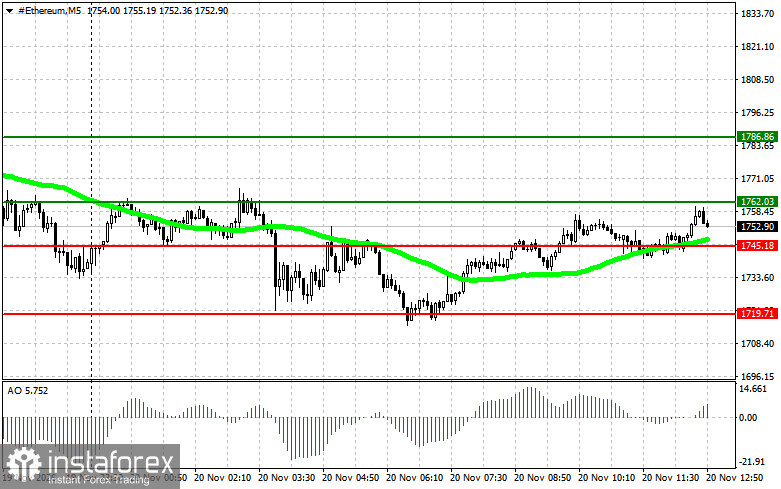
The logic for Ethereum mirrors Bitcoin on its own price scale. The active range is between support at $1,745 and resistance at $1,762. Buys are considered on a sustained move above $1,762 with a target of $1,786, or on a false break below $1,745 followed by a return to $1,762 and then $1,786. Sells are considered on a confirmed break below $1,745 with a target of $1,719, or on a rejection from $1,762 with a return to $1,745 and then $1,719. Both indicators are used as filters to exclude false moves rather than as reasons to enter prematurely; decisions are made only after price actually confirms the stated levels.


