
See also


 23.11.2026 08:50 AM
Philadelphia Fed President Anna Paulson said late last week that she is prepared to consider consecutive interest rate increases at upcoming meetings to rein in inflation, while urging a measured approach. "The direction of travel, in terms of where rates need to go, is really clear. They need to be higher," Paulson said in an interview. She did not endorse a specific cadence, adding, "I am not committed to every other meeting or every meeting," but called the idea of sequential rate hikes reasonable and worthy of discussion.
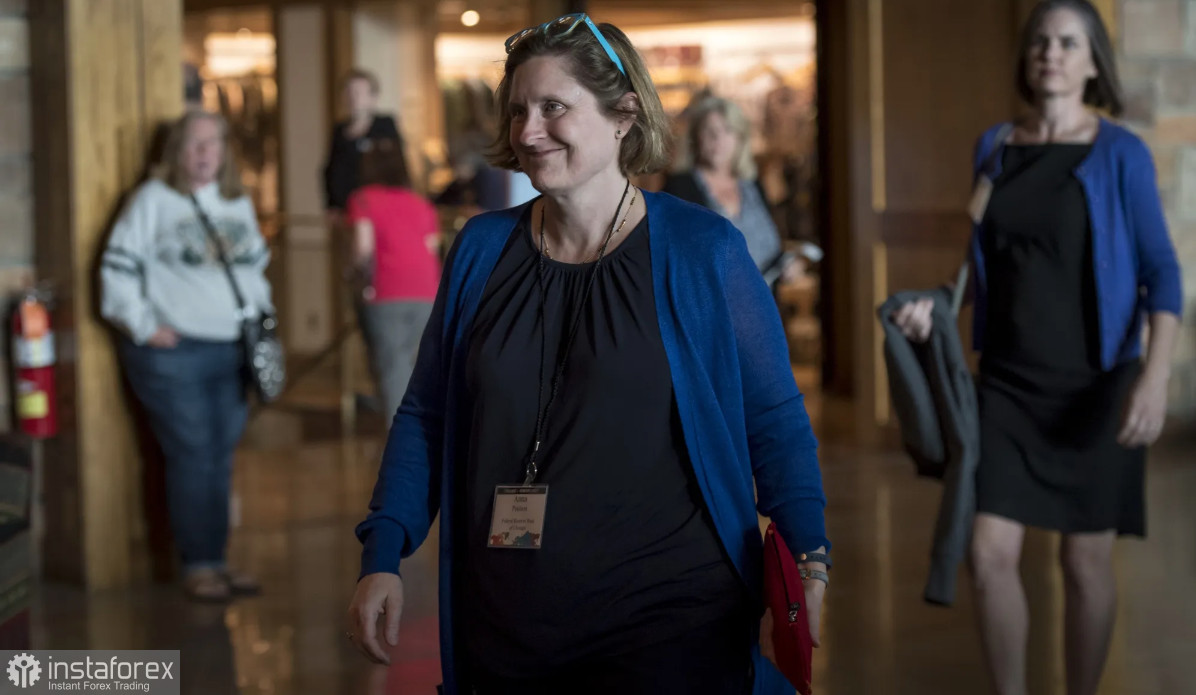
Paulson defends a measured path for two reasons. It gives households, businesses, and banks more time to adjust and preserves the Fed's flexibility to respond quickly if economic conditions change — avoiding the risks of both overshooting and lagging behind. Recall that the Fed raised rates 25 bps to 3.75–4.00% in September and then left them on hold on October 28 in a 10–2 vote (Hammack and Cook dissented). The minutes show that nearly all participants expect more tightening in the months ahead. The next meeting is scheduled for December 8–9.
Paulson's stance is noticeably firmer than earlier. On November 10, she said further gradual tightening was appropriate and that skipping a meeting was a matter of pace, not direction. She did not then see signs of accelerating inflation. Now she explicitly allows for sequential hikes and is watching for signs of accelerating price pressure and demand-supply imbalances.
All of this suggests the committee contains a broad spectrum of views on pace. Waller last week again urged consideration of a 50?bp move in December, Hammack favors smaller but steady steps, Musalem on November 17 spoke of multiple hikes into spring 2027, and Goolsbee on November 19 said he will consider all options. Paulson, who will vote on policy this year but not in 2027, occupies a middle ground: he favors rate hikes, but not sudden moves.
The case for tightening is inflation. Paulson says the economy "feels pretty good," hiring has expanded, and consumption proved stronger than expected earlier in the year, so the priority remains lowering inflation while weighing risks across both parts of the Fed's mandate. Core inflation surprised to the upside in October, driven by food, rents, and electricity. Core CPI was 0.3% m/m (consensus 0.2%), the third monthly upside surprise. New PCE data for October are due this week. The core PCE price index for September was 3.6% y/y vs. 3.4% in August. On wages, Paulson sees no evidence that local pay pressures are broadening across the labor market or that pay for data-center specialists is propagating through wages generally. Still, wage growth currently aligns with roughly 2% real income gains, and any deviation merits attention.
Tightening bias remains, but markets are also under pressure from the equity sell-off. Investors expect hikes in December and January, though the chance of a January move has fallen amid the sharp drop in stocks, especially tech. Nasdaq 100 closed last week at its lowest since April, and global equities fell for a seventh consecutive day. Risks remain two-sided — Paulson herself emphasizes this — and lower oil prices (Brent down roughly one-fifth month-to-date) could reduce energy's inflation contribution.
All this indicates that the Fed is moving toward a 25-bp rate hike on December 8–9, and Paulson's comments make a 50-bp step less likely than Waller's view. I expect a second hike in January to depend on PCE readings and how deep the equity decline becomes. Meanwhile, the dollar should remain supported while Fed officials talk up further hikes.
EUR/USD
Buyers should consider taking 1.0985. That would open the path toward 1.1010. From there, a move to 1.1040 is possible, but doing so without large-player support will be difficult. On a pullback, I expect increased buying activity only near 1.0960. If bids are absent there, it would be prudent to wait for a drop to a fresh low at 1.0930 or to consider long entries at 1.0895.
GBP/USD
Pound buyers need to overcome the nearest resistance level of 1.3130. That would enable a move toward 1.3170, above which further gains would be challenging. The next upside target is around 1.3210. On a decline, bears will try to seize 1.3085. If they succeed, a range break would deal a serious blow to bulls and push GBP/USD to 1.3040, with the prospect of extending the decline to 1.3010.


