
See also


 23.11.2026 04:45 PM
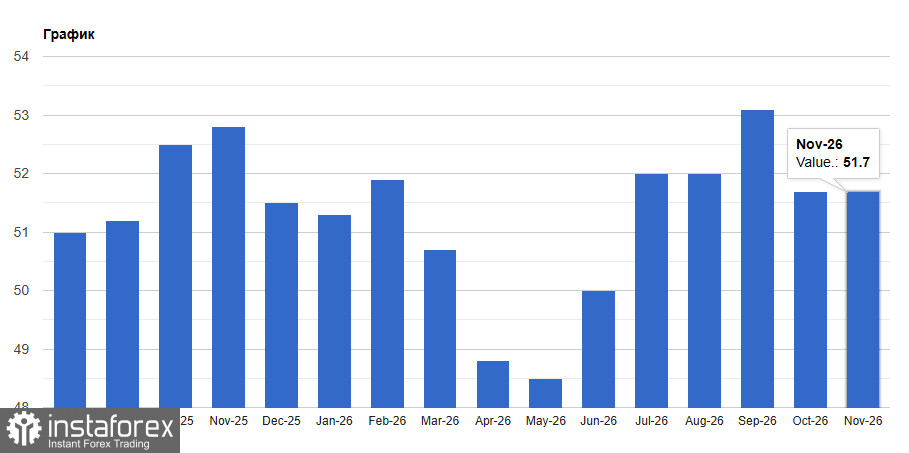
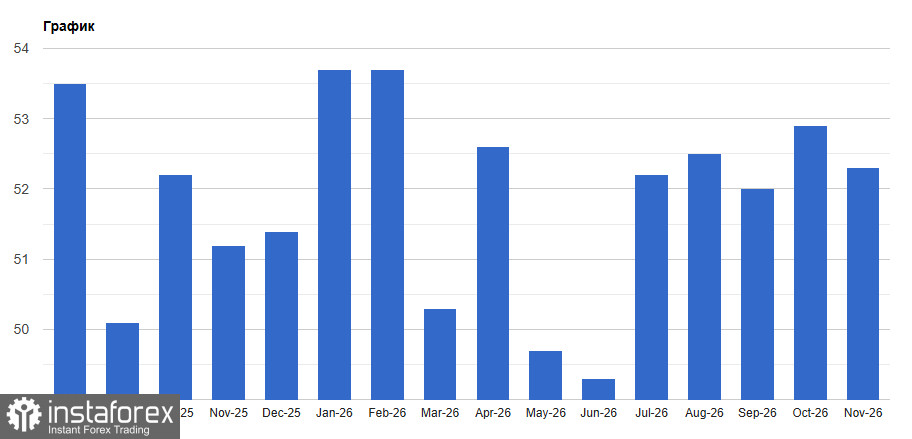
The eurozone and U.K. economies continued to grow in November, but that growth is being driven by industry while the services sector is noticeably weakening. That emerged from preliminary S&P Global business activity PMIs, where readings above 50 indicate expansion and below 50 contraction. The eurozone composite printed 51.7 in the final reading, unchanged from October, marking the fifth month of expansion. In the U.K. the index eased to 52.3 from 52.9, a two-month low, though still above 50.

Inside the eurozone the picture is mixed. Manufacturing was surprised on the upside—the sector's PMI rose to 52.9 versus a 52.7 forecast and hit a two-month high. Services, by contrast, softened: the services PMI fell to 51.2 versus a 51.8 forecast and 51.4 in October—the weakest reading in five months. For the economy this means growth is holding up on factories, while consumers and firms linked to them are becoming more cautious with spending. S&P Global estimates eurozone GDP is expanding at roughly a 0.3% quarterly pace, below 0.4% in Q3 and 0.6% in Q2.
The chief source of this divergence is Germany versus France. Germany's expansion accelerated to the fastest pace since March 2022 as equipment makers benefit from increased defense and AI infrastructure spending. France's business activity fell for a second month and by the largest margin in six months, and the gap between the two economies is the widest in six years. "The picture of economic resilience masks worrying divergences within the eurozone," said Chris Williamson, chief business economist at S&P Global Market Intelligence. French business is pessimistic because of political uncertainty, unrest, and high living costs, and confidence there is among the lowest since 2012 aside from the pandemic.
The good news is inflationary pressure has started to ease. Firms' input cost inflation slowed to a three-month low, and companies raised output prices at the slowest pace since August. Falling oil—down roughly a fifth in November—helped. By comparison, cost growth was the strongest in five months in October. Nevertheless, prices are still rising fast: eurozone CPI was 4.0% year-on-year in October versus 3.8% in September, well above the ECB's 2% target. The push for further tightening remains, and the market expects the deposit rate to rise from 2.50% to 2.75% on December 17, which many see as the final step. Williamson says the data support arguments for one more hike.
In the U.K., industry was also the support while services cooled. Manufacturing output rose to 54.2 from 53.6—a 27-month high—as plants filled orders for data center construction, defense, and food processing. The services PMI fell to 52.0 from 52.8—a five-month low and below a 53.0 forecast. Firms cite high living costs, weak property demand, and geopolitics. The composite in October was 53.1 on the flash reading—an eight-month high—so the new weakening is notable.
The U.K. labor market is deteriorating. Firms are cutting staff again, mainly in services, because high labor and tax costs push them not to replace departures even though employment ticked up slightly in October. On the positive side, cost pressures have eased—firms' input inflation slowed for the first time since July, and price growth is the slowest in four months. Business sentiment rose back to pre Middle East war levels in February, which Williamson suggests indicates the budget was broadly well received. The data still point to GDP growth near 0.6% in Q4 versus 0.7% in Q3.
All told, the ECB and the Bank of England remain on a tightening path, though there is no reason to accelerate. The BoE's rate is 4.00% after the November 5 unanimous 9-0-0 vote, and Williamson sees a December hike as almost certain even though the market recently judged the outcome 50/50; the risk of a February step has also risen. Risks remain—weak services, job cutting, and France's slowdown could quickly cool growth. I expect the ECB to lift the deposit rate to 2.75% on December 17 and then pause, and the BoE to hike in December. Markets will offer only limited support to the euro and the pound from rate expectations while they continue weighing growth risks.
Technical picture for EUR/USD
On the hourly chart, buyers should consider how to take 1.1000. Only that would allow a test of 1.1040. From there a move to 1.1060 is feasible, but achieving that without support from major players will be difficult. On declines I expect meaningful buying only around 1.0960. If nobody defends there, it would be prudent to wait for a fresh low at 1.0930 or to open longs from 1.0895.
Technical picture for GBP/USD
Pound buyers need to take the nearest resistance at 1.3140. Only then would a move to 1.3170 be possible, above which further progress will be difficult. The farther target is around 1.3210. On a drop, bears will try to seize control at 1.3100. If they succeed, a range break would inflict serious damage on bulls and push GBP/USD to 1.3075 with a prospect of extending to 1.3050.


