
See also


 24.11.2026 04:58 AM
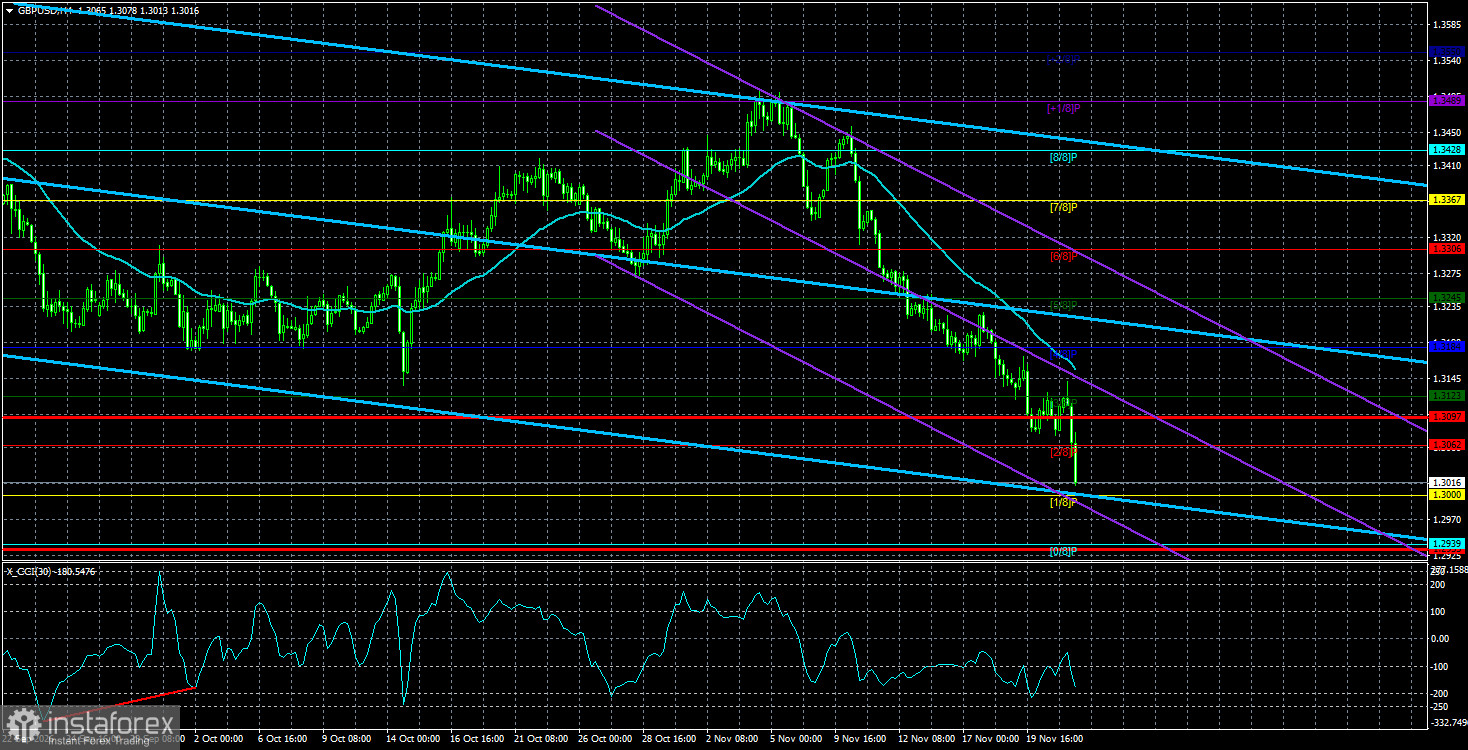
The GBP/USD pair continued to move calmly to the downside. As we noted in the EUR/USD piece, the euro began to fall on Monday before the first macro releases were out— and the pound did the same. In the first half of the day, the British currency plunged about 70 pips. What were the reasons? None. UK PMI readings for November were published in the morning: the manufacturing PMI was 52.7, 0.1 below forecasts, and the services PMI was 52.0, 0.2 above forecasts. So one report beat expectations and the other missed — and after those prints the pound fell 70 pips.
Compared with last week, the pound's situation has not changed. GBP/USD has been in a collapsing decline for more than two weeks; the only difference versus EUR/USD is that the pound has been falling for two weeks while the euro has been sliding for three months.
Nothing changes on the fundamental side either. Federal Reserve and Bank of England officials speak from time to time, but their rhetoric hasn't materially changed — both central banks have raised policy rates only once, while inflation in the UK and the U.S. continues to rise. Clearly both central banks are likely to keep tightening, but the market is focused almost exclusively on the Fed and its rate path.
The macro backdrop also offers no surprises. When releases come that should support the pound, the market ignores them. If data are neutral or dollar-friendly, the dollar rises. More precisely: the U.S. currency has been rising regardless of macro prints.
Technical factors matter little right now. The 1.3100–1.3180 zone was once considered very strong because it combined the lower bounds of two sideways channels on the daily and weekly charts. That doesn't mean price can never break it, but the pair passed through that area like a hot knife through butter—no reaction at all.
Therefore, only one strategy makes sense at present. Focus on the 4-hour timeframe and below, where the decline continues almost every day. Traders should open fresh short positions on small upward retracements and on breaks of important levels and lines. On the daily chart, the pair has already left the sideways channel that formed over the past year—only the weekly flat remains, with a minimal lower bound near 1.3008. Thus, the pound could potentially slide into the 1.2950–1.3000 area, where one should expect either a bounce or liquidity removal.
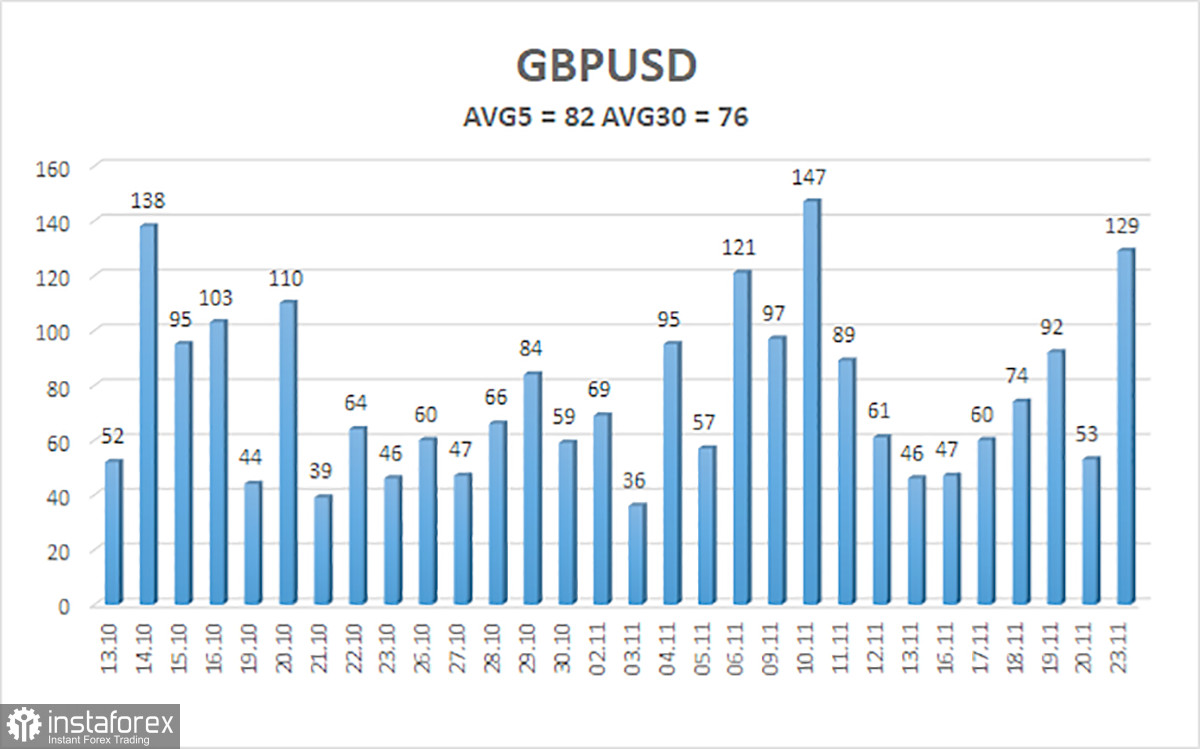
The average volatility of the GBP/USD pair over the last 5 trading days as of November 24 is 82 pips. For the pound/dollar pair, this value is "average." On Tuesday, November 24, we therefore expect the pair to trade within the range bounded by 1.2933 and 1.3097. The higher linear-regression channel is pointing down, indicating a downtrend. The CCI indicator has recently not entered overbought/oversold areas and has not formed divergences.
S1 – 1.3000
S2 – 1.2939
S3 – 1.2878
R1 – 1.3062
R2 – 1.3123
R3 – 1.3184
The GBP/USD pair continues its downward tendency, which can still be considered part of a sideways channel on the daily timeframe. 2026 has been very positive for the dollar because geopolitics and inflation have driven capital to safety and brought the Fed back to monetary tightening. On the weekly timeframe, price remains flat between 1.3000 and 1.3780 within a four-year uptrend, supporting the prospect of pound appreciation in the medium term. Consider long positions with targets of 1.3306 and 1.3367 when price is above the moving average. With price below the moving average, trade to the downside with targets of 1.3000 and 1.2933. Be cautious with shorts — the price is near the lower bound of the sideways channel.


