
See also


 26.11.2026 09:33 AM
Bitcoin climbed back above $61,000 overnight, although on Wednesday, immediately after the October PCE release, it fell to roughly $57,500 on fears of accelerating inflation and a tougher Fed. The drop proved short-lived. As soon as risk demand returned in the US stock market — the Nasdaq, which had plunged as much as 4.6%, recovered and closed only 0.6% lower — Bitcoin recouped over $3,000 and is trading around $60,800 on Thursday. This is an important signal for the market, because buyers responded to the bad data by buying the dip rather than by continuing to panic, although I would not yet call it a reversal.

The data themselves confirmed that US inflation continues to accelerate. Headline PCE for October was 3.8% year-on-year as expected, after a revised 3.7% in September (previously 3.6%) and 3.4% in August. The core measure, which excludes food and energy, rose to 3.3% from 3.1% in September and 3.0% in August, beating the 3.2% forecast and marking the highest reading in nearly three years. Both indices increased 0.3% month-on-month, while headline PCE had risen 0.5% in September. At the same time, the GDP revision for Q3 showed 4.3% annualized growth instead of the initial 3.4%, after 2.2% in Q2. A strong economy removes the Fed's main argument for a pause, giving the regulator more room to fight inflation without risking a sharp slowdown.
The market is almost certain about the next move. As of November 25, CME data showed a 94.4% probability of a 25-bp hike at the December 8–9 meeting, which would move the policy rate from 3.75–4.00% to 4.00–4.25%. That probability was about 97% on November 17–18 and about 90% on November 19, so the report essentially restored rate-hike expectations to prior levels.
However, the backdrop for the entire crypto market remains heavy. Total crypto market capitalization stands at $2.09 trillion — 32% below the January 1 level of $3.09 trillion. Pressure is being reinforced by funds: according to market summaries, outflows from US Bitcoin ETFs in November have reached $4.94 billion amid six consecutive sessions of net redemptions.
All this suggests the overnight bounce is a technical reaction to oversold conditions rather than a reversal, and I expect the rally to lose steam around $62,000, after which the price will likely return to test $57,500 unless a sustained inflow into ETFs appears before the December 9 Fed meeting. The decisive factor for Bitcoin will not be the rate hike itself — which is already priced in — but the Fed's tone and the new forecasts the regulator will publish at that meeting. If a hawkish 50-bp scenario gains traction, pressure on risk assets would quickly return.
Bitcoin
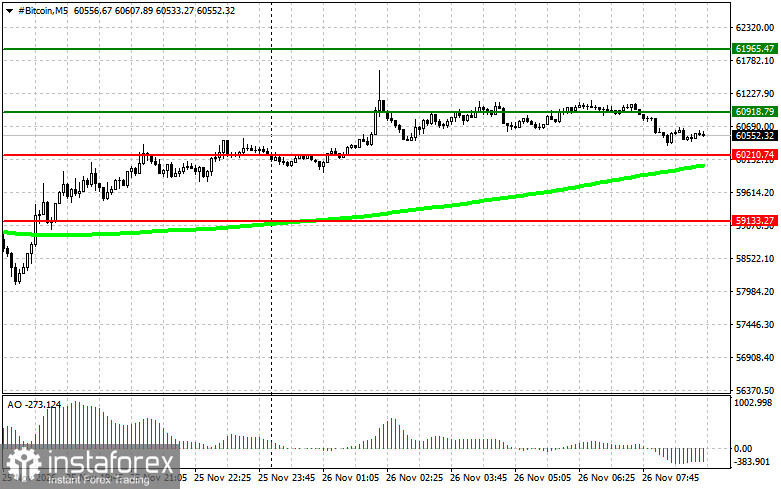
The immediate range is between support at $60,200 and resistance at $60,900, and the plan is built around two mirrored directions with full breakout and rejection scenarios. For long positions, I consider two options. First: a confident close above $60,900, with a target of $61,900 where I would take profits and watch for a reversal into shorts on a pullback. Second: if the drop below $60,200 proves false, buy with a target to return first to $60,900 and then to $61,900. In both cases, the price should remain above the 50-day MA and the Awesome Oscillator above zero.
Shorts work symmetrically. A confirmed close below $60,200 opens a short targeting $59,100, provided the 50-day MA sits above price, and the Awesome Oscillator is below zero. If a break above $60,900 fails to confirm and the market turns down, the short targets $60,200 and then $59,100.
Ethereum
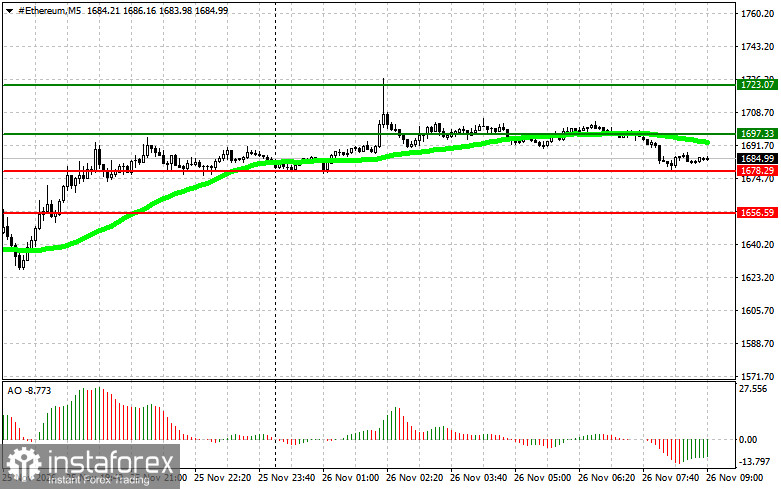
The logic mirrors Bitcoin on its own price scale, with the immediate range between support at $1,678 and resistance at $1,697. Buy on a confirmed close above $1,697 targeting $1,823, or buy the bounce from $1,678 after a false downside break with a return first to $1,697 and then to $1,823. Sell on a confirmed close below $1,678 targeting $1,656, or on an unconfirmed breakout above $1,697 with movement first to $1,678 and then to $1,656. Buy positions are only acceptable with price above the 50-day MA and the Awesome above zero; short positions require the MA above price and Awesome below zero.
Both indicators are filters to weed out false moves, not standalone entry signals, and trades should be taken only after price confirms the stated levels.


