
यह भी देखें


 11.06.2026 07:25 PM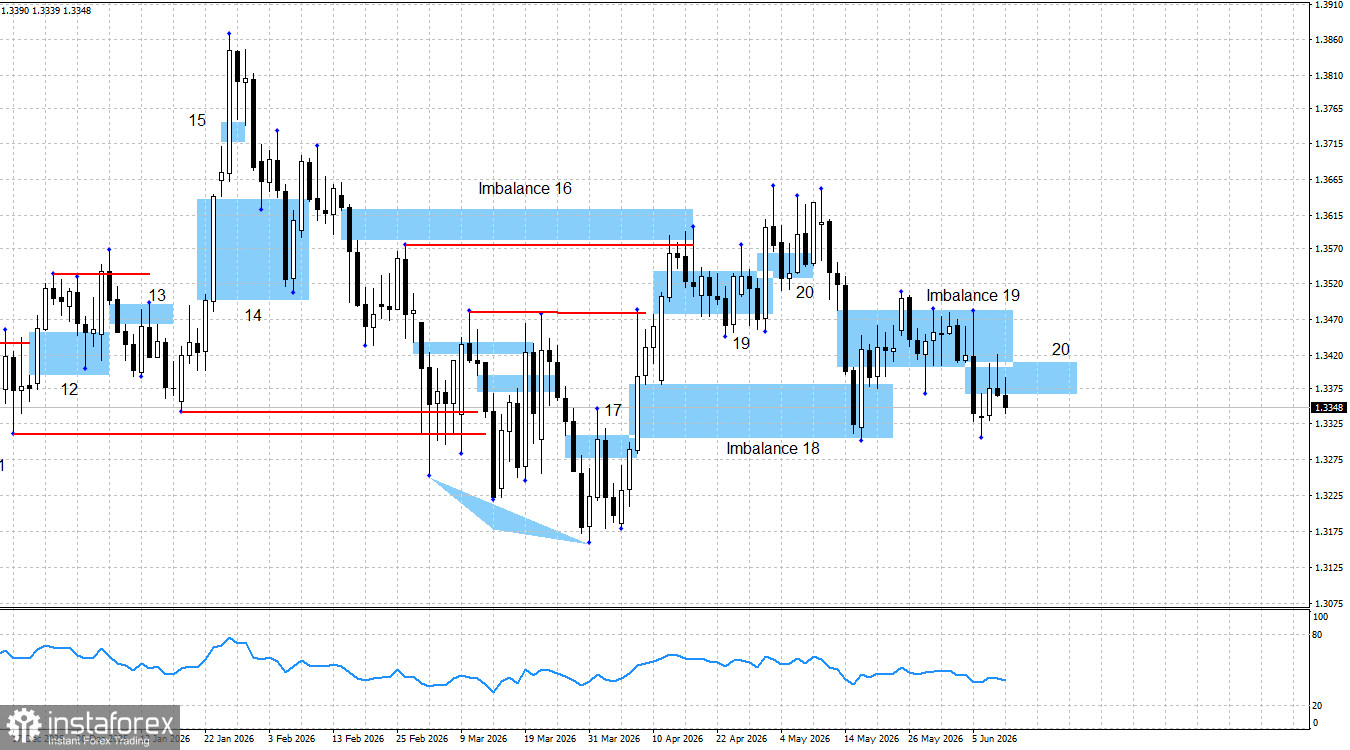
The GBP/USD pair has a strong opportunity to continue its decline after reacting to bearish imbalance 19. Yesterday, I assumed that another bearish imbalance 20 could be invalidated, but instead of rising, the pair moved lower on Wednesday. Today, amid pressure from geopolitical developments in the Middle East, the market continues to buy the US dollar. Once again, this week is developing in favor of the US currency.
The geopolitical conflict between Iran and the United States has gone beyond preventive strikes. US forces have been carrying out attacks on Iran for the third consecutive day, while Iran has responded by targeting US military bases in the Persian Gulf. In addition, although traders largely ignored Wednesday's inflation report, it still showed that inflation accelerated to 4.2%. Today's Producer Price Index report also pointed to faster price growth. As a result, developments in the Middle East appear to be moving toward a renewed military conflict, while inflationary pressures worldwide are likely to continue rising unless central banks take action. The ECB has already begun tightening policy today, inflation in the UK is paradoxically declining, and attention now turns to the Federal Reserve.
The situation in the Middle East is heating up again, which could support the US dollar in the coming weeks. I do not expect a rally in the dollar comparable to the one seen between January and March, but it is difficult to deny that the US currency performs better during periods of geopolitical uncertainty than either the euro or the pound. Therefore, even if the dollar does not post substantial gains, significant appreciation of the euro and pound also appears unlikely.
In my view, the broader trend remains bullish despite the pair's sharp declines this year. At present, the ceasefire in the Middle East exists only formally. The Strait of Hormuz remains effectively blocked, the nuclear issue remains unresolved, and any signs of progress in negotiations are based largely on statements from Donald Trump. Iran presents a very different assessment of the situation. Conditions continue to shift between improvement and deterioration. At the moment, the market is leaning toward the possibility of renewed conflict.
The current chart structure is as follows. Bullish imbalance 18 generated a price reaction, but bearish imbalance 19 ultimately produced a sell signal. Following that signal, another bearish setup emerged within imbalance 20. Geopolitical developments support further downside in the pair, and technical analysis points in the same direction. Until at least one bearish pattern is invalidated or a bullish pattern emerges, I would not expect meaningful gains in the pound.
The economic calendar on Thursday was largely uneventful. At least, the market paid little attention to the US Producer Price Index report, while even EUR/USD traders largely ignored the ECB's interest rate hike.
The broader fundamental backdrop still leads me to expect US dollar weakness over the long term. Even the conflict between Iran and the United States changes little in that regard. Geopolitical tensions have temporarily reminded investors of the dollar's safe-haven status, but the overall environment for the US currency remains less than favorable. If the US economy gains momentum in 2026, the Federal Reserve resumes its monetary tightening cycle, and the conflict between the United States and Iran becomes a prolonged confrontation, then the dollar could indeed target the 1.3100–1.3000 level. However, in my opinion, the long-term outlook for the US dollar could not have changed because of a single positive Nonfarm Payrolls report, and the Federal Reserve has not yet signaled readiness to tighten policy further.
Economic Calendar for the United States and the United Kingdom:
The economic calendar for June 12 contains only one event, which I do not consider particularly significant. Therefore, the impact of the economic backdrop on market sentiment on Friday is likely to be minimal.
GBP/USD Forecast and Trading Advice:
The long-term outlook for the pound remains bullish, but the most recent signals are bearish. Therefore, in the near term, provided geopolitical developments do not interfere, bears may continue pushing toward the March 31 low at 1.3158. Liquidity may be taken from recent swing points, after which bulls could regain control if geopolitical conditions become more favorable. At present, it is difficult to imagine a quick resolution to the conflict between Iran and the United States, which leaves the pound with limited upward potential.

