
Veja também


 30.01.2026 06:53 AM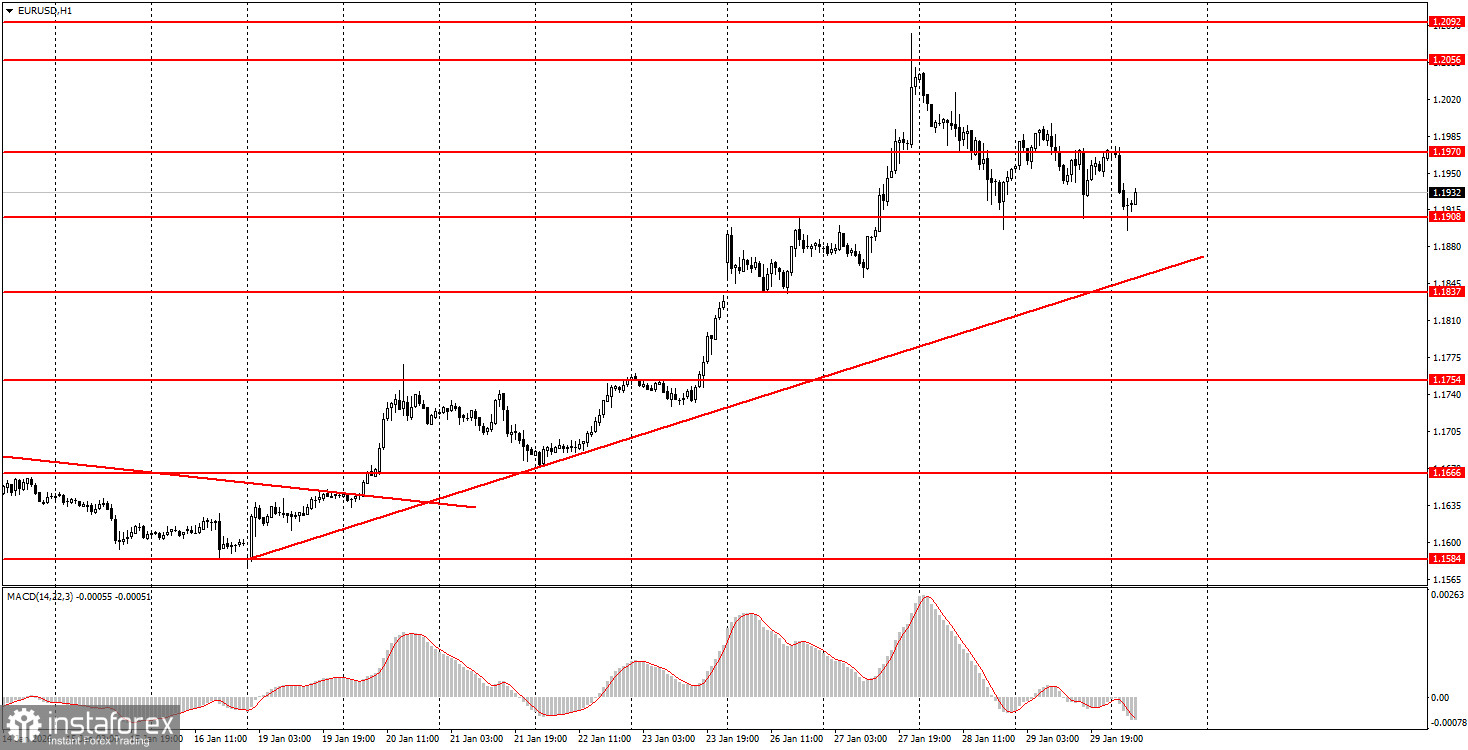
The EUR/USD currency pair continued a weak downward correction on Thursday following a surge over the past couple of weeks. The macroeconomic background for the day was virtually nonexistent, and Donald Trump, for the first time in a long while, did not impose new tariffs, launch a military operation, or threaten anyone. As a result, market movements were relatively stable despite the Fed meeting the previous day. However, the Federal Reserve did not make any significant decisions or announce any future changes in monetary policy. Therefore, there was nothing for traders to react to. Nevertheless, within the next 24-48 hours, the US may conduct missile and airstrikes against Iran. Currently, there is a significant fleet of aircraft carriers near the shores of Iran, capable of launching up to 300 missiles at once. Likely, Washington will soon strike Tehran and other cities in response to Iran's refusal to finalize a nuclear deal, which requires Iran to surrender all nuclear weapons and cease further nuclear development. The calm in the market is clearly temporary.
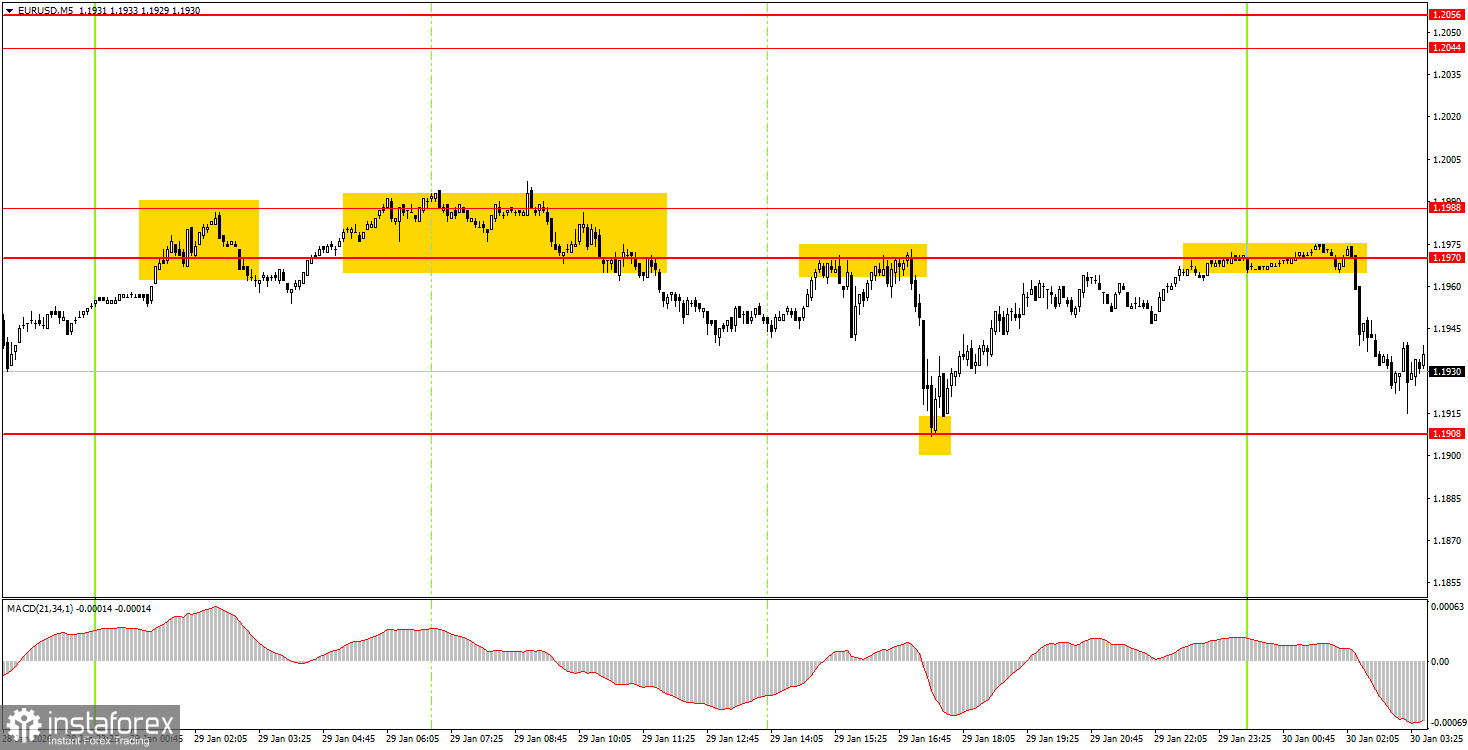
On the 5-minute timeframe, several good signals were formed on Thursday. The price bounced three times from the 1.1970-1.1980 area and ultimately reached the nearest target at 1.1908. The last two of the three signals could have been utilized by beginner traders. The bounce from the 1.1908 level was precise, allowing traders to open long positions. By the end of the day, the pair returned to the 1.1970-1.1980 area, from which it immediately bounced again.
On the hourly timeframe, an upward trend continues to form. On Monday night, the price consolidated above the area of 1.1800-1.1830, above the range of 1.1400-1.1830, so the flat that lasted for seven months can be considered completed. The overall fundamental and macroeconomic background remains very weak for the US dollar, so we fully support further growth of the euro currency.
On Friday, beginner traders can open new long positions in case of a bounce from the level of 1.1908, with targets at 1.1970-1.1980 and 1.2044-1.2056. A price consolidation below 1.1908 will allow opening shorts with a target of 1.1830-1.1837.
On the 5-minute timeframe, key levels to consider include 1.1354-1.1363, 1.1413, 1.1455-1.1474, 1.1527-1.1531, 1.1550, 1.1584-1.1591, 1.1655-1.1666, 1.1745-1.1754, 1.1830-1.1837, 1.1908, 1.1970-1.1988, 1.2044-1.2056, 1.2092-1.2104. Today, Germany will publish a package of macroeconomic data, including unemployment levels, fourth-quarter GDP, and inflation. The Eurozone will release its fourth-quarter GDP report. In the US, the Producer Price Index will be announced. A restrained market reaction may follow these reports. Politics and geopolitics remain on the agenda.
Support and resistance price levels — levels that serve as targets when opening buys or sells. Take Profit can be placed near them.
Red lines — channels or trendlines that reflect the current tendency and show which direction is preferable to trade now.
MACD indicator (14,22,3) — histogram and signal line — an auxiliary indicator that can also be used as a source of signals.
Important speeches and reports (always listed in the news calendar) can strongly affect a currency pair's movement. Therefore, during their release, trading should be done with maximum caution, or positions should be closed, to avoid a sharp price reversal against the preceding move.
Beginner forex traders should remember that not every trade can be profitable. Developing a clear strategy and effective money management are the keys to long-term trading success.


