
Veja também


 09.07.2026 08:39 AM
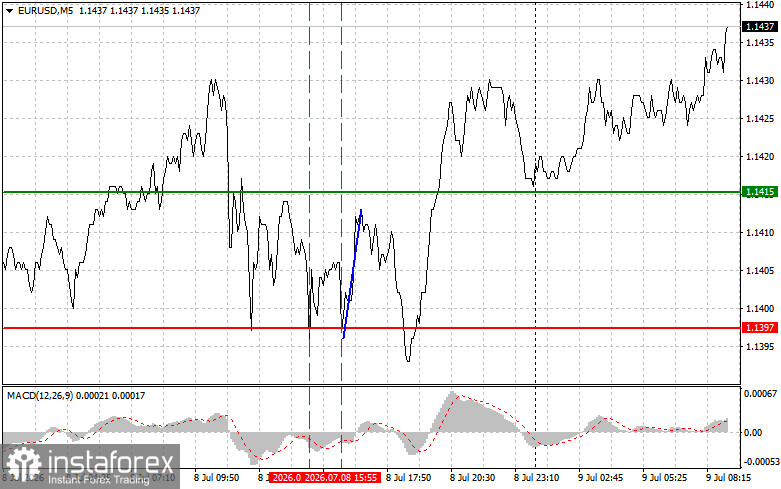
The price test at 1.1397 coincided with the MACD indicator moving significantly below the zero mark, limiting the pair's downward potential. For this reason, I did not sell the euro. The second test at 1.1397 led to the implementation of scenario #2 to buy euros, resulting in a 15-pip growth.
The market noticeably revised its expectations after yesterday's publication of the Federal Reserve minutes, which is perhaps its main takeaway. Previously, traders were anticipating further rate cuts, but now the baseline scenario has shifted to no changes until the beginning of 2027, with a single decrease expected in the second quarter of 2027. Moreover, there is now a possibility of a rate hike appearing on the horizon by mid-2027. This shift is largely explained by the Fed removing hints of monetary easing from its statement, indicating that the cycle of rate reductions has been postponed. However, just a week earlier, more hawkish assumptions were in play, predicting rate hikes by the end of the year, which have now been erased by the latest US inflation data, reducing demand for the US dollar.
Today's trading day promises to be quite interesting for European financial markets, as we expect the publication of key macroeconomic data from Germany in the first half of the day, being the locomotive of the European economy. The upcoming report on the trade balance is one of the most important indicators of its trade activity and competitiveness on the world stage. A positive balance generally indicates robust foreign demand for German goods and services, indirectly indicating the strength of the manufacturing sector and overall economic stability. Conversely, negative dynamics may signal a potential slowdown or increased competition, warranting closer analysis of factors affecting export-import operations.
Equally significant will be the release of the European Central Bank's report following their monetary policy meeting. Recall that the central bank decided to raise interest rates. This step is intended, on one hand, to cool the economy and bring inflation back to target levels, and on the other, theoretically, it should positively influence the European currency's value. Higher interest rates are expected to maintain the euro's appeal.
Regarding the intraday strategy, I will rely more on implementing scenarios #1 and #2.
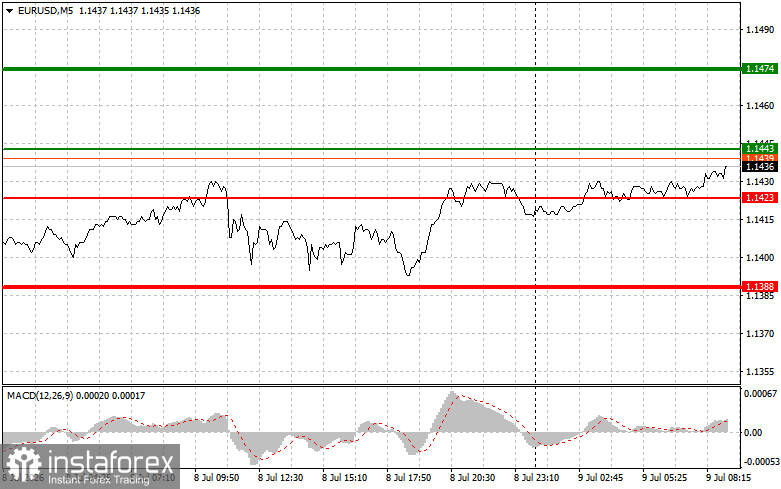
Scenario #1: Today, the euro can be bought when the price reaches around 1.1443 (green line on the chart), with a target for growth to 1.1474. At 1.1474, I plan to exit the market and sell the euro in the opposite direction, expecting a move of 30-35 pips from the entry point. Expectations for euro growth can only be based on favorable data. Important! Before buying, ensure that the MACD indicator is above the zero mark and is just beginning to rise from it.
Scenario #2: I also plan to buy euros today in the case of two consecutive tests of the price 1.1423, at which point the MACD indicator should be in the oversold area. This will limit the pair's downside potential and lead to an upward market reversal. A rise to the opposing levels of 1.1443 and 1.1474 is expected.
Scenario #1: I plan to sell the euro after it reaches 1.1423 (the red line on the chart). The target will be 1.1385, where I plan to exit the market and immediately buy in the opposite direction (expecting a move of 20-25 pips in the opposite direction from that level). Pressure on the pair will return today if ECB rhetoric is soft. Important! Before selling, ensure that the MACD indicator is below the zero mark and is just beginning its decline from it.
Scenario #2: I also plan to sell euros today in case of two consecutive tests of the price 1.1443, when the MACD indicator is in the overbought area. This will limit the pair's upward potential and lead to a downward market reversal. A decrease to the opposite level of 1.1423 and 1.1388 can be expected.
Important: Beginning traders in the Forex market must make entry decisions very cautiously. Before the release of significant fundamental reports, it is best to stay out of the market to avoid sudden price fluctuations. If you decide to trade during news releases, always set stop orders to minimize losses. Without stop orders, you can quickly lose your entire deposit, especially if you do not use money management and trade with large volumes.
And remember, for successful trading, it is necessary to have a clear trading plan, similar to the one I have presented above. Making spontaneous trading decisions based on the current market situation is fundamentally a losing strategy for intraday traders.


