
Veja também


 18.08.2026 08:20 AM
The geopolitical situation in the Middle East is heating up again. Just yesterday, Donald Trump announced that he is ready to order strikes against Oman "if it interferes with the U.S. in the fight against Iran for the Strait of Hormuz." In simple terms, Trump does not welcome any deals or agreements between Tehran and Muscat, but it remains unclear exactly what has angered him. In any case, Trump has issued threats against Oman, which had previously maintained complete neutrality and had not involved itself in the conflict in the Strait of Hormuz.
Meanwhile, Iran is tired of being isolated from the world (although it has been doing so for the last 50 years). One high-ranking Iranian official, speaking anonymously, informed Reuters that Iran is ready to forcibly break the American blockade of the Strait of Hormuz. I wouldn't qualify this announcement as "news of the week" that "will inevitably lead to new sparring." First, it's unknown how high-ranking the official really is. Second, it's uncertain whether this information is accurate. Third, it could simply be a typical "duck," of which there have been numerous over the past six months. Fourth, Iran cannot be unaware that lifting a naval blockade is unlikely to succeed. For the same reasons, Americans cannot break Iran's blockade by force either.
So, what is a blockade? Tehran declares that the strait is closed and that any vessel attempting to cross it will be attacked. How can it be lifted if Iran can strike any ship from any point? We are not living in the Stone Age or the Middle Ages. To strike, one does not need to be in proximity to the target or have visual contact with it. Therefore, Iran can launch strikes from anywhere within its territory, which is not small. Consequently, to lift the Iranian blockade, all launch sites, planes, missiles, and drones in Tehran's possession would need to be destroyed. It's clear to everyone that this is impossible.
The same applies to the American blockade. Suppose Iran destroys U.S. military vessels in the Persian Gulf. Washington can still launch missiles and the same drones from allied military bases, which are sufficiently numerous in the region. Therefore, Iran cannot lift the American blockade by force, and the U.S. will not lift the Iranian blockade of the strait either. The most Iran can achieve is to trigger a new escalation, which, by the way, it does not seem very interested in.
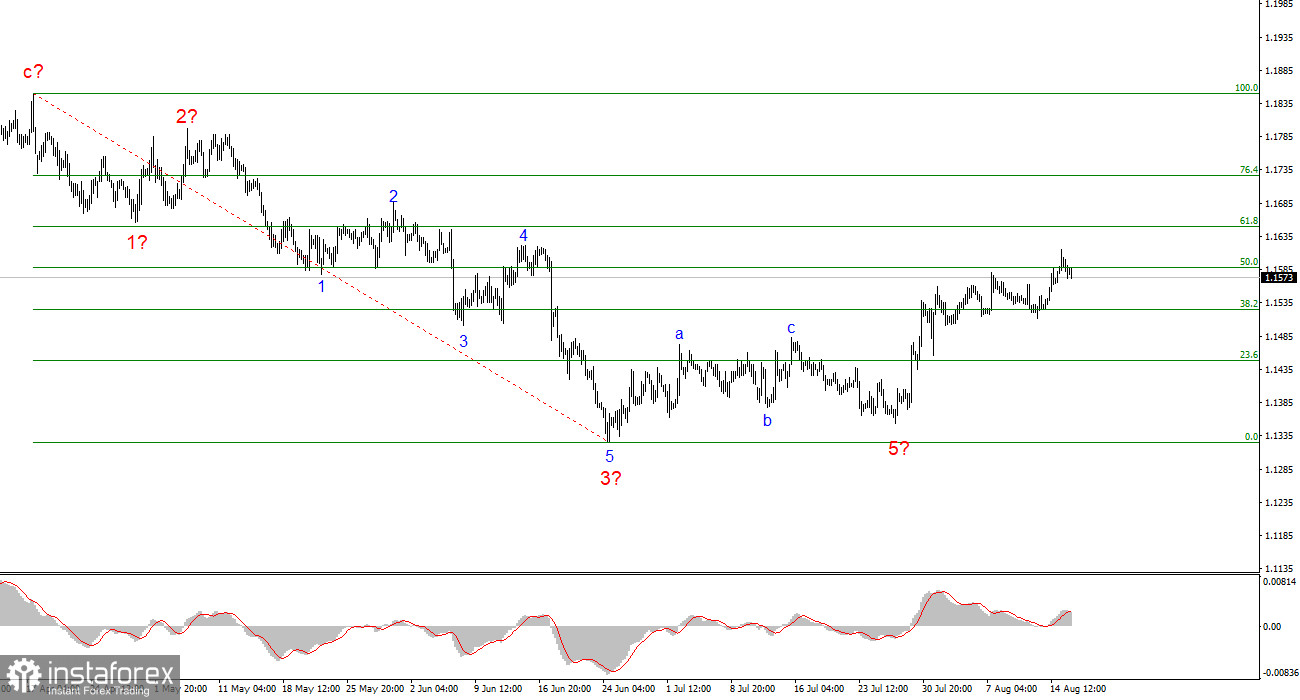
Based on the analysis of EUR/USD, the instrument remains within an upward segment of the trend and, in the short term, has presumably transitioned to a new upward wave sequence. In my opinion, this is an excellent time to form long positions. Wave 5 in C has taken on a shortened form. Unless the downward segment of the trend that began on January 28 takes on a more extended five-wave form (which requires a strong news background in favor of the dollar), the EUR/USD instrument is at the very beginning of a new, prolonged upward segment of the trend, with targets extending up to the 25 figure.
The wave structure of the GBP/USD instrument has taken on a completely clear form. We now see a well-defined corrective structure A-B-C on the charts, which has been completed. Therefore, I expect the construction of an upward wave sequence that takes on an impulsive form, which coincides with the impulsive structure of the EUR/USD instrument. If this is the case, the British pound is currently in its third wave, and the targets for the entire trend segment lie above the 39 figure. In the coming months, I only consider trading on the upside.


