
Veja também


 24.08.2026 01:17 PM
Analysis of Trades and Trading Advice for the Japanese Yen
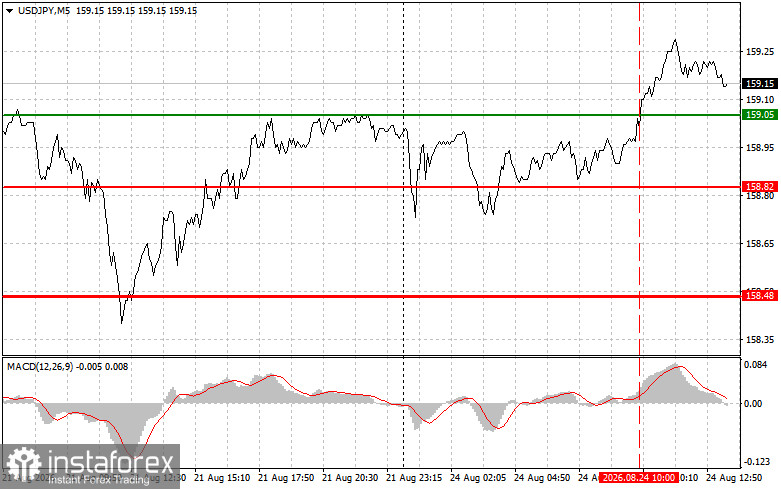
The test of the 159.05 level occurred when the MACD indicator was just beginning to move up from the zero line, confirming that this was an appropriate entry point for a long position on the dollar. As a result, the pair rose by 20 points.
In the second half of the day, the US market will have no major economic data releases, so all attention will shift to a speech by Treasury Secretary Scott Bessent and other US policymakers. However, the main event will be the announced plan for the economic isolation of Iran, details of which could be disclosed as early as this evening. The Japanese yen finds itself caught between two opposing factors in this situation. As a traditional safe-haven asset, it could benefit from an increase in geopolitical tensions. However, simultaneous dollar strength and the threat of higher oil prices work against Japan, which is heavily dependent on energy imports. If dollar strength pushes USD/JPY higher too quickly, the issue of currency intervention could resurface, as the Bank of Japan has previously intervened in the market to support the national currency when it weakened sharply. For now, the yen's reaction will depend on how stringent Bessent's plan turns out to be and how the market assesses its potential impact on oil prices.
As for the intraday strategy, I will rely primarily on the implementation of Scenarios #1 and #2.
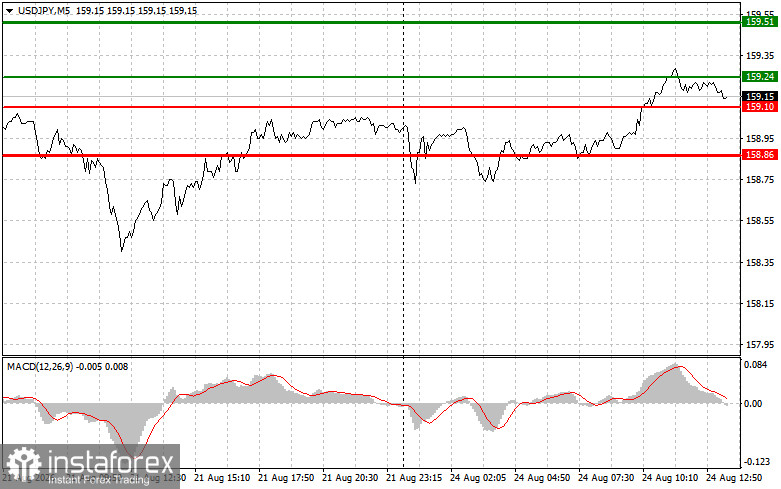
Scenario #1: Today, I plan to buy USD/JPY when the entry point is reached around 159.24 (the thin green line on the chart), with a target of 159.51 (the thicker green line on the chart). Around 159.51, I will close the long position and open a short position in the opposite direction, targeting a move of 30–35 points from the level. The pair's upward potential today can be considered, but it is rather limited. Important! Before buying, make sure that the MACD indicator is above the zero line and is just beginning to rise from it.
Scenario #2: I also plan to buy USD/JPY today if the price tests 159.10 twice consecutively while the MACD indicator is in the oversold area. This would limit the pair's downward potential and trigger a reversal to the upside. A rise toward the opposite levels of 159.24 and 159.51 can be expected.
Scenario #1: Today, I plan to sell USD/JPY after the 159.10 level is broken (the red line on the chart), which should lead to a rapid decline in the pair. The key target for sellers will be 158.86, where I will close the short position and immediately open a long position in the opposite direction, targeting a move of 20–25 points from the level. Downward pressure on the pair will return if the central bank intervenes. Important! Before selling, make sure that the MACD indicator is below the zero line and is just beginning to decline from it.
Scenario #2: I also plan to sell USD/JPY today if the price tests 159.24 twice consecutively while the MACD indicator is in the overbought area. This would limit the pair's upward potential and trigger a reversal to the downside. A decline toward the opposite levels of 159.10 and 158.86 can be expected.
Important. Beginner Forex traders should exercise great caution when making entry decisions. Before the release of important fundamental reports, it is best to stay out of the market to avoid being caught in sharp price fluctuations. If you decide to trade during news releases, always use stop orders to minimize losses. Without stop orders, you can lose your entire trading account very quickly, especially if you do not use proper money management and trade large volumes.
And remember that successful trading requires a clear trading plan, such as the one presented above. Making spontaneous trading decisions based on the current market situation is fundamentally a losing strategy for an intraday trader.


