Veja também


 28.08.2026 09:07 AM
The U.S. dollar has slightly lost its advantage against risk assets, but this has not led to any significant change in the market dynamics.
The dollar reacted with a slight decline to two fresh U.S. reports that painted a mixed picture ahead of Kevin Warsh's speech at Jackson Hole. On one hand, the labor market looked strong, as initial jobless claims fell to 203,000 for the week ending August 22, down from 229,000 a year ago, and the number of ongoing claims decreased to 1.778 million from last year's 1.934 million. Jobless claims serve as an operational barometer of employment, and such low figures confirmed the resilience of the labor market, which would typically support the dollar.
However, external trade presented an unpleasant surprise. The goods deficit soared to $118.8 billion from $101.4 billion in June, up 17.2%, as exports declined and imports rose sharply. Since imports are deducted when calculating GDP, the July spike in imports creates a headwind for the economy in the third quarter. At the same time, warehouses are filling up, as wholesale and retail inventories continued to grow, leaving the question open as to whether companies are stockpiling in preparation for future demand, as had been the case after the start of the Middle East war, or if goods are accumulating because buyers have already exhausted their purchasing power.
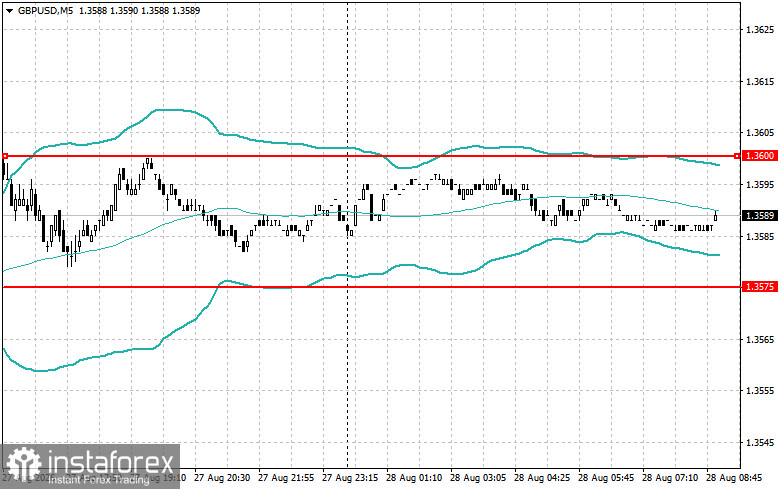
It is this duality that has defined the dollar's cautious reaction, as it retreated slightly. For the euro and the pound, this weakening provided moderate support, and both European currencies strengthened slightly, as the concerning signals from trade and inventories outweighed the strength of the labor market. Nevertheless, all the intrigue today has shifted to Warsh's speech in Jackson Hole, from which the market is expecting signals about the Federal Reserve's further course, so the sustainability of the growth in EUR/USD and GBP/USD is still in question.
Today, in the first half of the day, attention to the euro will focus on a block of European data, including changes in Germany's unemployment rate and unemployment figures, as well as important consumer inflation data and GDP figures from France. The unemployment rate reflects the state of the labor market in the bloc's largest economy; the consumer price index shows inflationary pressure and directly influences expectations regarding the European Central Bank rate; and GDP measures the economy's growth rate. Together, these indicators provide a broad overview and can adjust market sentiment.
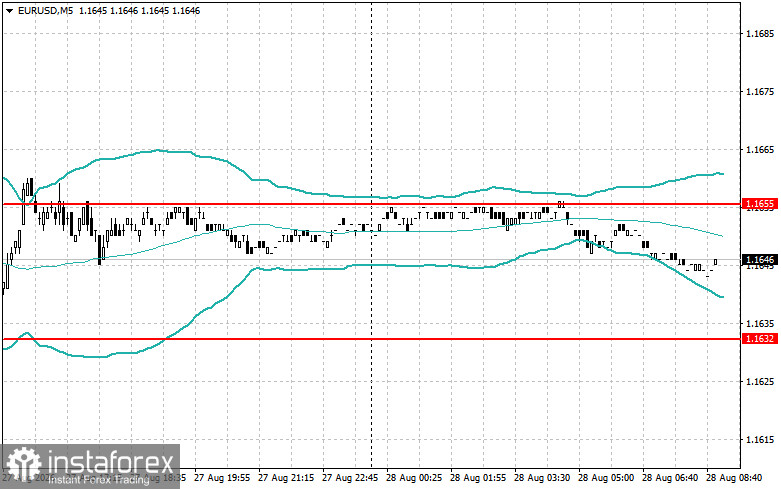
However, the bar for the euro is set high. Only strong positive surprises relative to economists' expectations can strengthen the single currency's position, as the market has already priced in a certain scenario. If the data confidently exceeds forecasts, the EUR/USD pair will have a basis for growth, while results that meet expectations or are weaker will leave the initiative in the dollar's hands. Before the data release, the euro is likely to remain cautious.
If the data align with economists' expectations, it is better to adopt a Mean-Reversion strategy. If the data is significantly higher or lower than expectations, it is best to use a Momentum strategy.