
Veja também


 07.09.2026 08:42 AM
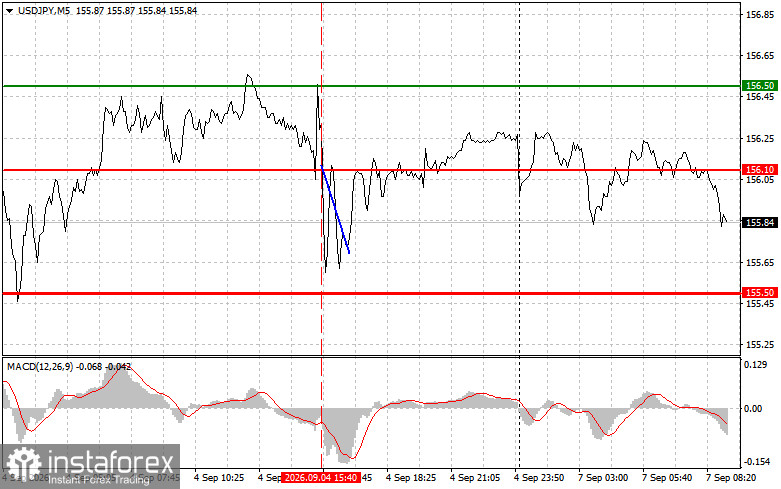
The price test at 156.10 occurred when the MACD indicator was just beginning to move down from the zero line, confirming the correct entry point to sell the dollar. As a result the pair fell about 40 pips.
The August NFP came in materially stronger than expected, adding 162,000 jobs versus a 55,000 consensus, and revisions to prior months all but erased the story of a weakening labor market. For the dollar, this was a powerful fundamental argument, since the dovish stance of parts of the Federal Reserve was built precisely on weak employment, and that support vanished. Under normal circumstances, I would have expected a confident rise in USD/JPY on the back of such a report. However, the yen situation is currently special because the Bank of Japan, in coordination with the US, continues currency intervention, keeping the dollar under pressure. In my view, this confrontation between fundamentals and direct intervention is what now determines the pair: a strong employment report pulls USD/JPY up, while ongoing regulatory actions push it down. I believe that in the near term intervention can restrain the pair's rise, but it will become increasingly difficult for the market to ignore such a robust labor market.
The resolution now shifts to the inflation report on September 11, since it will determine how hawkish the Fed will be. For now, I keep in mind that if the dollar attempts to recover the strong NFP, USD/JPY buyers risk bumping into further intervention by Japanese authorities, so I expect sharp moves in the pair with caution in both directions.
As for intraday strategy, I will rely mainly on execution of Scenarios No. 1 and No. 2.
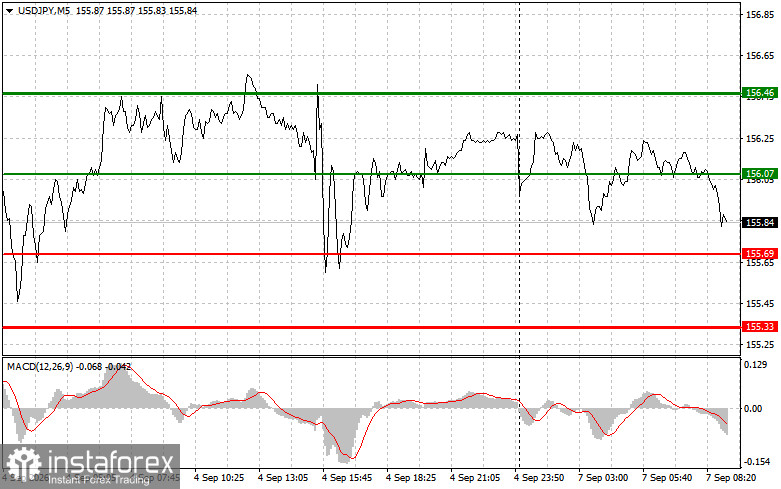
Scenario No. 1: I plan to buy USD/JPY today if the entry point around 156.07 (the green line on the chart) is reached, with a target to rise to 156.46 (the thicker green line on the chart). Around 156.46, I intend to exit long positions and open short positions in the opposite direction (expecting a 30–35 pip move in the opposite direction from that level). It is best to return to buying the pair on corrections and significant pullbacks in USD/JPY. Important! Before buying, make sure the MACD indicator is above the zero line and is just beginning to rise from it.
Scenario No. 2: I also plan to buy USD/JPY today in the event of two consecutive tests of 155.69, with the MACD indicator in an oversold area. This will limit the pair's downside potential and lead to an upward reversal. One can expect a rise toward the opposite levels of 156.07 and 156.46.
Scenario No. 1: I plan to sell USD/JPY today only after the 155.69 level (the red line on the chart) is broken, which will lead to a rapid decline in the pair. The key target for sellers will be 155.33, where I plan to exit shorts and immediately open longs in the opposite direction (expecting a 20–25 pip move in the opposite direction from that level). Sellers will return at any moment — we only need any hint from the central bank. Important! Before selling, make sure the MACD indicator is below the zero line and is just beginning to decline from it.
Scenario No. 2: I also plan to sell USD/JPY today if there are two consecutive tests of 156.07 while the MACD indicator is in an overbought area. This will limit the pair's upside potential and lead to a downward reversal. One can expect a decline toward the opposite levels of 155.69 and 155.33.
Important: Beginner traders in the Forex market need to be very cautious when making entry decisions. It is best to stay out of the market ahead of significant fundamental reports to avoid being caught in sharp price fluctuations. If you decide to trade during news releases, always set stop orders to minimize losses. Without stop orders, you can quickly lose your entire deposit, especially if you do not employ money management practices and trade large volumes.
Also, remember that successful trading requires a clear trading plan, similar to the one provided above. Making spontaneous trading decisions based on current market conditions is inherently a losing strategy for intraday traders.


