
Veja também


 15.10.2026 10:24 AM
Chicago Fed President Austan Goolsbee said yesterday that the US inflation report, which showed broad-based price pressures in September, was concerning. He also warned that the construction of infrastructure for artificial intelligence could overheat the economy.
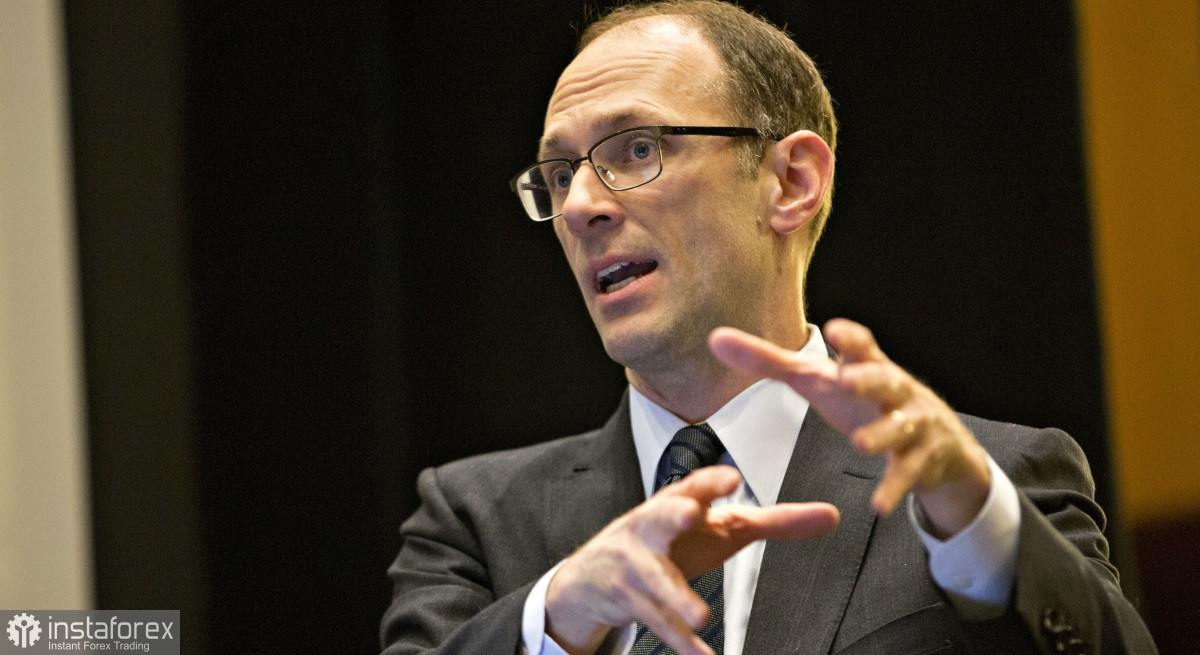
"I found it discouraging," Austan Goolsbee, president of the Federal Reserve Bank of Chicago, said in an interview. His remarks came shortly after the Consumer Price Index was released and added weight to the arguments of those who believe the Fed should not pause its tightening cycle too soon. Data from the Bureau of Labor Statistics showed that consumer prices rose by 0.6% month over month in September, following a 0.4% increase in August, marking the fastest pace in five months. Annual inflation accelerated to 3.7% from 3.4%. Core inflation, which excludes food and energy, rose by 0.3%, exceeding the forecast of 0.2%, while the annual rate accelerated to 2.6% from 2.4%. Core inflation is of greatest concern to policymakers because it reflects persistent price trends rather than one-off increases in fuel prices.
Goolsbee emphasized that persistent inflation in the services sector indicates that price increases are not limited to categories affected by supply shocks, such as tariffs and the war with Iran. This creates conditions for second-round inflationary effects in the economy, a development that many central banks are particularly concerned about. This is also a key argument because it undermines the view that inflation will subside on its own once the shocks ease. If service prices continue to rise, it suggests that price pressures are spreading to domestic demand and wages. Monetary policy can address this process only by maintaining higher interest rates.
The context of the Fed's policy decisions is also important. Last month, the central bank raised interest rates out of concern that, without higher borrowing costs, returning inflation to 2% would take longer. According to the median projections published after the September meeting, most committee members believed that another rate hike would probably be necessary this year. Federal funds rate futures indicate that investors expect such a move in December.
At the same time, Goolsbee noted that it is still too early to determine whether the current policy rate is sufficiently high to achieve the inflation target. This differs significantly from the position of New York Fed President John Williams, who suggested the previous day that one more rate hike could take place this year but saw no need for an increase in 2027.
In my view, Goolsbee's position appears more realistic following the latest data because uncertainty about the neutral interest rate means that the possibility of further monetary tightening must remain open. His stance is closer to that of hawkish policymakers such as Beth Hammack and Lorie Logan, who have already argued that more than one additional rate hike may be necessary.
A separate warning concerns artificial intelligence. Goolsbee acknowledged that he is now more concerned that data center construction and AI investment could be overheating the economy. He said it is important to prevent overheating from building up because demand-driven overheating tends to be persistent and difficult to reverse.
The implications for financial markets are relatively straightforward. If the Fed sees a risk of demand-driven overheating rather than pressure stemming solely from energy prices, the October pause is likely to be a brief respite rather than the beginning of the end of the tightening cycle. This would support bond yields and the US dollar while putting pressure on technology stocks, which are already facing doubts about the returns on AI investments. Attention is now turning to Fed Chair Kevin Warsh's speech in Bangkok, which will be his last public appearance before the communications blackout ahead of the October 27–28 meeting.
As for the current EUR/USD technical outlook, buyers need to break above the 1.1240 level. This would open the way toward a test of 1.1275. From there, the pair could advance to 1.1310, although achieving this without support from major market participants would be quite difficult. If the pair declines, significant buying activity is expected only near 1.1190. If no substantial buying interest emerges there, it would be preferable to wait for a new test of the 1.1155 low or consider opening long positions at 1.1125.
As for the current GBP/USD technical outlook, pound buyers need to break above the nearest resistance at 1.3250. This would open the way toward 1.3280, although breaking above that level would be quite difficult. The next major target is the 1.3310 level. If the pair declines, bears will attempt to regain control below 1.3225. If successful, a break below this level would deal a serious blow to the bulls and push GBP/USD toward the 1.3200 low, with the potential for a further decline to 1.3180.


