
Veja também


 19.10.2026 12:49 PM
The test of the 1.3320 price level occurred just as the MACD indicator was beginning to move down from the zero line, confirming that it was an appropriate entry point for selling the pound. As a result, the pair declined by only 15 points.
In the absence of major economic data releases, oil prices and geopolitics are once again taking center stage for GBP/USD. The market views high oil prices as an inflationary factor and, consequently, as an argument in favor of a restrictive Federal Reserve policy. In the September US inflation report, a 9.1% monthly increase in gasoline prices accounted for more than half of the overall rise in the Consumer Price Index, which reached 3.7% year over year. The link between oil prices, inflation, and expectations for US interest rates is therefore quite tangible.
The pound is affected in two ways. On the one hand, it loses ground against the US dollar when the greenback strengthens as a safe-haven asset. On the other hand, the UK economy itself is sensitive to fuel prices. In early October, S&P Global noted that sharply rising fuel prices amid the conflict in the Middle East continued to accelerate cost inflation in the UK services sector, while the prices charged by companies increased at their fastest pace since May. As long as news from the region remains unsettling, GBP/USD is likely to remain under pressure from the US dollar.
The US economic calendar today features only the NAHB Housing Market Index for October. This survey of homebuilders helps assess new home sales conditions and expectations for the coming months. It will most likely be a secondary factor for GBP/USD, as market attention is focused on geopolitics and oil prices, while the dollar is influenced by sentiment surrounding these issues.
Regarding the intraday strategy, greater emphasis will be placed on implementing Scenarios No. 1 and No. 2.
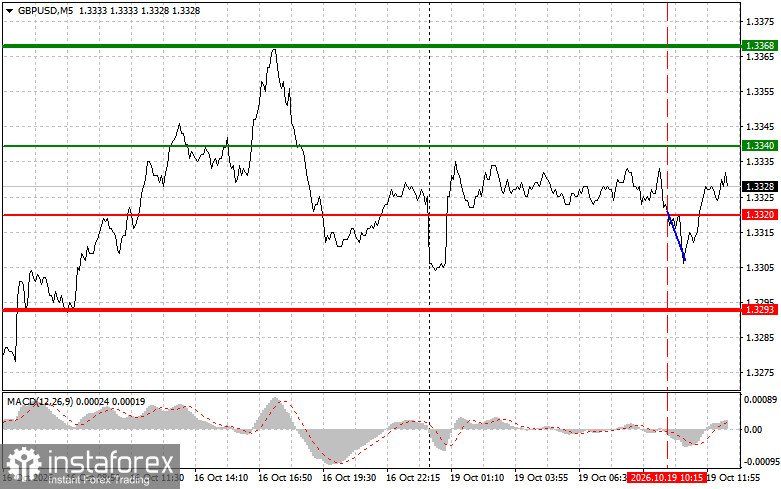
Scenario No. 1: The plan is to buy the pound today when the entry point near 1.3340 is reached (the green line on the chart), targeting a rise to 1.3368 (the thicker green line on the chart). Near 1.3368, the long position will be closed and a short position opened in the opposite direction, targeting a move of 30–35 points downward from that level. The pound may rise today if US economic data comes in weaker than expected. Important! Before buying, make sure that the MACD indicator is above the zero line and is just beginning to rise from it.
Scenario No. 2: The pound can also be bought today if the price tests the 1.3320 level twice consecutively while the MACD indicator is in the oversold zone. This would limit the pair's downward potential and trigger a reversal to the upside. The pair could then rise toward the opposite levels of 1.3340 and 1.3368.
Scenario No. 1: The plan is to sell the pound today after the 1.3320 level is broken (the red line on the chart), which could trigger a rapid decline in the pair. The key target for sellers is 1.3293, where the short position will be closed and a long position opened immediately in the opposite direction, targeting a 20–25-point move upward from that level. Strong selling pressure on the pound could return if the geopolitical situation deteriorates. Important! Before selling, make sure that the MACD indicator is below the zero line and is just beginning to decline from it.
Scenario No. 2: The pound can also be sold today if the price tests the 1.3340 level twice consecutively while the MACD indicator is in the overbought zone. This would limit the pair's upward potential and trigger a reversal to the downside. The pair could then decline toward the opposite levels of 1.3320 and 1.3293.
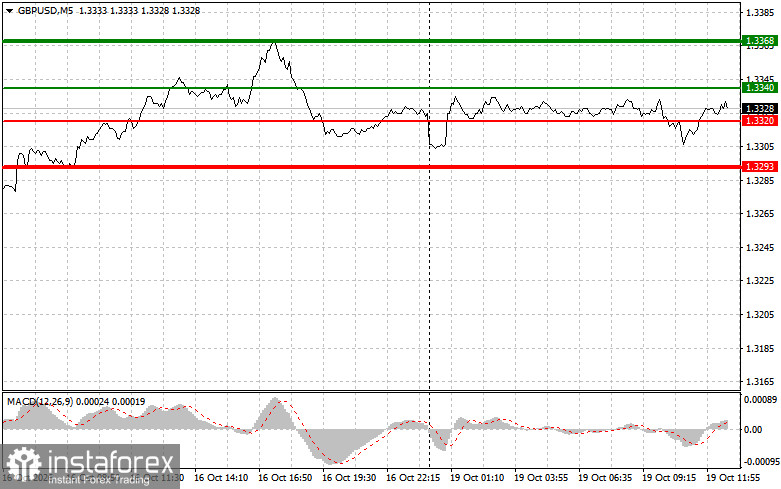
Important. Beginner Forex traders should exercise considerable caution when making entry decisions. Before the release of major fundamental reports, it is best to stay out of the market to avoid exposure to sharp exchange-rate fluctuations. If trading during news releases, always place stop-loss orders to minimize losses. Without stop-loss orders, the entire trading account can be depleted very quickly, especially when large position sizes are used without proper money management.
Remember that successful trading requires a clear trading plan, such as the one outlined above. Making spontaneous trading decisions based on current market conditions is a fundamentally losing strategy for an intraday trader.


