
Veja também


 30.10.2026 12:10 PM
Yesterday, the euro reacted sharply to the European Central Bank decision. The deposit rate remained at 2.5%, and the main rate stayed at 2.65%. All of this was expected, but Christine Lagarde's words proved to be something of a surprise.

Lagarde, who will resign in February next year, said that current inflation above 3% does not worry her much overall, although it is far from the 2% target. She said she does not see second-round effects and blamed energy prices and the war in the Middle East. In her view, once that is over, prices will return to the desired path, so there is no special reason for alarm.
Lagarde did not speak directly about a December rate hike, but her remarks made clear the central bank will not tolerate persistent high inflation. On the one hand, she reassured markets; on the other, the ECB continued to take a hard line. That partly helped the euro, but then attention shifted to US data.
US GDP was released. The day before, after the Fed's decision to hold rates, Fed chair Kevin Warsh said he expected growth above 3% in Q3. The market quickly priced that in, and the actual figure was 3.4% versus a 3.2% forecast and 2.2% in Q2. There was no particular market reaction to this, because the main focus was on the personal consumption expenditures index. The annual figure was forecast to rise from 3.4% to 3.6% and the monthly September print from 0.3% to 0.5%—and that is exactly how it turned out. The data fully matched expectations and reassured those who feared the Fed had erred by not hiking on Wednesday and needed to be more aggressive. There was no sharp increase in price pressure, even though oil remains at yearly highs and has no sign of retreat, since the Middle East situation remains unresolved.
Now, let us turn our attention to the economic calendar, where there are plenty of events today, especially in Europe. France will publish GDP with a forecast of +0.1%—fairly disappointing—and also CPI with a monthly forecast of +0.2% after a decline a month earlier. Germany's GDP is forecast at +0.1% after +0.3%, which is also weak. Eurozone Q3 GDP is forecast at +0.2% after +0.6% in Q2 and +1.1% y/y. That is very little for the European economy, and weaker prints could put pressure on the euro, although after the US data it felt relatively OK. German inflation is also expected, and growth is forecast to be less strong than a month ago—which may also deter traders from buying the euro.
As for the US, only the Chicago PMI is due today—the consensus is 55.8, a fairly high reading but down from 58.8 last month, so a decline could weigh on the dollar. We will also hear from ECB member Philip Lane, who may say a few words about Lagarde's departure and possible successors. But even that long-anticipated departure did not shock markets yesterday; the euro was trading mainly on the data, and attention will remain on data today.
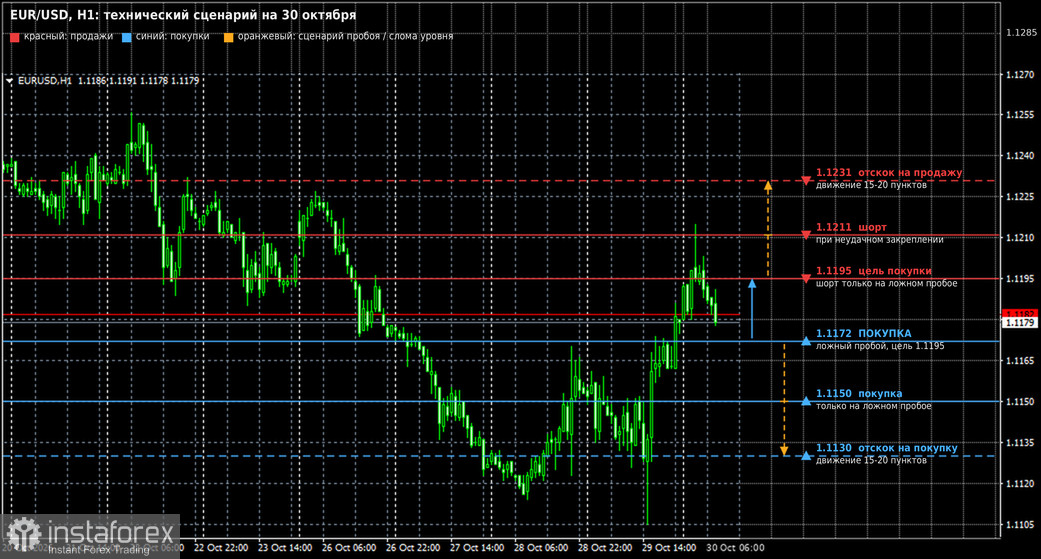
If the price breaks and holds below, trading will move under that level, and strong US data combined with a cautious ECB would push the pair toward 1.1115. A break of that band would drive the euro down to ~1.1082, where I will look for buys on a 20–25 pip rebound. Longs are considered from 1.1115 or 1.1136 on false breaks.
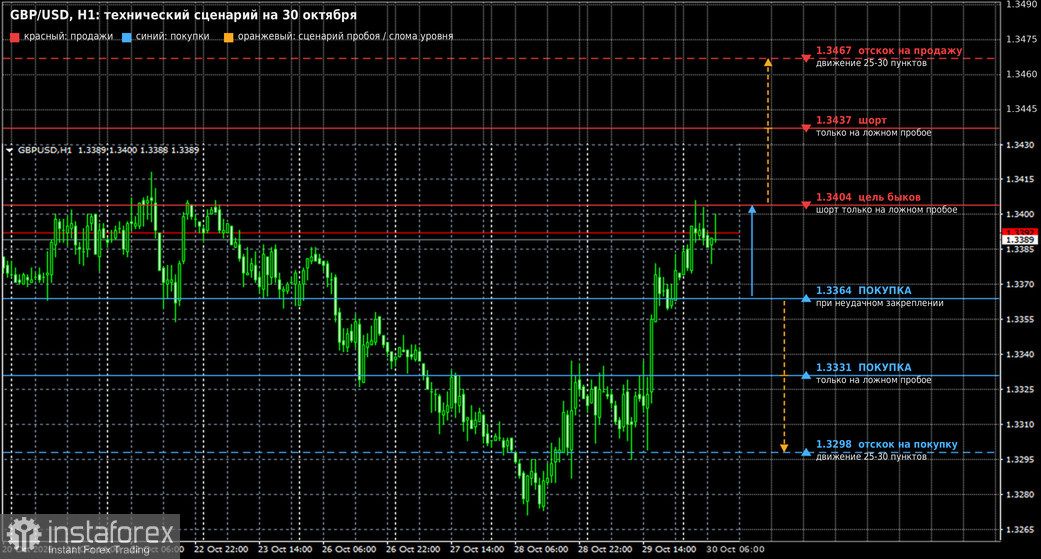
GBP/USD: the weekly decline has been fully retraced, and the immediate target for bulls is 1.3404. A break and close above that band would open a move to 1.3437, with a farther target at 1.3467, where I plan to sell on a rebound for 25–30 pips. Shorts from last week's high at 1.3404 are only on failed breaks (as in the Asian session) or on a failed break of 1.3437. The bullish market still has a good chance to continue. If bears increase pressure, buy-the-dip trades at 1.3364 on a failed hold or at a false break of 1.3331 are possible. If the situation deteriorates further, I would buy a rebound from 1.3298 for 25–30 pips.
I think the main test for the euro on the last day of October will be eurozone GDP. I fully allow that weak figures for France and Germany could outweigh Lagarde's hawkish words, especially if German inflation disappoints. The pound's outlook is calmer; absent unpleasant surprises in UK data, the bullish stance may hold.


