
Veja também


 20.11.2026 08:47 AM
The euro's decline continued, and yesterday's bounce proved short-lived. During the day, the pair rallied above 1.1000, then slid down and fell overnight to about 1.0962. Now EUR/USD stands near 1.0979 — roughly 17 pips recovered. Since November 10, when the pair was around 1.1229, the euro has lost about 250 pips. Dollar demand remains very strong, and neither euro-area data nor weak U.S. figures have been able to stop it.
Yesterday the eurozone current-account balance for September printed €12.5 billion versus €16.6 billion expected. The larger the surplus, the stronger external demand for the euro, since foreign buyers must convert into the currency. August's figure was revised up from €8.7bn to €11.6bn, but September still missed estimates. On October 20, the disappointing €8.7bn (versus €25.2bn expected) pushed the euro down; now, a miss provoked almost no reaction. Construction activity rose 0.10% after a 0.49% decline — a secondary data point that changed nothing.
U.S. data were weak. The Philly Fed manufacturing index — a survey of factories in the region — plunged to 6.3 versus a 20.6 forecast. In September, it was 37.8 and fell sharply in October. Initial jobless claims were 203k versus a 198k forecast (compared with a 189k print on November 5, a multi-decade low). Such numbers would normally weigh on the dollar, but they didn't.
Words from Fed officials outweighed the data. Mary Daly, president of the Federal Reserve Bank of San Francisco, said on November 10 that gradual further tightening was appropriate, clarifying that any pause is about pace, not direction. Yesterday in New York, she cautioned against explicit rate promises outside crisis periods but stressed that policy decisions must be explained; she noted she supported the October pause.
The European Central Bank picture is different. The deposit rate is currently 2.50%; a rise to 2.75% on December 17 is expected, and many see that step as the last. Bundesbank President Joachim Nagel said yesterday rates need to be raised and warned of possible second-round inflation effects; on October 16 he had only said further steps could not be ruled out, so his tone has hardened. However, the market expects the Fed to hike again in January, and the divergence in central-bank stances continues to weigh on the euro.
Today's calendar is busier. Germany publishes October producer prices, with a monthly forecast of 0.9% after 1.9% in September. PPI measures how quickly factory output prices are rising and often leads consumer inflation. The September 1.9% outturn exceeded expectations; a slowdown to 0.9% would mean input-cost pressure is easing, though that monthly gain would still be rapid. Germany's wholesale prices rose 0.4% month-on-month in October, as expected, with year-on-year gains at 8.8% after 8.7%, while consumer inflation eased to 2.8% from 3.3%.
The euro-area consumer-confidence indicator for November will also be released. In October it fell to -17.9 versus -17.0 expected (September was -16.5). Lower readings mean households are more cautious, and spending may weaken. Lagarde and Nagel will speak as well, but their positions are well known, so they are unlikely to provide a fresh impulse for the euro.
Now EURUSD stands at 1.0979, inside a very narrow range between 1.0956 and 1.0984. It is about five pips to the upper boundary and about 23 pips to the lower. A move beyond the border is a breakout, but one touch is not enough—consolidation is required, meaning several consecutive five-minute candles must close beyond the level.
From above 1.0984 is active. Consolidation above it opens the way to 1.1010 and then to 1.1040. The first target lies just above yesterday's high around 1.1006, where the pair has already reversed down, so I expect sellers there. The second target, 1.1040, is far away, and reaching it without a clear catalyst would be difficult. Yesterday, the pair failed to reach the 1.1022 buying level by roughly 16 pips, which shows buyer weakness. A hawkish tone from Lagarde or Nagel could provide a reason, but their positions are well known, so I have little faith in an upside burst.
From below, the reference is 1.0956; consolidation below it leads to 1.0927 and then to 1.0897. I consider this direction primary. Yesterday 1.0956 was the first downside target, and the overnight low near 1.0962 stopped about six pips above it, after which the pair bounced. If you recall where the euro stood earlier — around 1.1229 on November 10, around 1.0996 yesterday daytime, and 1.0979 now — the picture is clear: each day is lower than the previous one. It is about 23 pips to the level. If consolidation below occurs and U.S. data and Fed officials again support the dollar, a drop to 1.0927 could be rapid. I would not enter on the first touch.
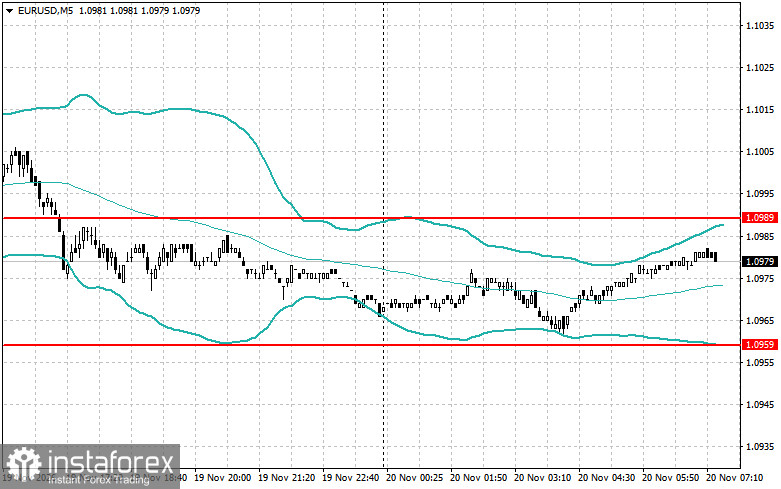
There are two levels here, 1.0989 and 1.0959. The upper reference, 1.0989, lies five pips above the upside breakout point, 1.0984, so special caution is needed. The two marks sit close together, and on the first touch it is impossible to tell which scenario has been triggered. If the price consolidates above 1.0989, the upward breakout is working, and you must not sell there. If, however, it reaches 1.0989, finds no continuation, and quickly returns below, I consider selling toward 1.0959 with a stop above 1.0995 — i.e., above the breakout point with a small margin. That picture is likely if German producer prices print close to forecast and the market retraces after the initial reaction. The difference between the two scenarios may take several minutes, so it is better to skip the first reaction in the zone.
The lower reference 1.0959 lies just three pips above the downside breakout point 1.0956 and 20 pips below the current price. The overnight low near 1.0962 stopped three pips above this level, so buyers have already appeared here. The scheme is this: price falls to 1.0959, cannot consolidate below, and returns higher; then I look to buy toward 1.0989 with a stop below 1.0950. A buffer is necessary because price often slips a few pips beyond the level, and a stop exactly at 1.0956 could be taken out. A rebound is likely if the Fed offers no new hawkish words and the market starts taking profits at the end of the week. If the price confidently consolidates below 1.0956, the return is canceled and the downward breakout to 1.0927 works.


