
Veja também


 24.11.2026 08:55 AM
Yesterday, the US dollar strengthened notably against the euro and the pound sterling — interesting because it happened amid events that might have been expected to work against it. Over the day, EUR/USD fell from 1.0984 to 1.0909, and GBP/USD from 1.3111 to 1.3038 — both currency pairs lost roughly 75 pips and broke down out of their sideways channels. The euro hit a monthly low at 1.0884, while the pound dropped to around 1.3012. The prior session's scenario — where a break of 1.0956 opened the way to 1.0927 and 1.0897 — played out almost in full, and the pound moved even deeper than the mentioned 1.3078 into the area below 1.3049.
Let's start with euro?area data, to which the euro gave a muted response. The preliminary November services PMI for the euro area fell to 51.2 from 51.4 versus a forecast of 51.8 — a five?month low — while the manufacturing PMI rose to 52.9 from 52.7 in line with expectations. The composite index remained at October's 51.7 versus a forecast of 51.9, which is not a bad outcome. So if services had been supporting the economy before, manufacturing has taken over that role now. Dispersion within the region is large: in Germany services rose to 54.0 (forecast 52.4) and manufacturing to 55.0 (forecast 54.1), while in France services were 46.6 and manufacturing 47.9 versus a forecast of 49.8. Recall that a similar release in October disappointed — the composite came in at 51.9 versus 52.7, and the euro fell sharply — but this time the market's reaction was muted, and the euro received no support, since business expectations fell to their lowest since May.
UK data disappointed more. Services activity came in at 52.0 after 52.8 versus an expected rise to 53 — a five?month low — the composite dropped to 52.3 from 52.9, and manufacturing was roughly 52.7 versus 52.8. Employment has slipped again after a small rise in October (the first in more than two years), and costs are rising at the slowest pace since July, i.e., price pressures are cooling. After a small upside correction, this pushed the pound down and triggered a sell?off that was amplified by Fed speakers' comments. Notably, on November 5 Bailey linked a second Bank of England hike to a return of energy prices to previous levels, and in my view cooling energy prices and cheaper oil make a December move less certain than it looked after the 3.6% October inflation print.
In the US, services activity unexpectedly slowed to 54.7 from 56.1 versus a forecast of 55.6, manufacturing fell to 54.5 from 54.9 in line with expectations, and the composite printed 54.6 versus 55.9 in October — a four?month low. New orders rose at the slowest pace since July and price indicators at the slowest since August, though they remain high. But, as we see, the dollar was indifferent to that, and we saw a similar pattern on Thursday when the Philly Fed index was 6.3 versus a forecast of 20.6 and pairs stayed in their channels.
Fed policymakers also spoke yesterday. Christopher Waller said rates should be raised gradually, that the economy is strong and inflation high and persistent, and therefore must be fought. However, his tone was softer than on November 18 when he urged consideration of a 50 bp move in December. John Williams added he does not rule out increases at consecutive meetings — which could have triggered further dollar buying — though nearly all Fed officials have made similar remarks over the past two weeks, so this was not new market news. The more important development was the shift in expectations. Last Friday, after the equity crash, rate?hike expectations fell, swaps stopped fully pricing a December hike, and yesterday they recovered amid a tech?sector rebound after news around Nvidia's CEO, with the Nasdaq jumping sharply after its worst week in more than six years. Treasury yields were falling at the same time, which should have weakened the dollar, but that had little effect. Why? I'd venture the market trades the Fed's trajectory rather than day?to?day yield moves, and as long as that trajectory remains upward traders keep adding long dollar positions.
For today, in the first half of the day, Germany's Ifo indicators for November are due. The business climate is forecast at 90.5 after 90.2, the current?situation assessment at 89.2 after 88.8, and expectations at 92.0 after 91.6 — an improvement across the board. Note that in October the overall index rose on the back of expectations while the current?situation assessment worsened, so particular interest will focus on its recovery. If the data beat economists' forecasts, they could support the euro and produce a small upside correction in the pair in the morning. After that, a series of less important releases follow, including the composite housing?costs index and consumer confidence (which was 91.7 in October). I'd also add that Megan Green of the Bank of England, who on October 20 called for a rate hike, will speak — her remarks may matter for the pound after the PMI disappointment. Attention will shift to rate expectations, equity behavior and Fed speakers' comments.
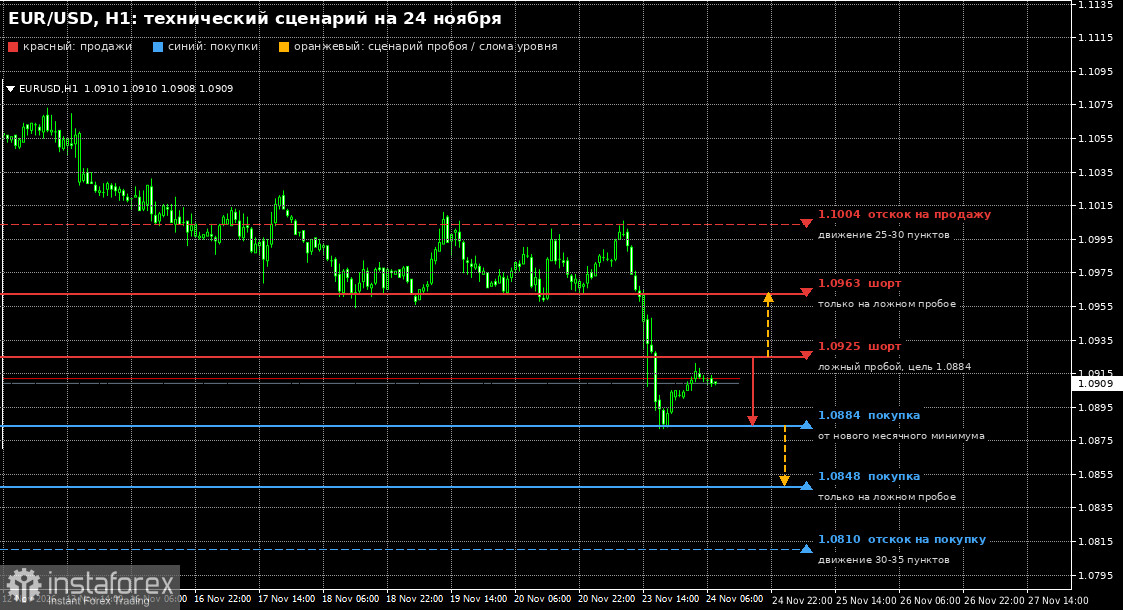
Technical picture for EUR/USD
On the 1-hour chart, look to resistance at 1.0925 for new short positions: a false breakout there following weak German data would be a reason to sell, targeting 1.0884. A break and close below would open the way to 1.0848 and 1.0810, where I would look for buy?on?pullback trades of 30–35 pips, and counter?trend long positions are possible from 1.0848 on a false breakout or from the new monthly low 1.0884. If bulls recover and reverse yesterday's drop, that would only happen after a breakout and close above 1.0925; a retest would push to 1.0963, with a further target at 1.1004 where I would look to sell on a retracement for 25–30 pips. Shorts from 1.0963 and 1.0925 are only on false breakouts. All levels have shifted 36–87 pips lower versus the previous session, when the sell?on?rally began from 1.1040, and the lower buy zone was at 1.0897.
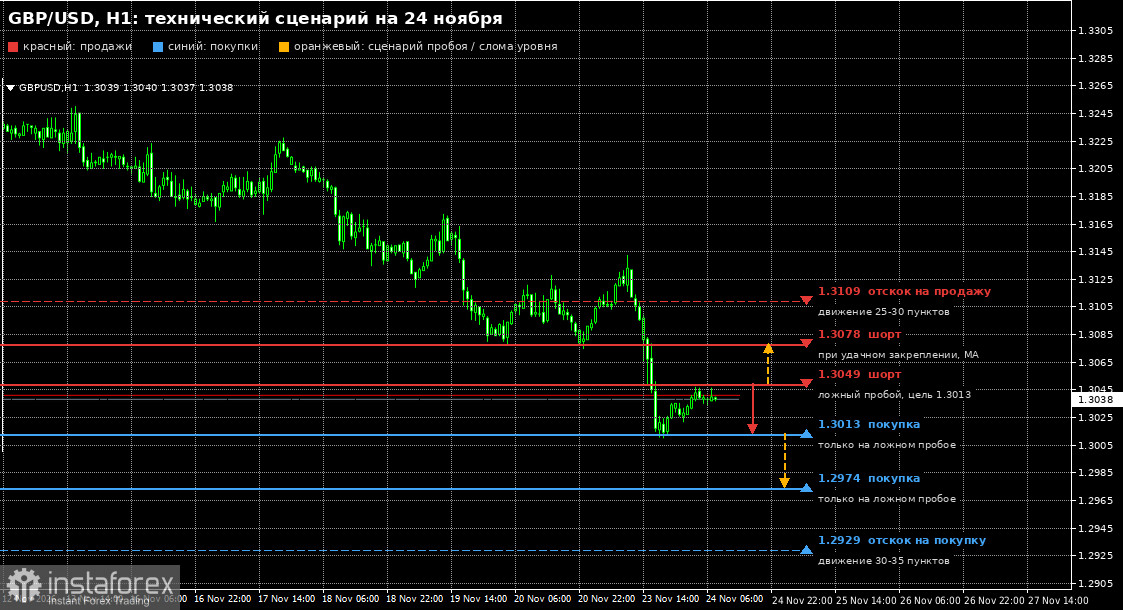
Technical picture for GBP/USD
Yesterday's disappointing services PMI pulled the British pound down. A false break of 1.3049 would be a signal to open shorts targeting 1.3013, while a break and close below that range would push toward a further drop to 1.2974, with a farther target at 1.2929 where I would look for buy?on?pullback trades of 30–35 pips. Longs from 1.2974 and 1.3013 are only on false breakouts. If bulls do not show up at 1.3013 and bears hold 1.3049, then a move beyond that range would likely produce a larger upward impulse toward 1.3078 (near the moving average), where selling on a successful close or shorting bounces from 1.3109 for 25–30 pips are also possible. Compared with the prior session, targets have fallen 79–120 pips, since 1.3049 and 1.3013 were recently buy zones and are now the working range.
The bottom line favors the dollar: the Fed talks of further hikes, rate expectations recovered after Friday's pause, and weak US data are being ignored for now. I lean toward the view that pressure on the euro will persist until the Ifo data and Fed speakers, although good German figures could trigger a small correction toward 1.0925 where sellers, I expect, will be active. The pound's picture is weaker — PMI, cooling prices and falling employment weaken the case for a December BoE hike, so I would not rule out a move to 1.3013 and below until Green says otherwise. The main risk for the dollar remains equities: a renewed tech sell?off would again lower Fed expectations as it did on Friday, and until the Fed meeting on December 9 and the ECB meeting on December 17, the market will react to every such signal.


