
Veja também


 27.11.2026 08:24 AM
Today, oil is heading for its first weekly rise this month. Brent trades around $96 per barrel, up about 4.3% for the week, while WTI holds near $86. By comparison, yesterday morning Brent was above $95 and WTI around $84, and on the morning of November 25 prices were about $90 and $81. Attacks on energy infrastructure and tankers in the Middle East are pushing the market higher, along with fears that escalation could disrupt regional exports.

The Houthis continue methodically striking Saudi targets. The Jazan refinery on the Red Sea has now been hit, forcing part of its operations to halt temporarily. Earlier this week, they struck the Ras Tanura export hub in the Persian Gulf, attacked Riyadh's financial district on November 24, and on November 25 carried out retaliatory strikes on two Red Sea ports. This creates a chain in which each new strike digs deeper into the kingdom's oil infrastructure.
A new flashpoint has emerged in Kuwait. On Thursday, a drone killed two Italian civilians there and wounded two others; Kuwait blamed Iran for the attack. In the Strait of Hormuz on Wednesday, a tanker was hit, according to the UKMTO. Earlier, Tehran said six vessels struck mines, but independent confirmation was lacking — this is the first such case reported by an independent source. Still, transit through the strait rose this month, and that is what has so far kept prices in check.
The market appears to be paying serious attention to the risk. If volumes fall significantly amid new attacks, oil could return to $100 per barrel. Yet excess supply has not gone away. Brent has lost nearly a fifth over the month, down from $116.06 on October 30, as Gulf exports have recovered and the IEA expects a surplus of about 2 million barrels per day this quarter.
President Donald Trump has postponed renewed strikes on Iran since the midterms, although on November 23 he said he might resume strikes after the New Year if talks fail. Refined product markets have also eased: diesel futures in Europe and retail gasoline prices in the US are falling.
The main event this weekend will be the OPEC+ meeting on Sunday, November 29. The alliance is discussing production policy for 2027 and, according to delegates, is considering keeping current quotas through January, as members dispute how much they can pump without harming the market. Iraq is pushing for more room to raise output.
Overall, I do not yet expect Brent to exit the $90–$100 range. If OPEC+ leaves quotas unchanged on Sunday, that would, in my view, provide further support for prices, and any new confirmation of export losses through Hormuz or Saudi terminals would push oil toward $100. The supply surplus the IEA warns of will remain the limiting factor.
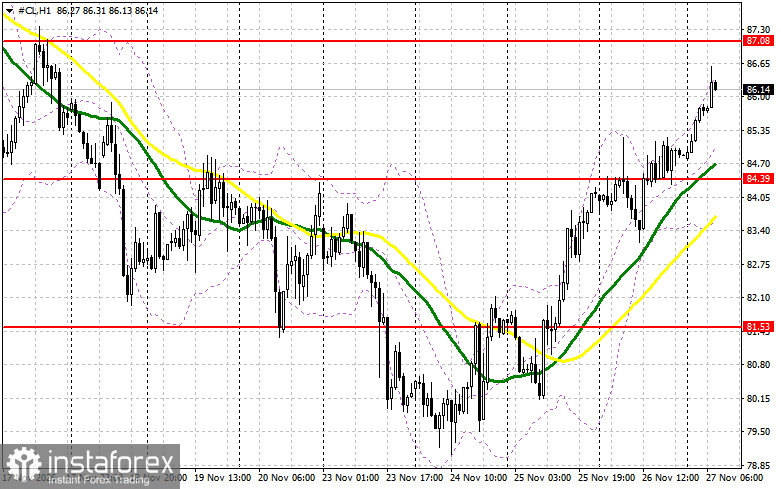
On the technical side, buyers need to take the nearest resistance at $87. That would set up a target of $89, above which a breakout will be difficult. The farther target is around $92. In case of a decline, bears will try to seize control of $84. If they succeed, a range breakout would deal a serious blow to bullish positions and push oil to a low of $81, with a prospect of reaching $78.


