
Vea también


 13.02.2026 08:32 AM
Yesterday, Bitcoin fell to around $65,000, then slightly recovered, and is currently trading at $66,600. Ethereum remains below $2,000, indicating sustained selling pressure.

Against the backdrop of a broader market decline in cryptocurrencies, many financial giants have begun revising their forecasts. For example, yesterday Standard Chartered lowered its short-term forecast for cryptocurrencies, warning that prices could fall further in the coming months before recovering later this year.
The company expects BTC to drop to $50,000 or slightly lower, while ETH may fall to $1,400. The target level for Bitcoin at the end of the year is now set at $100,000, significantly lower than the previous forecast of $150,000. Last December, Standard Chartered also revised its Bitcoin forecast from $300,000 and for Ethereum from $7,500 to $4,000. The company now expects Ethereum to be at $1,400.
Regarding altcoins, forecasts for the end of 2026 suggest that Solana will reach $135, XRP will be around $2.80, BNB will grow to $1,050, and Avalanche will reach $18.
It is worth noting that many analysts and experts expect Bitcoin to decline to around $50,000 in the near future. While this figure is crucial, it's important to understand that it is much closer than the previously anticipated $100,000 for Bitcoin, which we nearly approached at the beginning of this year.
As for the intraday strategy in the cryptocurrency market, I will continue to base my actions on major dips in Bitcoin and Ethereum, anticipating the continuation of the long-term bullish market, which has not disappeared.
Here are the short-term trading strategies and conditions outlined below.
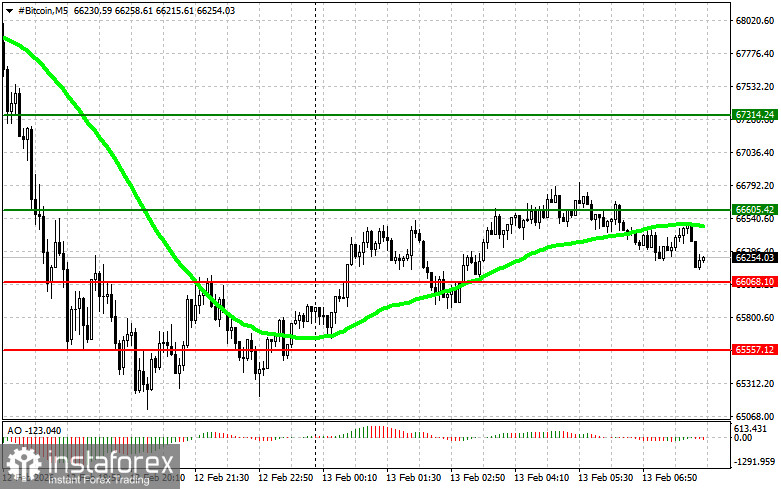
Scenario #1: I plan to buy Bitcoin today when the entry point reaches around $66,600, targeting a move to $67,300. At around $67,300, I plan to exit the purchases and sell immediately on the bounce. Before buying on a breakout, make sure the 50-day moving average is below the current price and the Awesome indicator is above zero.
Scenario #2: I can buy Bitcoin at the lower boundary of $66,000 if there is no market reaction to its breakout back towards $66,600 and $67,300.
Scenario #1: I plan to sell Bitcoin today when the entry point reaches around $66,000, targeting a drop to $65,500. At around $65,500, I plan to exit the sales and buy immediately on the bounce. Before selling on a breakout, make sure that the 50-day moving average is above the current price, and the Awesome indicator is in the zone below zero.
Scenario #2: I can sell Bitcoin at the upper boundary of $66,600 if there is no market reaction to its breakout back towards $66,000 and $65,500.
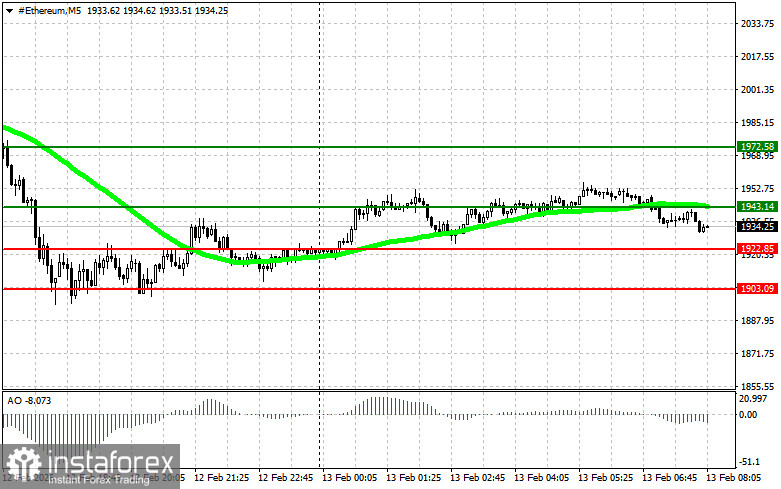
Scenario #1: I plan to buy Ethereum today when the entry point reaches around $1,943, targeting a move to $1,972. At around $1,972, I plan to exit the purchases and sell immediately on the bounce. Before buying on a breakout, make sure the 50-day moving average is below the current price and the Awesome indicator is above zero.
Scenario #2: I can buy Ethereum at the lower boundary of $1,922 if there is no market reaction to its breakout back towards $1,943 and $1,972.
Scenario #1: I plan to sell Ethereum today when the entry point reaches around $1,922, targeting a drop to $1,903. At around $1,903, I plan to exit the sales and buy immediately on the bounce. Before selling on a breakout, make sure that the 50-day moving average is above the current price, and the Awesome indicator is in the zone below zero.
Scenario #2: I can sell Ethereum at the upper boundary of $1,943 if there is no market reaction to its breakout back towards $1,922 and $1,903.


