
Vea también


 23.04.2026 12:34 AM
The second round of negotiations between Iran and the US has failed to take place for the fifth consecutive day. No one currently understands when Iranian and American diplomats will finally meet. Whether this meeting will even happen is also uncertain. Tehran demands the unblocking of the Strait of Hormuz, while Washington refuses but extends the truce. For what reason?
Donald Trump stated on Tuesday that the extension of the truce is due to the division within the Iranian government. According to him, Supreme Ayatollah Mojtaba Khamenei is ready for negotiations with the US, but the Islamic Revolutionary Guard Corps insists on the unblocking of the Strait of Hormuz and Iranian ports before negotiations with Washington can proceed. Trump mentioned that he was asked not to resume strikes on Iran by the Prime Minister of Pakistan and the Iranian Marshal. The Iranian leaders need more time to reach a consensus regarding negotiations with the US, and Trump decided to grant them this time. The U.S. president also indicated an important detail— the ceasefire will remain in effect until negotiations are completed. Consequently, negotiations must first resume and then conclude either with a deal or a definitive failure.
What will happen in either case is probably clear to everyone. In the first scenario, peace in the Middle East for a certain period. In the second scenario, escalation of war. In my opinion, it is unlikely that the negotiations will end with a signed deal. At least at the moment, I see no grounds for that, considering the categorical positions of both sides. At the same time, no one is in a rush to return to hostilities. As I warned, the transition to a protracted conflict has been realized, and it is not fully extinguished; it smolders and can flare up at any moment.
This is likely the best scenario given the circumstances. If the situation in the Middle East does not flare up anew, it will at least give the whole world time to adapt to the new energy reality. Countries with energy resource shortages will look for new suppliers, and oil and gas companies will seek new deposits and develop new territories. The world will gradually get rid of its dependence on Arab oil. And that is good. It is a solution to the problem, however partial. In this case, the cost of oil and gas will at least not continue to rise exponentially. Energy resources will now cost much more than they did two months ago, but I remind you that this is far from the first time in human history that oil has cost over $100 per barrel.
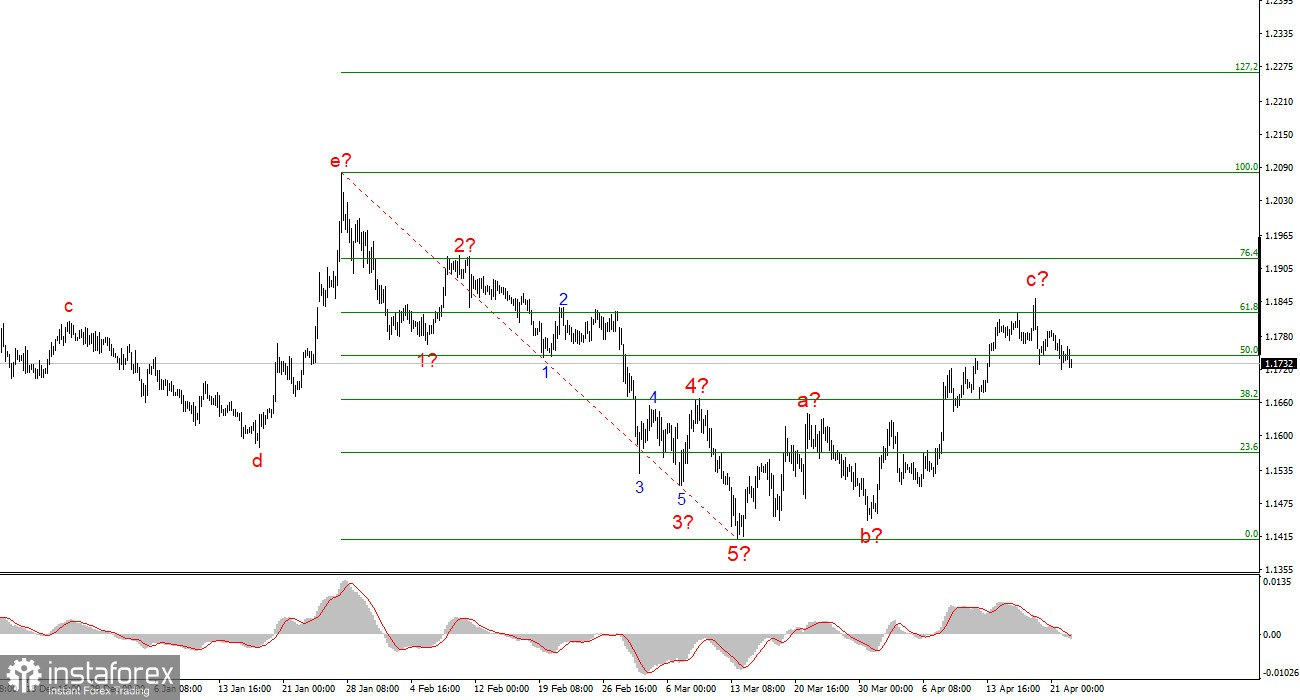
Based on my analysis of EUR/USD, I conclude that the instrument remains within an upward segment of the trend (lower picture) and, in the short term, is within a corrective structure. The corrective wave set appears quite complete and may take on a more complex, elongated form only if a stable and long-term truce is established among Iran, the US, Israel, and ALL the other countries in the Middle East. Otherwise, I believe that a new downward wave set may begin from the current positions. Or at least a corrective wave.
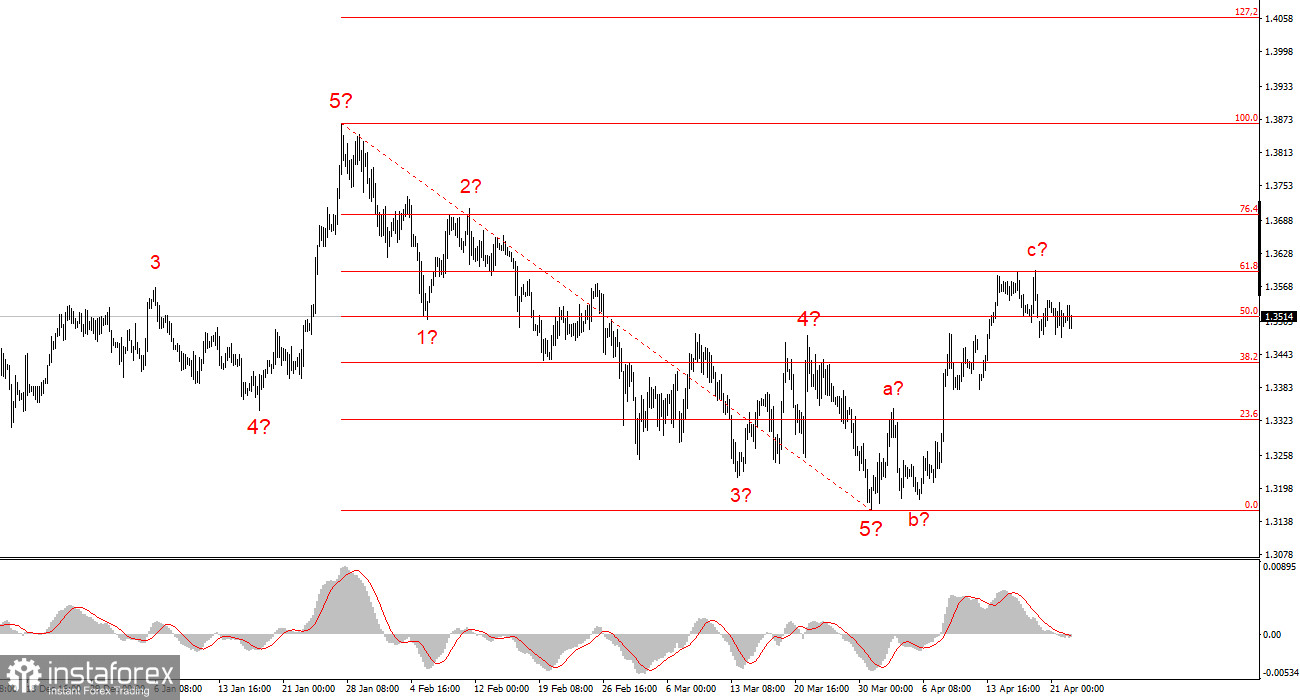
The wave structure of the GBP/USD instrument has become clearer over time, as I had anticipated. Now we see a clear three-wave upward structure on the charts, which may already be completed. If this is indeed the case, we can expect the formation of at least one descending wave (presumably d). The upward segment of the trend may take on a five-wave form, but for that to happen, the conflict in the Middle East needs to cool down, not reignite. Therefore, the base scenario for the coming days is a decline into the 34th figure or slightly below. After that, everything will again depend on geopolitical factors.


