
Vea también


 05.05.2026 07:11 PM
The EUR/USD pair remains in a mild corrective pullback that cannot yet be considered complete. Last week saw a number of important events, but it is hard to say they had a strong impact on trader sentiment or on the pair's movement. The key takeaway from the news flow at the end of April was the ECB's readiness to raise interest rates if inflation continues to accelerate, contrasted with the FOMC's reluctance to take similar action. This provided bulls with another supportive factor, although they were not lacking such support before.
However, on Monday it was reported that Iran attacked a U.S. destroyer in the Persian Gulf near the Strait of Hormuz. Washington quickly stated that the ship had not been sunk, but where the missiles struck—or whether they hit the U.S. Navy vessel at all—remains unclear. Shortly afterward, tensions in the Middle East escalated further, as Iran launched missiles at one of the U.S.'s allies, the UAE, for the first time in over a month. Local reports indicated that a refinery in Fujairah was hit, though there has been no official confirmation or denial. Something is clearly happening in the Middle East, but traders are left to speculate—and the market is no longer willing to rely on speculation. Despite escalation, bears are not rushing to sell, and despite ongoing negotiations, bulls are not eager to buy.
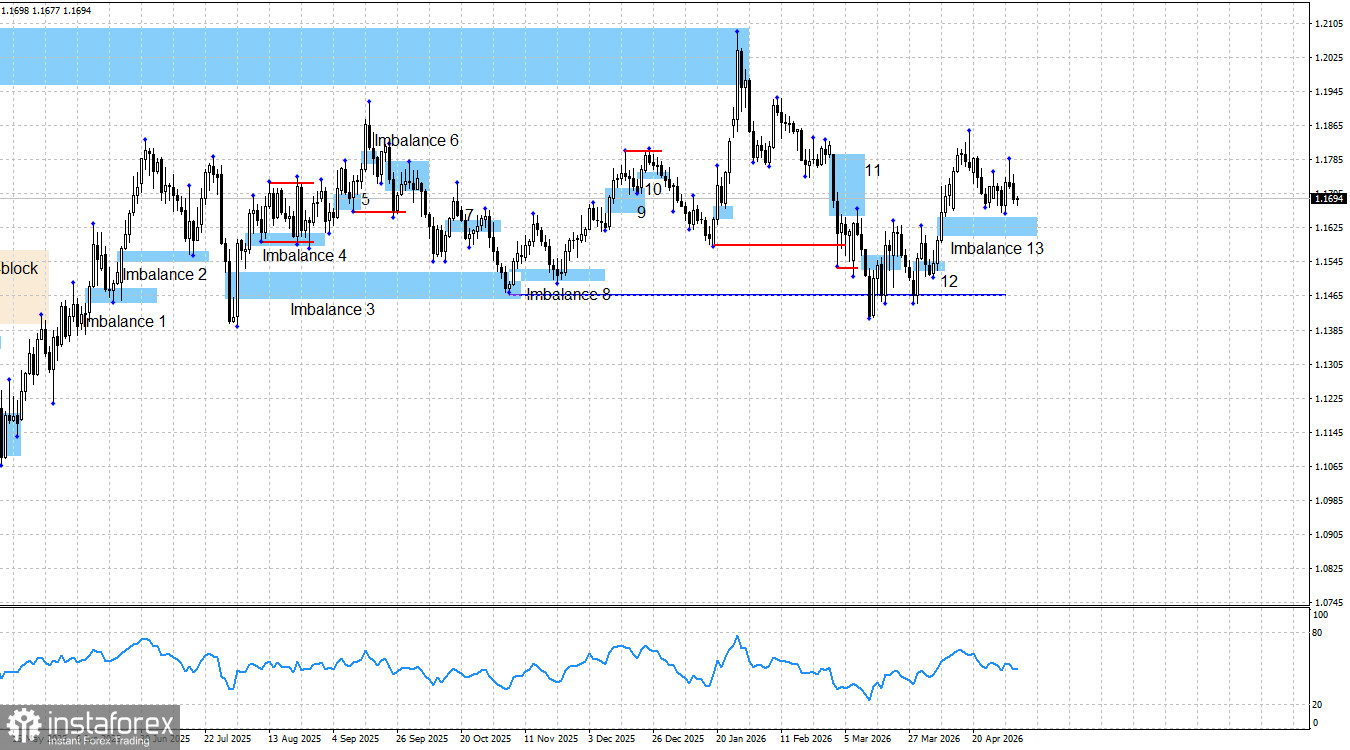
In the current situation, traders are waiting either for a reaction from imbalance 13 or for the formation of new bullish patterns. I continue to view the trend as bullish. Last week, bulls came very close to testing imbalance 13 and generating a signal. Notably, there are no bearish patterns at present, leaving little justification for selling the pair. The last buy signal from imbalance 12 worked well, with the euro gaining approximately 270 points.
It is worth emphasizing again that the U.S. dollar's rally from January to March was driven entirely by geopolitics. As soon as the United States and Iran agreed to a ceasefire, bears retreated and bulls moved aggressively higher. At present, the truce remains fragile but is still in place. I have repeatedly stated that I do not believe the bullish trend has ended, despite the break of key structural lows and the conflict in Iran. The price movement over the past three months could turn into a bearish trend if geopolitical conditions continue to deteriorate. However, markets often price in the worst-case scenario in advance. Therefore, it is possible that traders have already fully priced in the Middle East conflict. For now, bulls lack positive catalysts for further gains, while bears lack negative drivers to push the market lower.
The overall technical picture is clear. The bullish trend remains intact but requires additional support. This week, such support may come from U.S. data on employment, unemployment, job openings, and ISM business activity, as well as from geopolitical developments. As we have seen, Monday began with renewed attacks in the Middle East, but by Tuesday it became clear that a full-scale escalation has not yet occurred.
There was no significant news flow on Tuesday. In the coming hours, ISM and JOLTS reports are due in the United States. The ISM Services PMI is expected to decline slightly, but the market's reaction—or lack thereof—will depend on the actual figure. According to forecasts, JOLTS job openings for March are expected to decline further. Three years ago, the U.S. consistently reported around 10 million job openings per month; over the past year, the figure has remained below 7 million.
There are still many reasons for bulls to push higher in 2026, and even the outbreak of conflict in the Middle East has not reduced them. Structurally and globally, Trump's policies—which contributed to a significant decline in the dollar last year—have not changed. In the coming months, the U.S. dollar may occasionally strengthen due to risk aversion, but this would require continued escalation in the Middle East. I still do not believe in a sustained bearish trend for EUR/USD. The dollar has received temporary support, but what long-term drivers do bears have?
Economic Calendar (U.S. and Eurozone):
U.S.: ADP Employment Change (12:15 UTC)
On May 6, the economic calendar includes only one release, which cannot be considered significant. As a result, the impact of the news flow on market sentiment on Wednesday is expected to be limited.
EUR/USD Forecast and Trading Advice:
In my view, the pair remains in the process of forming a bullish trend. The news backdrop changed sharply two months ago, but the trend itself cannot be considered invalidated or completed. Therefore, bulls may well continue their advance in the near term, provided that geopolitics does not suddenly shift toward renewed escalation.
Traders previously had the opportunity to open long positions based on the signal from imbalance 12, and the upward movement could extend toward the yearly highs. Imbalance 13 has also formed and may provide a new bullish signal in the near future. For uninterrupted growth of the euro, the Middle East conflict would need to move toward a stable peace—something that is not currently evident. Bulls still lack sufficient support but may gain it over the course of the week.


