
Vea también


 06.05.2026 08:47 AM
The price at 157.67 was tested when the MACD indicator had risen significantly from the zero mark, which limited the pair's upward potential. For this reason, I did not buy the dollar.
Today, the Bank of Japan conducted another currency intervention to strengthen the Japanese yen, leading to a sharp decline in the USD/JPY pair. This event marked the culmination of a period of weakness for the Japanese currency, which has shown a downward trend in recent days. A weak yen negatively affects imported goods, raising inflation and reducing the purchasing power of consumers. Additionally, it creates risks for export-oriented companies that lose competitiveness in global markets. Therefore, to stabilize the economy, the BOJ took decisive measures.
Although the decline in the USD/JPY pair was actively bought back, the risk of further central bank currency interventions remains.
Regarding the intraday strategy, I will primarily rely on implementing Scenarios #1 and #2.
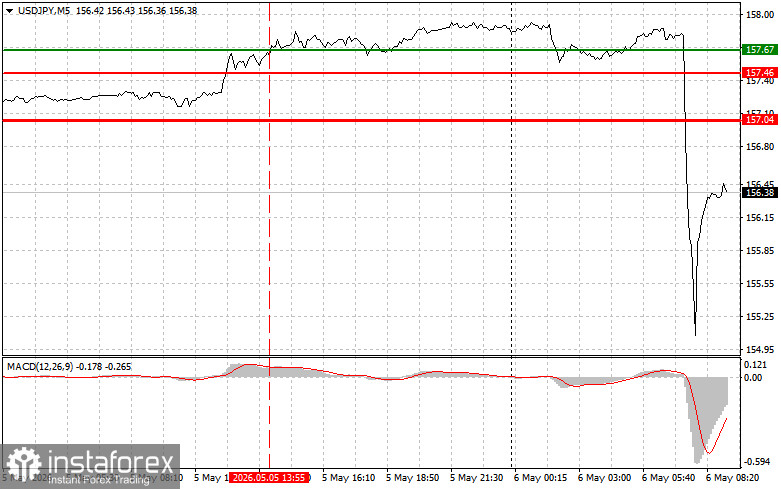
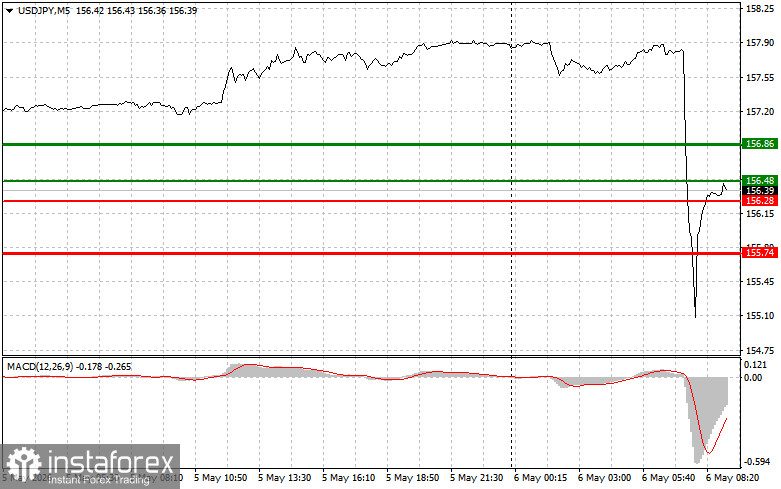
Scenario #1: I plan to buy USD/JPY today upon reaching the entry point around 156.48 (green line on the chart) with a target increase to the level of 156.86 (thicker green line on the chart). Around 156.86, I intend to exit my long positions and immediately sell in the opposite direction (expecting a 30-35-pip move in the opposite direction from this level). It is best to resume buying the pair on corrections and significant pullbacks in USD/JPY. Important! Before buying, ensure that the MACD indicator is above the zero mark and is just beginning to rise from there.
Scenario #2: I also plan to buy USD/JPY today in the case of two consecutive tests of the price at 156.28 when the MACD indicator is in the oversold area. This will limit the pair's downside potential and lead to an upward market reversal. An increase to opposing levels of 156.48 and 156.86 can be expected.
Scenario #1: I plan to sell USD/JPY today only after the 156.28 level is updated (red line on the chart), which will trigger a rapid decline in the pair. The key target for sellers will be the 155.74 level, where I intend to exit my short positions and immediately buy in the opposite direction (expecting a 20-25-pip move in the opposite direction from this level). Sellers could return at any moment; any hint from the central bank would be enough. Important! Before selling, ensure that the MACD indicator is below the zero mark and is just beginning to decline from there.
Scenario #2: I also plan to sell USD/JPY today in the case of two consecutive tests of the price at 156.48 when the MACD indicator is in the overbought area. This will limit the pair's upward potential and lead to a market reversal downward. A decrease to opposing levels of 156.28 and 155.74 can be expected.
Important: Beginner traders in the Forex market need to make entry decisions very cautiously. It is best to stay out of the market before important fundamental reports to avoid sharp price fluctuations. If you decide to trade during news releases, always set stop orders to minimize losses. Without placing stop orders, you can quickly lose your entire deposit, especially if you do not use money management and trade in large volumes.
And remember, for successful trading, it is essential to have a clear trading plan, as outlined above. Making impulsive trading decisions based on the current market situation is fundamentally a losing strategy for an intraday trader.


