
Vea también


 22.05.2026 03:46 AM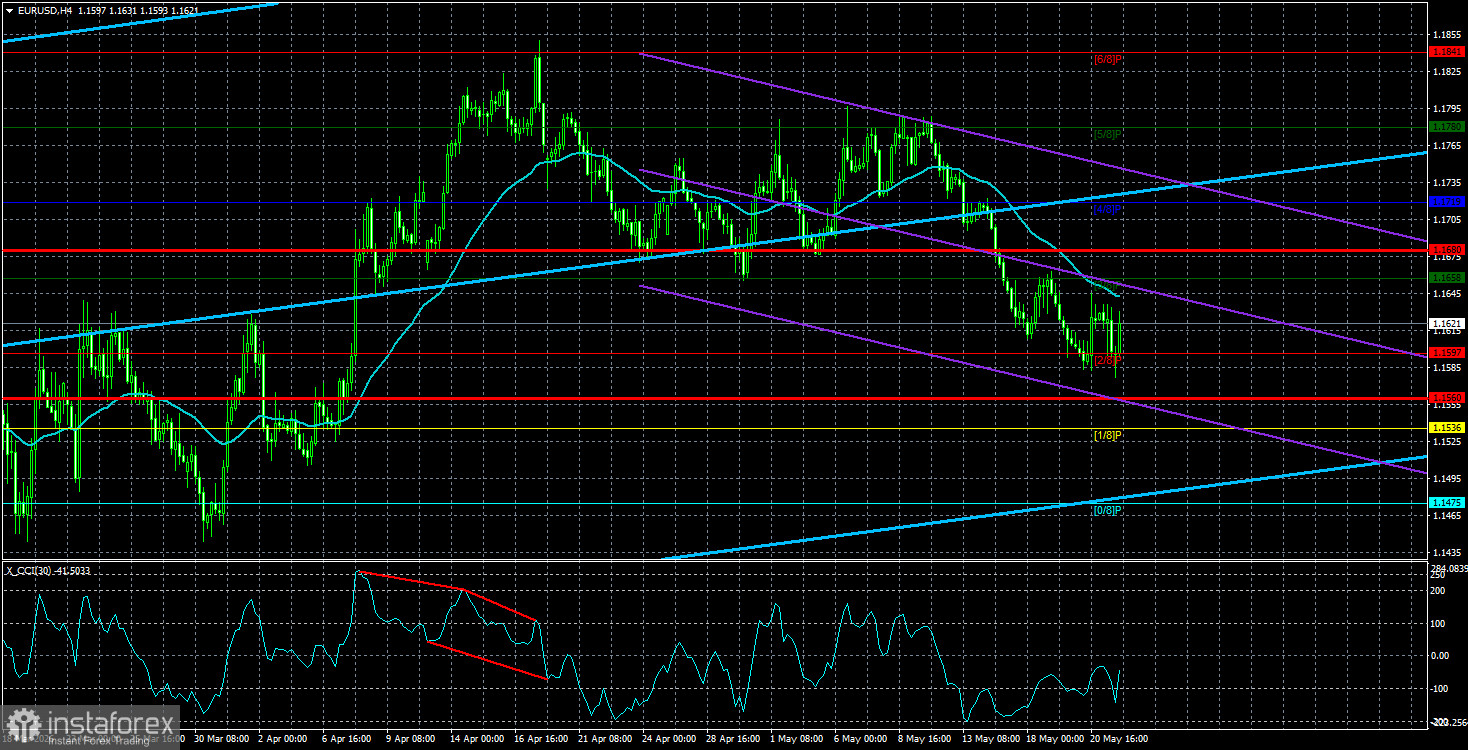
The EUR/USD currency pair traded quite calmly on Thursday. The illustration below shows that the pair's volatility has exceeded 67 pips only once in the last 11 days. This is a fairly average value for the European currency, so we are not talking about increased volatility, despite the daily influx of news.
There is certainly no shortage of news. Recently, it seems that the American and Iranian delegations, along with Donald Trump, are working nonstop. Almost every day, a flood of messages about new agreement projects, plans to open the Strait of Hormuz, new demands, and fresh threats hits the market. Moreover, all these messages come mixed together. Traders might receive news of a breakthrough in the negotiations, and just an hour later, Trump speaks up again about forcibly pressuring Iran into an agreement. Thus, the market continues to jump up and down, reacting almost to every message, whereas it would be better to wait for official information.
We mean there is no point in reacting to yet another threat from Tehran or to yet another statement from Trump saying, "The deal will be signed soon." We have heard both of these things a hundred times already. As the saying goes, the situation remains unchanged. For example, yesterday it was reported that Washington had sent a new draft peace agreement to Tehran. And the day before that, Trump stated that "the negotiations are going very well," and that the leaders of Qatar, the UAE, and Saudi Arabia have convinced him not to launch new strikes on Iran on Tuesday. Tehran, by the way, has yet to respond and has not sent anything to Washington. Tehran very rarely issues official statements. Therefore, it is likely that the US considered it necessary to flood the information space with a variety of news every day.
What does all this lead to? Despite the market's reactions to geopolitical news, the market is in no hurry overall, as evidenced by its activity. Traders no longer take Trump at his word, who alternates between planning new strikes on Iran (only divine grace is holding him back) and preparing to sign an agreement. Therefore, the market has cautiously bought dollars over the last month, but at the same time, it is ready to shed them at any moment if, by some miracle, a deal is actually signed.
It should also be noted that the dollar received slight support from the Federal Reserve, which is now forced to consider tightening monetary policy following a 1.4% rise in inflation over just two months. The minutes of the last Fed meeting confirmed this, but even without them, it was clear that the FOMC would at least consider a possible increase in the key rate. However, we still do not expect significant growth for the American currency unless the war in the Middle East resumes in full.
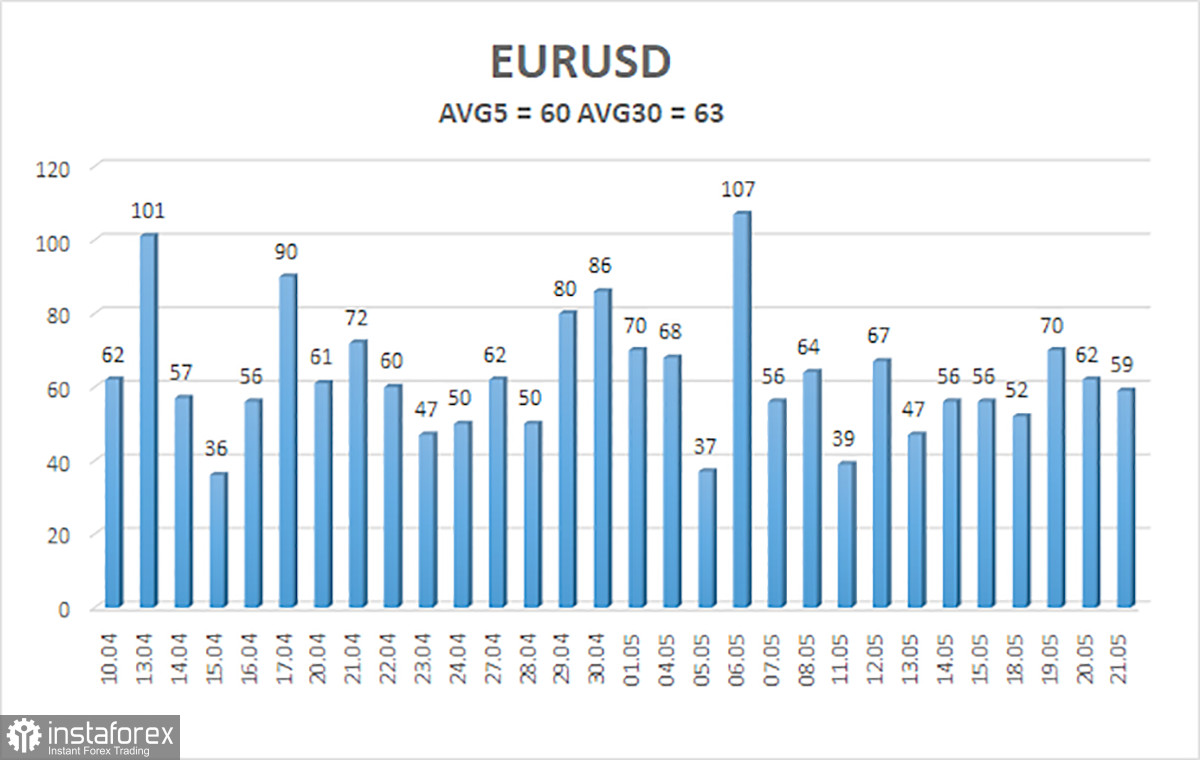
The average volatility of the EUR/USD currency pair over the last 5 trading days as of May 22 is 60 pips, which is considered "average." We expect the pair to move between levels 1.1560 and 1.1680 on Friday. The upper channel of the linear regression has turned upward, indicating a trend change to bullish. In fact, the ascending trend for 2025 could have resumed a month ago. The CCI indicator has entered the overbought area and formed two "bearish" divergences, signaling the start of a downward correction that is still ongoing.
S1 – 1.1597
S2 – 1.1536
S3 – 1.1475
R1 – 1.1658
R2 – 1.1719
R3 – 1.1780
The EUR/USD pair continues its downward movement, which is presumably a correction within the framework of a global upward trend. The global fundamental background for the dollar remains extremely negative, and only the geopolitical factor regularly provides it with support. When the price is below the moving average, short positions can be considered with targets of 1.1560 and 1.1536. Above the moving average line, long positions are relevant with targets of 1.1780 and 1.1841. The market continues to distance itself from the geopolitical factor, but last week was disappointing for the euro currency. We are not currently expecting a sharper decline, but no one knows how relations between Iran and the US will develop.


