
Vea también


 12.08.2026 06:41 PM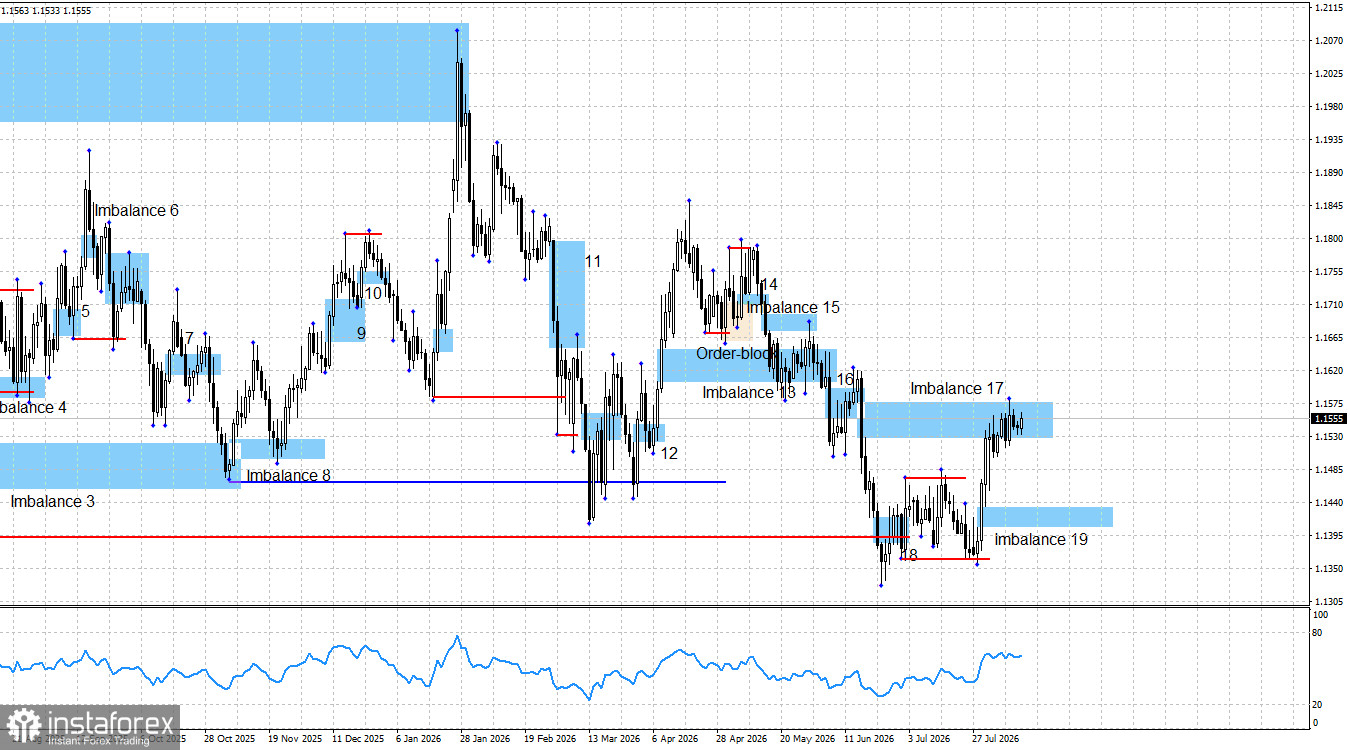
The EUR/USD pair remains within the local bearish impulse that began on April 17, but the bulls are putting increasing pressure on their own trend with each passing day. The only thing they lack to establish a bullish trend is the invalidation of bearish imbalance 17, which could have occurred a week ago. However, at the most critical moment, the bulls lost momentum and have been unable to consolidate above this pattern. The fundamental backdrop remains unfavorable for the bears. Traders did not receive any clear signals from Kevin Warsh that he is prepared to pursue monetary policy tightening. In July, the number of new Nonfarm Payrolls jobs fell by 23,000, marking a decline for the fourth consecutive month. Inflation slowed by 0.7 percentage points in June and by another 0.1 percentage points in July. All of this suggests that the Fed should not be expected to tighten monetary policy in September.
As I warned in recent weeks, if the labor market once again produces a weak result, this would be a sufficiently strong reason for the Fed to refrain from raising interest rates. Of course, this cannot be stated with complete certainty, but I am almost certain that we will not see monetary policy tightening in the near future. Today's inflation report has strengthened my conviction, and almost all traders are now abandoning their hawkish expectations for September. However, this is still not enough to invalidate imbalance 17.
Let me remind you that expectations of Fed monetary policy tightening are currently just expectations, which can change in response to geopolitical developments or economic data. The latest US labor market data were weak, inflation slowed, and GDP growth declined. These three factors cast doubt on an FOMC rate hike in the foreseeable future. If the Strait of Hormuz is reopened in the near future, this would only ease energy market pressures and allow inflation to continue declining, further weakening the bears' prospects. The bears' only opportunity at present lies in a new escalation and a prolonged blockade of the Strait of Hormuz.
The current chart structure indicates that the bearish impulse that began on April 17 remains in place. Bearish imbalance 17 has been tested, but the reaction to it was weak. Therefore, this pattern could be invalidated. A bullish imbalance 19 has also formed, allowing the bulls to look to the future with optimism. If imbalance 17 is invalidated while imbalance 19 remains untested, traders will have to wait for new bullish patterns before they can consider opening long positions.
The economic backdrop on Wednesday turned out to be less favorable than it had appeared in the morning. US inflation slowed to 3.4% year-on-year, but this was exactly the figure traders had expected. Thus, their expectations were met, but at the same time, inflation showed only a minimal slowdown and could begin rising again as early as next month. The report supported the bulls, but not strongly enough to finally break the bearish impulse.
The bulls still have numerous reasons to advance in 2026, and even the war in the Middle East has not reduced their number. Structurally and globally, the Trump administration's policies, which led to a significant decline in the dollar last year, have not changed. At present, I see no significant factors supporting the US currency despite the FOMC's hawkish stance. Nevertheless, the bears remain in control for now, and there are no bullish signals.
European Union – Industrial Production (09:00 UTC).
On August 13, the economic calendar contains three releases, none of which I consider important. The impact of the economic backdrop on market sentiment on Thursday is likely to be weak or nonexistent.
In my view, the pair remains in the process of forming a bullish trend. The fundamental backdrop shifted sharply in favor of the bears five months ago, but the trend itself cannot be considered canceled or complete. Therefore, the bulls may well continue their advance after two liquidity sweeps of clearly defined lows. A sell signal could have formed within imbalance 17, but the reaction was weak, so this pattern will most likely be invalidated. A bullish signal could form within imbalance 19, but the price is moving increasingly farther away from this pattern. Despite the relatively strong rise in the European currency, there is currently no clear setup for opening long positions. It is necessary to wait for new bullish patterns to form, for imbalance 19 to be tested, or alternatively trade the British pound.


