
Vea también


 27.10.2026 02:00 PM
The test of the 157.68 price level in the first half of the day occurred just as the MACD indicator was beginning to move down from the zero line, confirming that the entry point for selling the US dollar was appropriate. However, the pair did not experience a significant decline.
The second half of the day is likely to be more volatile for the yen than the morning session. US economic data could restore the dollar's momentum and push Treasury yields higher. These yields finally fell below the 5.0% mark last week but remained relatively elevated. Today's releases include durable goods orders, forecast at 0.6% after -0.1%; the Consumer Confidence Index, expected at 80.5 compared with 81.9 previously; new home sales, forecast at 649,000 after 684,000; and the Richmond Fed Manufacturing Index, expected at 1 after -2. Taken together, these indicators will help the market assess the resilience of the US economy ahead of the Fed meeting. Strong data would provide additional support for the dollar and put risk assets under pressure. In such conditions, the yen, as a safe-haven currency, would normally benefit. However, elevated yields tend to outweigh this effect. Earlier today, the yen also failed to benefit from accelerating inflation. The Bank of Japan's core consumer price index for September came in at 2.4%, compared with a forecast of 1.9%, while USD/JPY barely reacted. The key event for the yen remains the Bank of Japan meeting on October 30, with the market assigning a probability of approximately 25% to a rate hike.
As for the intraday strategy, the focus will be on implementing Scenarios No. 1 and No. 2.
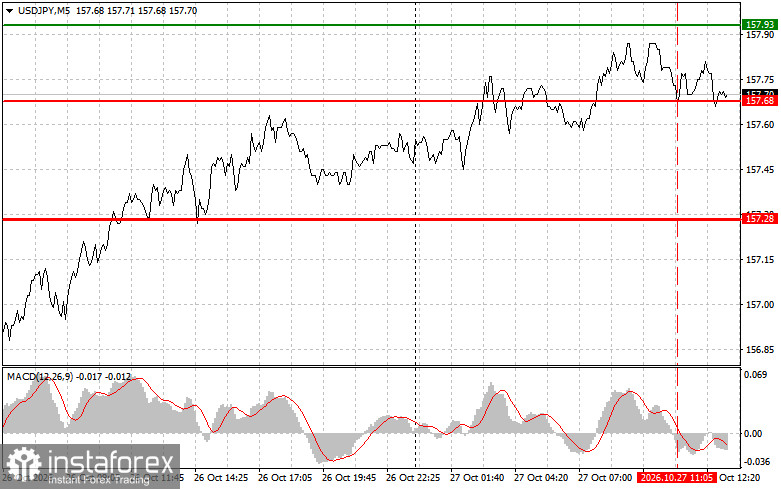
Scenario No. 1: The plan is to buy USD/JPY today when the price reaches the entry level around 157.82 (the green line on the chart), targeting a rise to 158.16 (the thicker green line on the chart). Near 158.16, the plan is to close buy positions and open sell positions in the opposite direction, targeting a 30–35-point move back from that level. A rise in the pair is possible today, although the upward potential appears limited. Important: Before buying, make sure that the MACD indicator is above the zero line and has only just begun to rise from it.
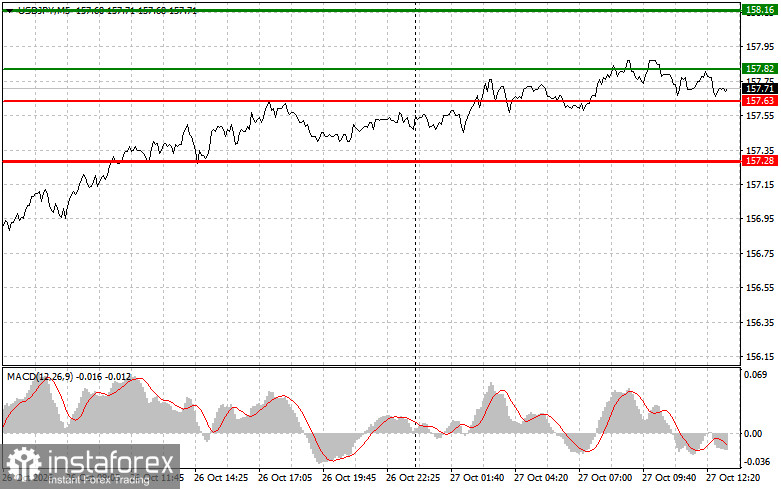
Scenario No. 2: USD/JPY can also be bought today if the price tests the 157.63 level twice consecutively while the MACD indicator is in the oversold area. This would limit the pair's downward potential and trigger an upward reversal. The pair could then rise toward the opposite levels of 157.82 and 158.16.
Scenario No. 1: The plan is to sell USD/JPY today after the price breaks below 157.63 (the red line on the chart), which could lead to a rapid decline in the pair. The sellers' main target will be 157.28, where the plan is to close sell positions and immediately open buy positions in the opposite direction, targeting a 20–25-point move back from that level. Downward pressure on the pair could return today if the central bank intervenes. Important: Before selling, make sure that the MACD indicator is below the zero line and has only just begun to decline from it.
Scenario No. 2: USD/JPY can also be sold today if the price tests the 157.82 level twice consecutively while the MACD indicator is in the overbought area. This would limit the pair's upward potential and trigger a downward reversal. The pair could then decline toward the opposite levels of 157.63 and 157.28.
Important: Beginner Forex traders should exercise considerable caution when deciding whether to enter the market. Before the release of major fundamental reports, it is generally best to stay out of the market to avoid sharp exchange-rate fluctuations. If you choose to trade during news releases, always place stop-loss orders to limit potential losses. Without stop-loss orders, you can lose your entire trading account very quickly, especially if you do not use proper money management and trade large position sizes.
Remember that successful trading requires a clear trading plan, such as the example presented above. Making spontaneous trading decisions based on current market conditions is an inherently losing strategy for an intraday trader.


