
Vea también


 29.10.2026 04:42 AM
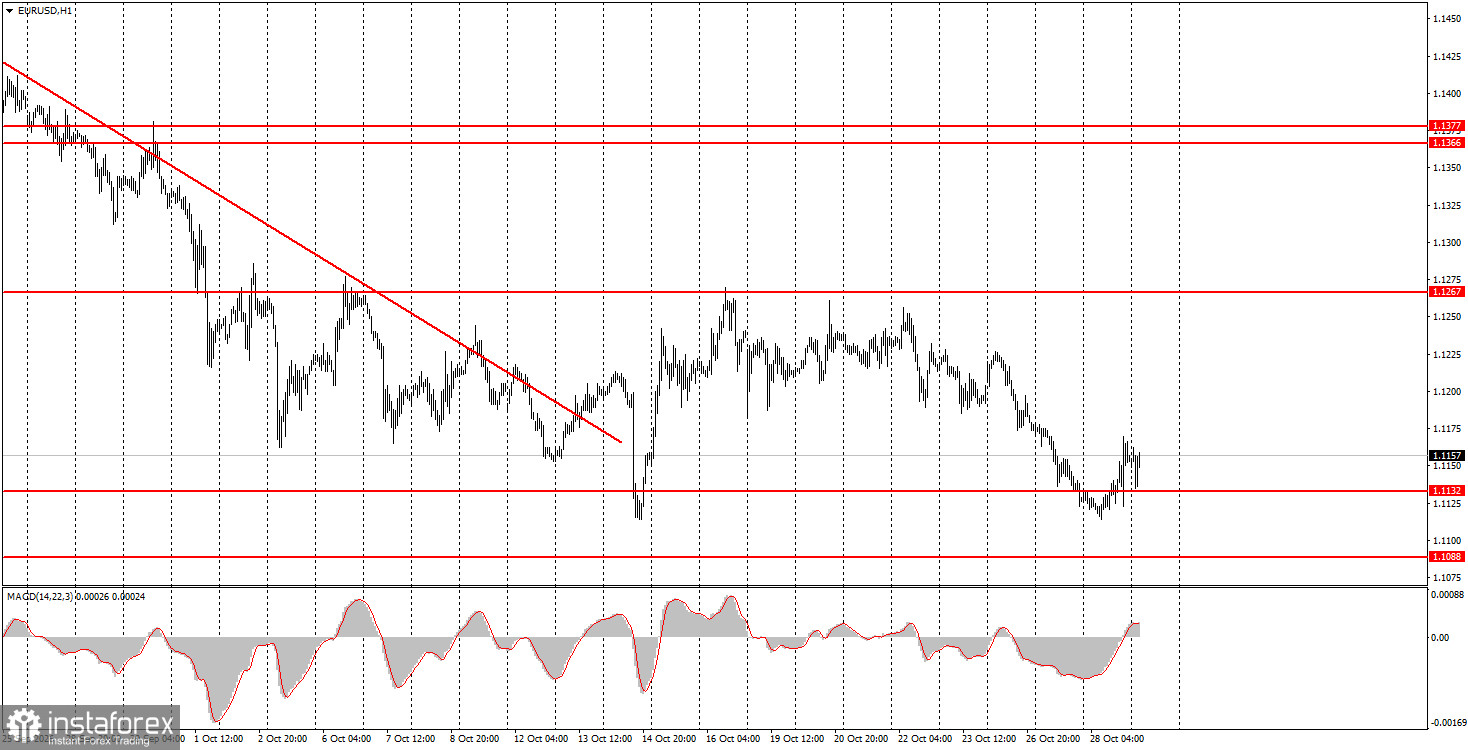
The EUR/USD pair managed a minimal rise on Wednesday against the backdrop of the Federal Reserve meeting. The first thing to note is the pair's very low volatility. Although the Fed decision had been known for weeks, traders awaited Kevin Warsh's remarks with bated breath, expecting guidance on the policy trajectory for the coming months. (The market already largely expects the December outcome, too.) Warsh discussed productivity, economic strength, and elevated inflation, but the market barely reacted. Traders saw no reason to cover short positions (because hawkish scenarios had been priced in before the meeting) or to open new short positions. After the "event of the month," the U.S. dollar stayed roughly where it was.
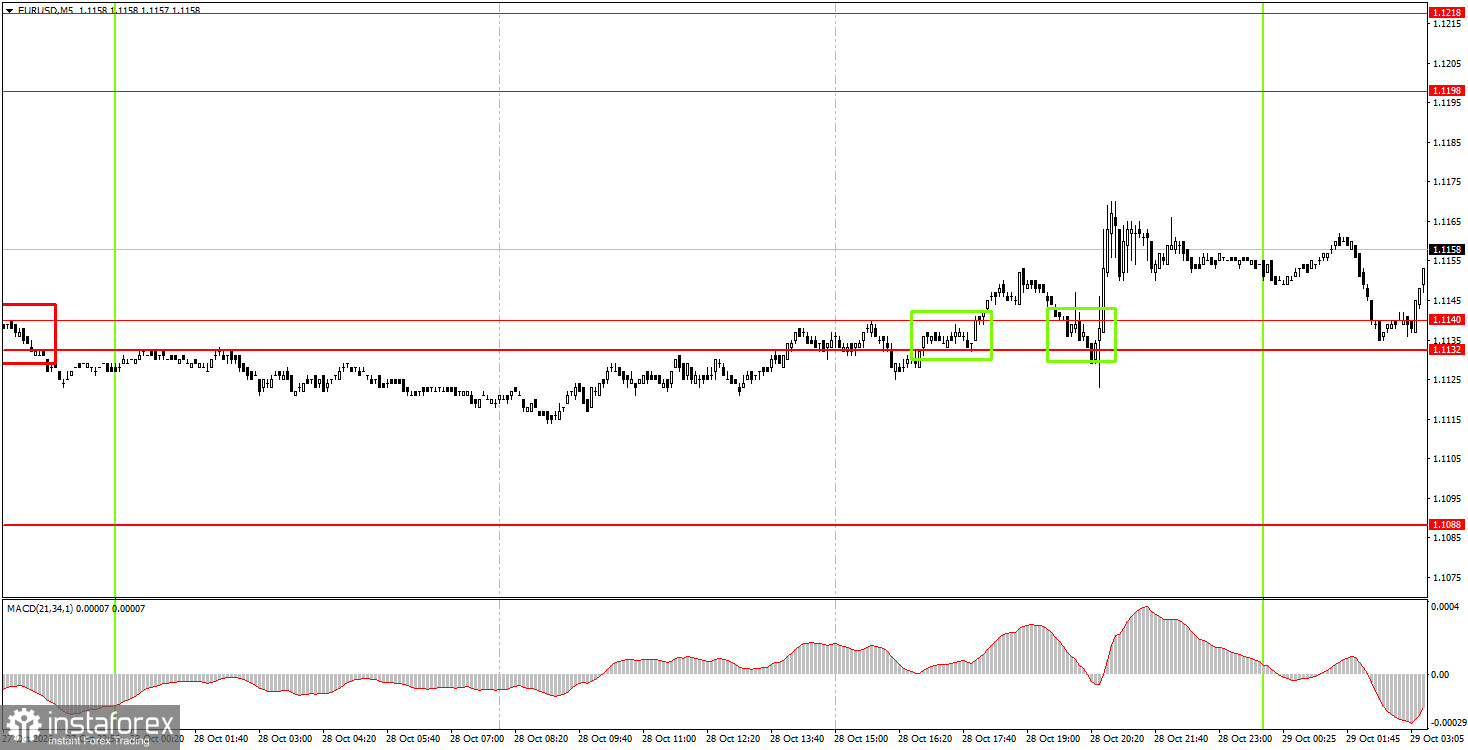
On the 5-minute timeframe, two buy signals formed on Wednesday, but moves were weak even after the Fed. Price first cleared the 1.1132–1.1140 area, then bounced off it to the upside. Thus, novice traders had an opportunity to open longs that could develop toward the 1.1198–1.1218 area today.
On the hourly timeframe, EUR/USD retains a downward tendency that is a full-fledged trend. The euro has failed to stage a proper correction in recent weeks. Given recent months' events, we do not believe the euro should have fallen so sharply. The dollar is heavily overbought, and many euro-positive factors are being ignored.
On Thursday, novice traders can open short positions if the pair holds below the 1.1132–1.1140 area, targeting 1.1088. Longs can be supported after three buy signals in the 1.1132–1.1140 area, targeting 1.1198–1.1218.
On the 5-minute TF consider the levels 1.1011, 1.1088, 1.1132–1.1140, 1.1198–1.1218, 1.1267–1.1275, 1.1366–1.1377, 1.1461–1.1474, 1.1527–1.1531, 1.1584–1.1594, 1.1655–1.1665. On Thursday, the European Central Bank meets in the euro area, and the U.S. will release key Q3 GDP and PCE inflation figures. We saw no large moves yesterday; we may see them today — though the market already largely prices in expected ECB outcomes.
Price levels (areas) of support and resistance serve as targets for opening buy or sell trades or as sources of signals.
Red lines indicate channels or trend lines that show the current trend and the preferred trading direction.
The MACD indicator (14,22,3) — the histogram and signal line — is an auxiliary indicator that can also provide signals.
Important speeches and reports (listed in the news calendar) can significantly influence currency pair movements. Therefore, during their release, traders should approach trading with utmost caution, or exit the market to avoid sudden reversals against the preceding move.
Beginner forex traders should remember that not every trade can be profitable. Developing a clear strategy and practicing money management are key to long-term success in trading.


